What to expect
Highlights
- The fort and palace ruins.
- The Rani Chennamma memorial and museum.
- The relics of the 1824 uprising.
Kittur Fort holds the fort and palace ruins of the Desai chiefs of Kittur, where in 1824 Rani Chennamma led one of the earliest armed revolts against the British East India Company.

The on-site government museum displays arms, coins and sculptures recovered from the fort, telling the story of the revolt.
Road km to Belagavi; ghat roads and traffic vary — allow extra.
October to February; mornings.
Live forecast loads in your browser.
Sun and moon are calculated for this location and shown in IST. Photography windows are the hour around sunrise and sunset; the sunset bearing is degrees clockwise from true north. Moon phase is accurate to about half a day.
Verified hotels, homestays, restaurants, experiences, sights, shops and rentals around Kittur Fort — commission-free, with direct contact. Filter by what you need.
Verified places are being added. The category filters will fill in as approved stays, restaurants, experiences, sights, shops and nature listings go live.
List your placeRoampedia is commission-free — own or know a stay, eatery, guide or shop near Kittur Fort? List it and it appears here once verified.
Add a nearby businessEntry: Fort free; museum ticketed
At Kittur on the Belagavi–Dharwad highway, ~50 km from Belagavi; bus or taxi
If you are travelling by bus or ferry, check the return service with the operator before setting out. Leave time to reach the stop or jetty after your visit.
Ask at the bus stand for the time of the last service back, not the next one. If you miss it, an auto or app cab is the fallback — agree the fare before you get in.
If you need step-free access, contact the site before travelling. Ask about a level entrance, steps along the route, the nearest drop-off point, seating and accessible toilets.
Emergency numbers are verified against official government and state tourism sources. 112 works anywhere in India.

A Vishnu temple at Halasi (Halsi) in Khanapur taluk, an old Kadamba capital; the Bhuvaraha Narasimha shrine and its neighbours preserve fine early sculpture in a village dotted with ancient temples.
22.5 km · ~38 min by cab · straight line
A hill fort south of Belagavi whose surviving walls and high plateau overlook the western approaches to the city. Go in daylight and treat the exposed edges and monsoon grass with care.
33.3 km · ~55 min by cab · straight line
Karnataka's second, granite-and-dome legislature building, opened in 2012 on the edge of Belagavi so the assembly can hold a winter session in the north — a monumental modern landmark modelled on Bengaluru's Vidhana Soudha and floodlit at night.
33.3 km · ~56 min by cab · straight line
The walled fort in Saundatti town, a compact historic stop close to the market streets. It is distinct from Parasgad Fort south of town.
39.1 km · ~65 min by cab · straight line
A hill fort south of Saundatti linked to the Desai chiefs and later the Marathas, its broken walls occupying an exposed ridge above the Malaprabha country.
39.2 km · ~65 min by cab · straight line
An Adil Shahi–era mosque within Belagavi Fort, its pillared prayer hall said to reuse columns from earlier temples, with Persian inscriptions set over the arches.
40.4 km · ~67 min by cab · straight lineThe oval Kote fort of Belagavi, first raised by the Ratta dynasty around 1204 and later held by the Vijayanagara, Bahmani, Adil Shahi, Maratha and British — a water-girt fort of curved ramparts and bastions enclosing old temples, Jain bastis and mosques.
40.4 km · ~67 min by cab · straight line
A 12th-century Jain temple (basadi) inside Belagavi Fort, named for the lotus (kamala) carved on its black-stone mandapa ceiling; it enshrines a fine image of Neminatha and is a protected relic of the Ratta capital.
40.6 km · ~68 min by cab · straight line
The Malaprabha dam and Renuka Sagara reservoir at Navilutirtha, which the Belagavi district administration places 10 km from Saundatti in a valley between two hills.
40.8 km · ~68 min by cab · straight lineA modern Shiva temple associated with the Maratha Light Infantry in Belagavi cantonment. Visitors should follow current gate and photography instructions and avoid photographing military installations.
41.0 km · ~68 min by cab · straight lineA colonial-era Roman Catholic church in the Belagavi cantonment, one of the oldest in the Camp, with British-period architecture and old stained glass.
42.0 km · ~70 min by cab · straight line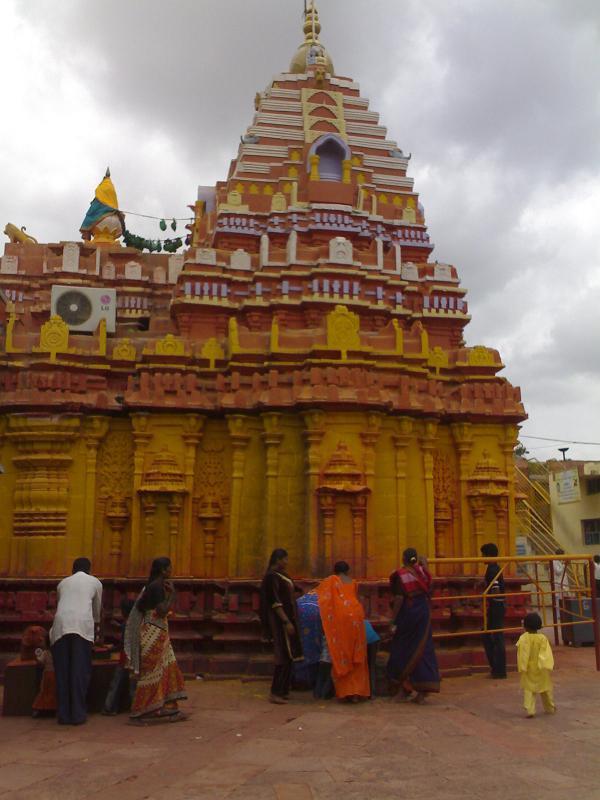
The Renuka–Yellamma temple on Yellammana Gudda, about 5 km from Saundatti. Belagavi district dates the present temple to 1514; its jatres require current crowd and transport planning.
42.4 km · ~71 min by cab · straight lineOctober to February; mornings.
Entry: Fort free; museum ticketed. Timings: Fort daylight; museum has set hours, usually one weekly closed day.
At Kittur on the Belagavi–Dharwad highway, about 50 km from Belagavi; reached by bus or taxi. The museum has its own hours and is usually closed one day a week — check before going.
1 to 1.5 hours with the museum.
Nearby you can pair Halasi Bhuvaraha Narasimha Temple (22.5 km), Rajhansgad Fort (33.3 km), Suvarna Vidhana Soudha (33.3 km), Savadatti Fort (39.1 km).
We have not published a story about Kittur Fort itself yet. These cover Kittur and the wider district, with separate journeys between stops.
Route-level itineraries and practical guides for the rest of Karnataka.


Photographs: Suma, CC BY-SA 2.0, via Wikimedia Commons (CC BY-SA 2.0), Sarangib (CC0), Akshatha Inamdar (CC BY-SA 4.0). Wikimedia Commons.