What to expect
Highlights
- The painted 18th-century ceilings.
- The terracotta and stucco work.
- The Narasimha shrine.
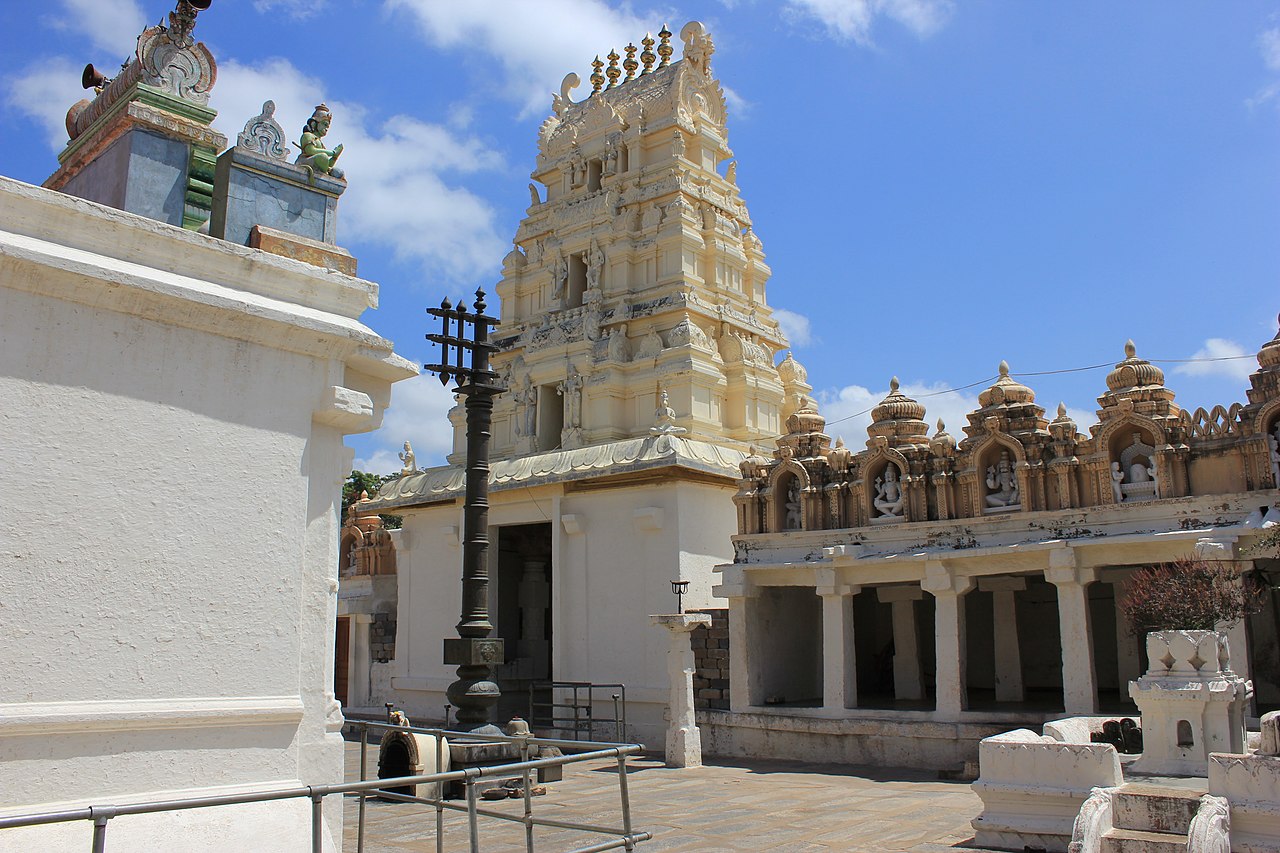
The Seebi Narasimha Temple, on the Tumakuru–Sira road, is a Lakshminarasimha temple celebrated for its 18th-century painted ceilings.
Check entry arrangements. Ask temple staff about visitor entry, dress requirements and access to the inner shrine before you travel, especially if you are visiting as a non-Hindu.
Dress respectfully and follow the institution’s admission and photography rules.
Its terracotta and stucco work make it one of the district’s most colourful temple interiors.
Road km to Tumakuru; ghat roads and traffic vary — allow extra.
October to February; daytime for the ceiling colours.
Live forecast loads in your browser.
Sunset is in about 50 minutes.
Sun and moon are calculated for this location and shown in IST. Photography windows are the hour around sunrise and sunset; the sunset bearing is degrees clockwise from true north. Moon phase is accurate to about half a day.
Verified hotels, homestays, restaurants, experiences, sights, shops and rentals around Seebi Narasimha Temple — commission-free, with direct contact. Filter by what you need.
Verified places are being added. The category filters will fill in as approved stays, restaurants, experiences, sights, shops and nature listings go live.
List your placeOne more place around Sira worth a day of its own.

25.9 km · ~43 min by cab
The four-sided fort of Sira, founded by Rangappa Nayaka and later a Bijapur–Mughal Deccan provincial capital, with the ASI-protected 17th-century Jama Masjid and the nearby Malik Rihan tomb complex — a Deccan-Islamic heritage cluster ~54 km north-west of Tumakuru.
Roampedia is commission-free — own or know a stay, eatery, guide or shop near Seebi Narasimha Temple? List it and it appears here once verified.
Add a nearby businessEntry: Free
At Seebi on the Tumakuru–Sira road, ~30 km from Tumakuru; by road
If you are travelling by bus or ferry, check the return service with the operator before setting out. Leave time to reach the stop or jetty after your visit.
Ask at the bus stand for the time of the last service back, not the next one. If you miss it, an auto or app cab is the fallback — agree the fare before you get in.
If you need step-free access, contact the site before travelling. Ask about a level entrance, steps along the route, the nearest drop-off point, seating and accessible toilets.
Emergency numbers are verified against official government and state tourism sources. 112 works anywhere in India.

A 17th-century hill fort built by Chennappa Gowda about 10 km from Madhugiri, at some 1,130 m, with ruined tiered gateways and herb-rich slopes — a rewarding, quieter trek than Madhugiri.
23.6 km · ~39 min by cab · straight lineThe Chennabasaveshwara math-temple of the historic trading town of Gubbi on NH-206 west of Tumakuru, with the nearby Gadde Malleshwara shrine — an anchor of the town’s Veerashaiva heritage.
25.6 km · ~43 min by cab · straight lineThe four-sided fort of Sira, founded by Rangappa Nayaka and later a Bijapur–Mughal Deccan provincial capital, with the ASI-protected 17th-century Jama Masjid and the nearby Malik Rihan tomb complex — a Deccan-Islamic heritage cluster ~54 km north-west of Tumakuru.
25.9 km · ~43 min by cab · straight line
A fort climbing one of Asia’s largest monolithic granite hills at Madhugiri, ~45 km north-east of Tumakuru, with multi-tier gateways, cisterns and a Gopalakrishna temple ruin near the top — the district’s signature trek, ASI-protected.
26.2 km · ~44 min by cab · straight lineThe Veerashaiva monastery near Kyatsandra of the late Shivakumara Swami — the "walking god" — with a Siddhalingeshwara shrine on the rock and a vast free residential school; one of Karnataka’s most revered living maths.
26.7 km · ~44 min by cab · straight line
A Hoysala temple about 10 km south of Tumakuru at Kaidala, the village of the legendary sculptor Amarashilpi Jakanachari, holding a fine Chennakeshava (Kesava) image; the Someshwara and Kodirameshwara shrines stand nearby. (Distinct from the Chennakeshava temples of Belur and Somanathapura.)
27.0 km · ~45 min by cab · straight line
A perennial rock spring in the Devarayanadurga foothills, said in legend never to dry (Rama’s arrow), with an adjoining deer park and nursery — nearly always paired with the Devarayanadurga hill temples.
27.4 km · ~46 min by cab · straight line
A forested granite hill about 16 km east of Tumakuru with the twin Yoganarasimha (base) and Bhoganarasimha (summit) temples built and renovated by the Mysore Wodeyars, plus a Sanjeevaraya (Hanuman) shrine — the district’s signature hill-temple climb.
28.5 km · ~47 min by cab · straight lineA popular Mahalakshmi pilgrimage temple at Goravanahalli in Koratagere taluk, ~30 km north-east of Tumakuru, revered for its self-manifested idol and busiest at its Friday poojas.
31.2 km · ~52 min by cab · straight line
A rocky hill on the Tumakuru–Gubbi border, also called Basadi Betta, topped by old Jain basadis and the modern Sri 1008 Chandraprabha Digambar Jain complex, reached by a long stone stairway with wide plateau views.
32.5 km · ~54 min by cab · straight lineA ruined hill fort about 22 km north of Madhugiri with a summit Hanuman shrine and old fortifications — a lesser-known trek of the northern Tumakuru country.
40.0 km · ~67 min by cab · straight line
The state’s protected blackbuck grassland at Maidenahalli in Madhugiri taluk, on the Tumakuru–Andhra frontier, home to a large blackbuck herd along with wolves, foxes and grassland birds.
41.8 km · ~70 min by cab · straight lineOctober to February; daytime for the ceiling colours.
Entry: Free. Timings: Temple hours.
At Seebi on the Tumakuru–Sira road, about 30 km from Tumakuru; by road. A living temple with fragile paintings — remove footwear, do not touch the ceilings or use flash carelessly.
30 to 45 minutes.
Nearby you can pair Channarayana Durga (23.6 km), Gubbi Chennabasaveshwara Temple (25.6 km), Sira Fort & Jama Masjid (25.9 km), Madhugiri Fort (26.2 km).
Photographs: Dineshkannambadi, CC BY-SA 4.0, via Wikimedia Commons (CC BY-SA 4.0), Dineshkannambadi (CC BY-SA 4.0). Wikimedia Commons.