The Mullakkal Rajarajeswari temple sits inside the 1762 town plan, in the middle of Alappuzha’s commercial centre. Its origin legends belong to the temple’s own page and we are not going to retell them here. What belongs to the town is what happens to the street.
Forty-one days, of which eleven are the point
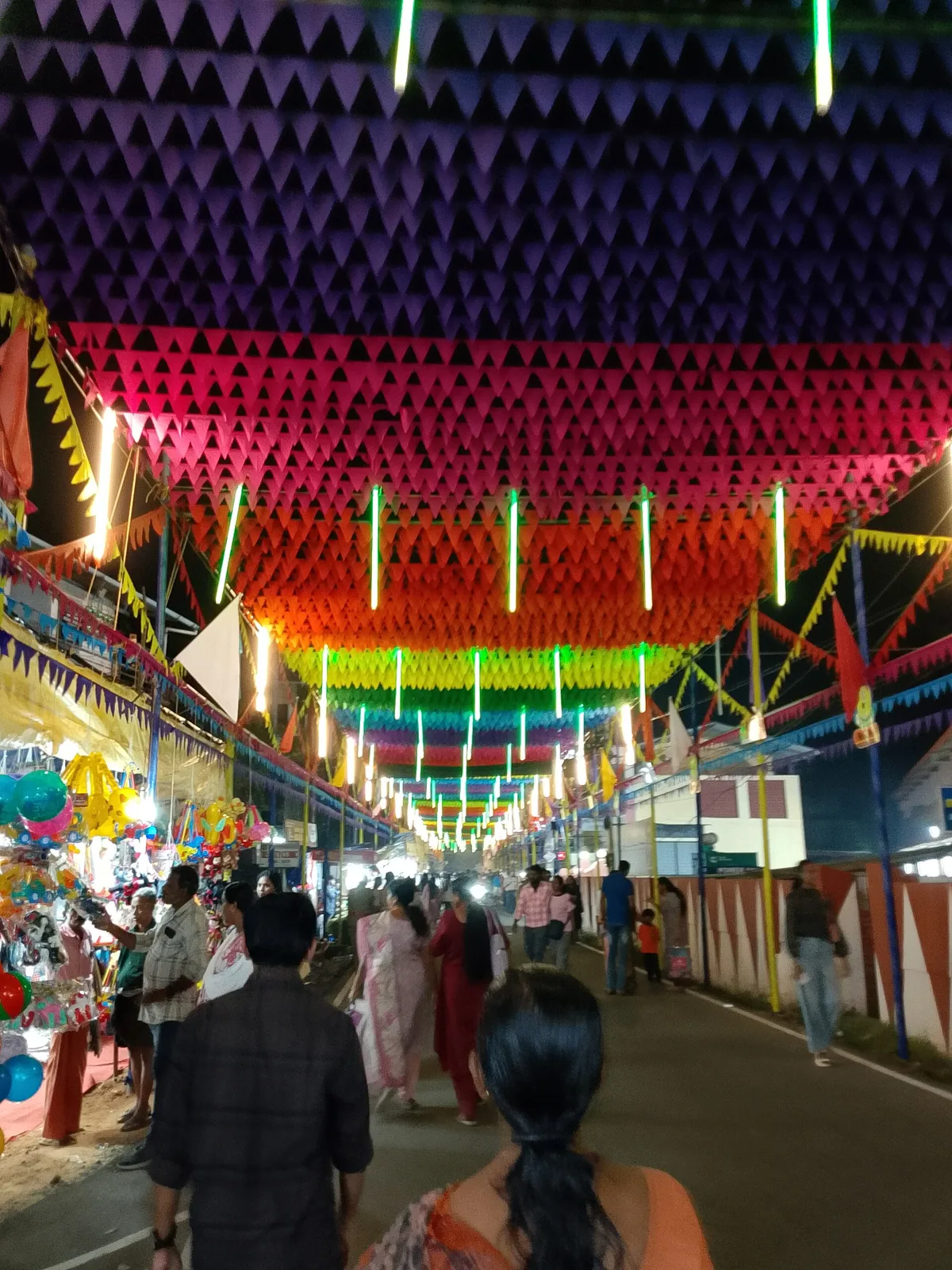
The festival period runs 41 days, falling across November and December. The last 11 of those days are the Chirappu proper, and the final two are the ones everything builds towards. During the Chirappu the lanes around the temple — which are the town’s main shopping lanes — are canopied overhead in coloured cloth and pleated decoration, strung with lights, and lined with stalls selling toys, bangles and everything else a temporary street market sells.
There are elephant processions, cultural programmes through the evenings, and Malayalam playback singers on stage. It closes with a fireworks display that draws a very large crowd. One detail worth knowing: the first Sunday of December is observed here as a women’s festival.
Why the street matters more than the temple here
Alappuzha was designed as a commercial town. Kesavadas laid out roads, canals, warehouses and a market and then recruited traders to fill them, and Mullakkal is where the retail half of that plan ended up. A festival that takes over the shopping street for eleven nights is not a religious event that happens to inconvenience commerce; in a town built for commerce it is the two things being the same thing.
That is also why it looks different from the state’s better-known festivals. Thrissur Pooram is staged on a maidan. The Nehru Trophy is on open water. Chirappu is in among the shops, at the width of an ordinary street, with the town’s daily traffic displaced around it.
- It falls in the Malayalam month of Vrischikam, so November into December. The dates move; check them rather than assuming.
- The last two days are by far the busiest, and the fireworks night is extremely crowded.
- Accommodation in the town centre is tight across the final week — this is Alappuzha’s other peak alongside the August boat race.
- The town centre is closed or heavily restricted to traffic around the temple. Plan to walk from wherever you are staying.
The rest of the year
Outside the festival Mullakkal is simply the busiest street in Alappuzha, and it is still worth walking. The temple sits in the middle of it, the town’s older commercial fabric is around it, and the two heritage mosques and the Jain temple on Gujarati Street are all inside the same short walk. The 1762 plan is still legible on the ground here in a way it is not anywhere else in the town.
It is also the practical answer to the most common complaint about Alappuzha — that there is nothing to do in the town itself, only on the water. That complaint is usually made by people who went from the boat jetty to the beach and back. Half an hour on this street is the correction.