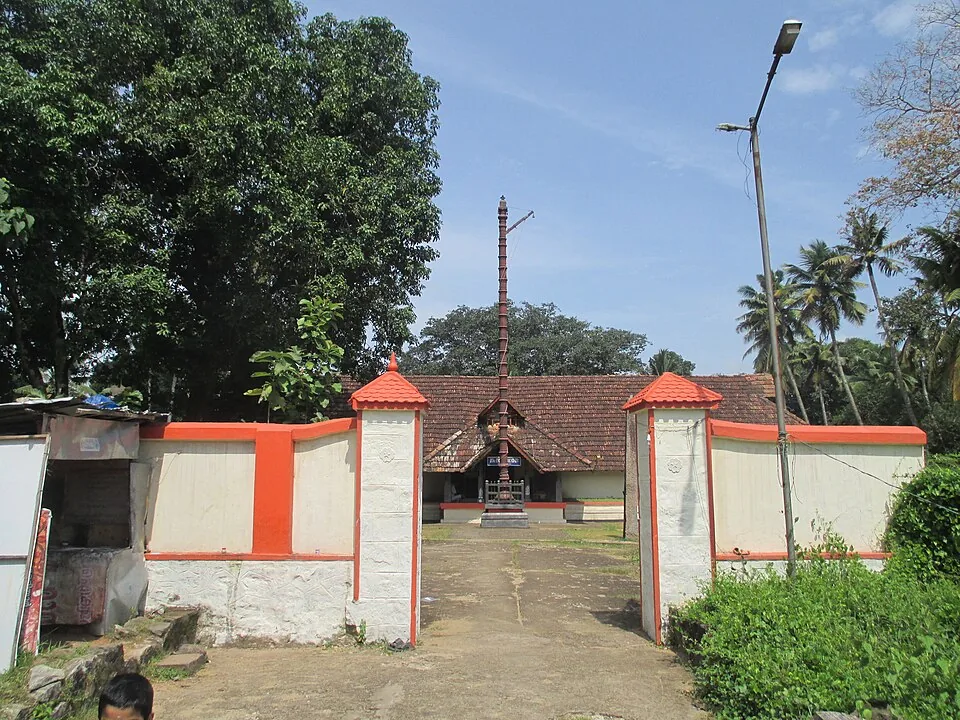
Five ancient Vishnu temples stand along the banks of the Pamba in and near Chengannur, and tradition assigns one to each of the five Pandava brothers, built by them during their exile. What makes the group unusual is not the attribution — Kerala has plenty of Pandava traditions — but that it is a circuit, with an order, traditionally walked as a route.
The five, in the prescribed order
| # | Temple | Brother | District |
|---|---|---|---|
| 1 | Thrichittatt Maha Vishnu Temple | Yudhishthira | Alappuzha |
| 2 | Thiruppuliyoor (Puliyoor) Mahavishnu Temple | Bhima | Alappuzha |
| 3 | Aranmula Parthasarathy Temple | Arjuna | Pathanamthitta |
| 4 | Thiruvanvandoor Mahavishnu Temple | Nakula | Alappuzha |
| 5 | Thrikodithanam Mahavishnu Temple | Sahadeva | Kottayam |
What is verifiable, and what is tradition
The Pandava attribution is a consistent, well-attested tradition, recorded the same way across sources, and it is the organising idea of the whole circuit. It is not an archaeological claim about who laid the foundations, and nobody local presents it as one.
What is independently verifiable is arguably more interesting. All five are Divya Desams — among the 108 temples praised by the Alvars in the Tamil Vaishnava canon. That is a documentary fact about a body of devotional poetry, and it establishes that these five were significant Vishnu sites long before any modern account of them. Five Divya Desams within one short stretch of one river is genuinely unusual, and it is the reason the circuit exists at all.
The order is not a nicety
The sequence — Thrichittatt, then Thiruppuliyoor, then Thiruvaranmula, then Thiruvanvandoor, then Thrikodithanam, beginning from Chengannur — is part of what makes this a pilgrimage rather than a list. Completing all five in order is held to be especially meritorious.
Itineraries that reorder the five for driving convenience are offering something different from the tradition. That is perfectly fine, as long as you know that is what is happening — and it is worth asking, if you book a car for the day, which of the two you are being sold.
Three districts, which is why nobody lists all five
This trips people up on the ground. Chengannur is in Alappuzha, but the circuit does not respect the district boundary: Aranmula is in Pathanamthitta, and Thrikodithanam is in Kottayam district near Changanassery. A route sold as “the Chengannur temples” crosses three districts. That matters for planning your distances, and it explains why different official tourism sites each list only the part of the set that falls inside their own patch.
- Thrichittatt, the first stop, has a full page here.
- Aranmula, the third, is a destination in its own right for the snake-boat regatta and the metal mirrors, and has its own pages.
- Puliyoor and Thiruvanvandoor do not yet have pages on this site. They are researched and on the build list, and we have deliberately not linked their names to pages that do not exist. Their absence reflects our coverage, not their importance: both are Divya Desams and both are integral to the circuit.
Frequently asked questions
What are the Pancha Pandava temples?
Five ancient Vishnu temples along the Pamba near Chengannur — Thrichittatt, Thiruppuliyoor, Aranmula, Thiruvanvandoor and Thrikodithanam — held by tradition to have been founded by the five Pandava brothers during their exile. All five are Divya Desams.
In what order should the five temples be visited?
Thrichittatt, then Thiruppuliyoor, then Thiruvaranmula, then Thiruvanvandoor, then Thrikodithanam, beginning from Chengannur. Completing the sequence in that order is held to be especially meritorious.
Are all five temples in Alappuzha district?
No. Thrichittatt, Thiruppuliyoor and Thiruvanvandoor are in Alappuzha; Aranmula is in Pathanamthitta; Thrikodithanam is in Kottayam district near Changanassery.
What is a Divya Desam?
One of the 108 Vishnu temples praised in the hymns of the Tamil Alvars. That all five Pandava temples carry the status is a documentary fact about the Vaishnava canon, independent of the Pandava tradition itself.