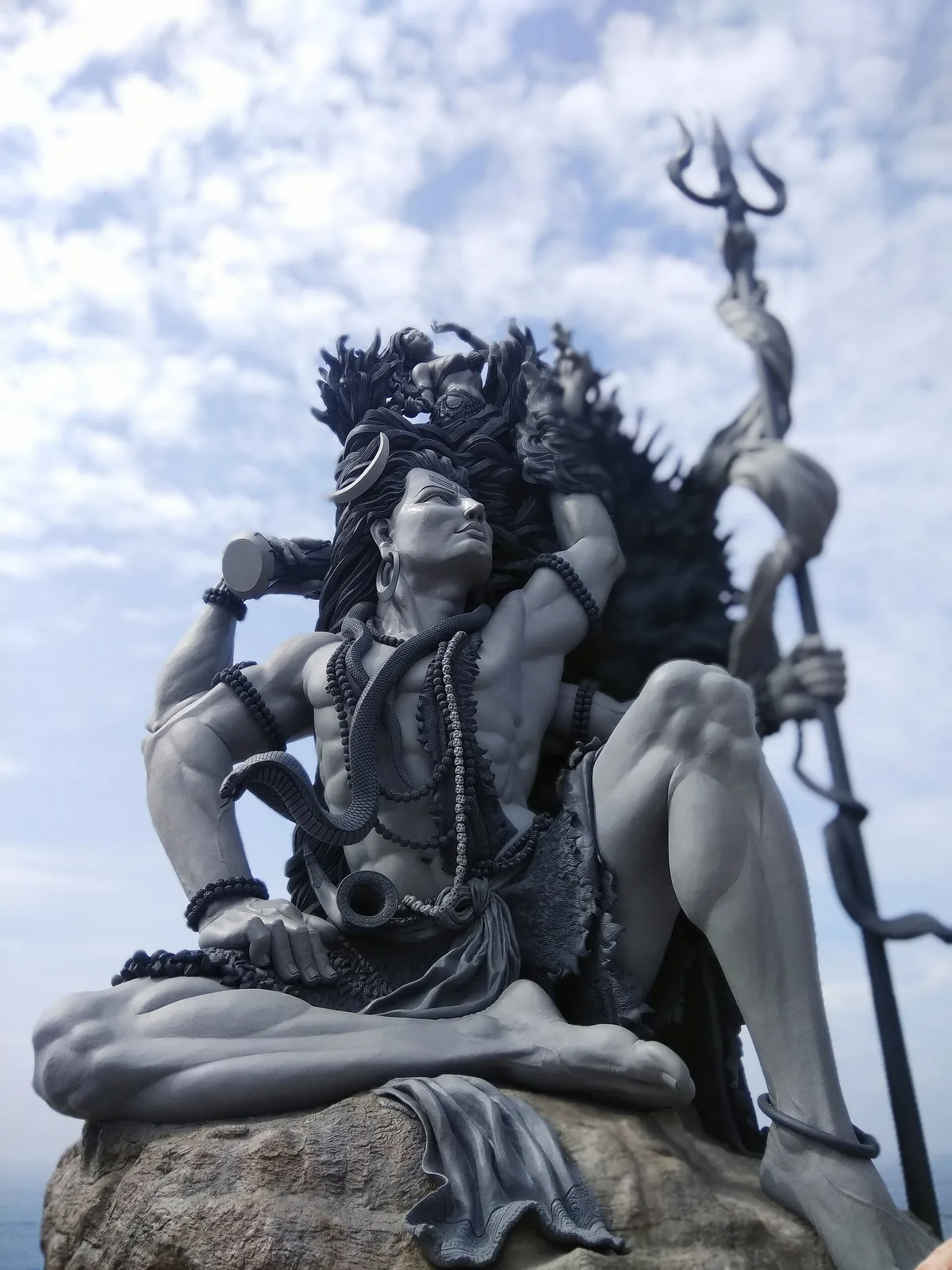
The colossal Shiva on the cliff at Aazhimala reads, at first sight, like the work of a committee: a state project, or a temple trust’s commission to an established studio. It was not. It is the work of one young Kerala sculptor, P. S. Devadathan, who began it at twenty-three and finished it at twenty-nine, and who was doing a fine-arts degree for part of the time he was making it.
Twenty-three, and a cliff
The commission was to produce a monumental Gangadhareswara — Shiva as the bearer of the Ganga — on a rock headland facing open sea. The finished figure stands around 58 feet, roughly 18 metres, seated on rock about 20 feet above the waterline, so its apparent height from the shore is greater still. It took about six years. Devadathan worked on it through the latter part of his twenties, continuing his studies alongside, and it was completed and opened to the public in January 2021. Photographs of the finished statue exist from early 2020, so the last stretch was the site rather than the sculpture.
What is actually difficult about it
It is worth being specific about the problem he was solving, because scale alone undersells it. A seated figure of this size on a clifftop has to read from three quite different distances: from the road as a silhouette against the sky, from the temple platform as a coherent body, and from directly beneath as a face. The Gangadhareswara subject makes that harder rather than easier. The whole meaning of the form sits in the hair — the matted locks that caught the falling Ganga — which means the most sculpturally demanding element, a mass of coiled, wind-thrown strands with a small secondary figure of the goddess worked into them, is also the part furthest from the viewer and most exposed to salt air. Look at the head from below and you can see the problem being met: the locks are cut deep enough to hold shadow at distance without turning to mush up close.
Right subject, right place
The choice of Gangadhara for this particular headland is the thing that makes the sculpture more than large. The legend is about water: the Ganga descending from heaven with force enough to shatter the earth, and Shiva stepping under the torrent to take it in his hair and let it down gently. Putting that figure on a cliff above the Arabian Sea sets one holy water against another, and gives the statue’s stillness something to be still against. On a windy day, with spray coming up the rock and the sea working below, a god who mastered a flood sitting unmoved above one is not a subtle piece of staging — but it is the correct one, and it is why the site photographs the way it does.
A claim we checked
The Gangadhareswara is routinely called the tallest Shiva sculpture in Kerala, and that stands up — we went looking for a taller one and did not find it. Two qualifications are worth carrying, though. It is the tallest in Kerala and not in India; taller Shiva figures exist elsewhere, including one of around 85 feet at Shivagiri in Karnataka. And published heights for monumental sculpture wobble by a foot or two depending on what is being measured, so 58 feet is the commonly reported figure rather than a surveyed one. Neither qualification takes anything away from what a twenty-something did on a cliff.
Seeing it
Come at either end of the day — the temple keeps temple hours rather than beach hours, and the light is better besides. Beneath the figure is the Dhyana Mandapam, a cave-like meditation chamber of about 3,500 square feet cut into the rock, which is worth going into precisely because it is the opposite of the exterior: dim, cool and enclosed, with the whole weight of the sculpture overhead. Mind your footing on wet rock near the sea, dress as you would for any Kerala temple, and give the place longer than the photograph takes. Practical detail is on the Aazhimala Shiva Temple page.
Frequently asked questions
Who made the Aazhimala Shiva statue?
The sculptor P. S. Devadathan. He began the work at about twenty-three and completed it at about twenty-nine, working on it for roughly six years alongside a fine-arts degree.
When was it finished?
It opened to the public in January 2021. Photographs of the completed figure exist from early 2020, so the final stage was the surrounding site rather than the sculpture itself.
How tall is it?
Around 58 feet, roughly 18 metres, seated on rock about 20 feet above sea level — so it appears taller still from the shore. Published figures vary slightly, so treat 58 feet as the commonly reported measure.
Is it the tallest Shiva statue in India?
No. It is the tallest Shiva sculpture in Kerala. Taller Shiva figures stand elsewhere in India, including one of about 85 feet at Shivagiri in Karnataka.