Sabarimala is the most famous pilgrimage in south India, and the whole of it rests on one fact about its god: Ayyappa there is Naishtika Brahmachari, the eternal celibate. His vow is the reason for the forty-one days of austerity, the reason for the black clothes, and the reason for the restriction on women of childbearing age that has been litigated in the Kerala courts since 2018.
Eighty kilometres west of it, at Achankovil, the same god sits facing east with two wives beside him.
The sequence
The temples of this circuit are not competing accounts. They are stages of one life, and they are visited in that understanding.
At Kulathupuzha the Sastha is a child. At Aryankavu he is the young bridegroom — and that shrine has the wedding itself: the Thiru Kalyanam, in which his marriage to Pushkaladevi is re-enacted every year following the customs of the Sourashtra community, a people originally from Gujarat, long settled in the Tamil country, who hold Pushkaladevi as their own. Our page on Aryankavu tells that story in full, because it belongs there.
Achankovil is the chapter after the wedding. Here he is in the grihastha ashrama — the householder’s stage, the settled middle of a life — and there are two consorts, not one: Poorna and Pushkala, installed on either side of him. That is the difference between the two temples, and it is a precise one. Aryankavu has the wedding. Achankovil has the household.
And then Sabarimala has the renunciation, and the vow, and the pilgrimage built on it.
The contradiction, and why nobody minds
A visitor almost always tries to resolve this. Which is it — is he married or is he celibate? Which temple has it right?
The question does not have the purchase it seems to. The same tradition holds both, with complete seriousness, often through the same pilgrims, sometimes on the same journey up the same road. It is not that one shrine is literal and the other symbolic, or that one is older and the other a later accretion. It is a theology of aspects: what is true of the god at Achankovil is true at Achankovil, and what is true of him at Sabarimala is true at Sabarimala, and a pilgrim walking the circuit meets him at each stage of a life he is living all at once.
Anyone who has held two irreconcilable things about a person they love will recognise the move.
The five that are not five
Achankovil is always described as one of the five great Sastha temples of Kerala, the Pancha Sastha. The trouble is that no two published lists of the five agree.
The Travancore Devaswom Board’s own pilgrimage circuit runs Pandalam, Kulathupuzha, Aryankavu, Achankovil and Erumeli. Devotional accounts commonly give Kulathupuzha, Aryankavu, Achankovil, Sabarimala and Kanthamala. Other lists differ again. Only three names appear in every version — Kulathupuzha, Aryankavu and Achankovil — and Achankovil is one of the three.
So the honest formulation is not a number. It is this: whichever five you are told, this temple is always among them. That is a stronger claim than the contested one, and it is the form we use across all our pages on this circuit.
What this means for women visiting
Because the god here is a householder rather than a celibate, the restriction that governs Sabarimala is generally described as not applying at Achankovil, and travel sites state plainly that women may enter.
We would like to give you a firmer answer than that and we cannot. No official source states an entry rule either way: not the Travancore Devaswom Board, not the Kerala government’s Sabarimala portal, not Kerala Tourism, all of which are silent. The sites that do give an age contradict one another, one saying ten and above and another eighteen and above, which is usually what it looks like when nobody actually knows.
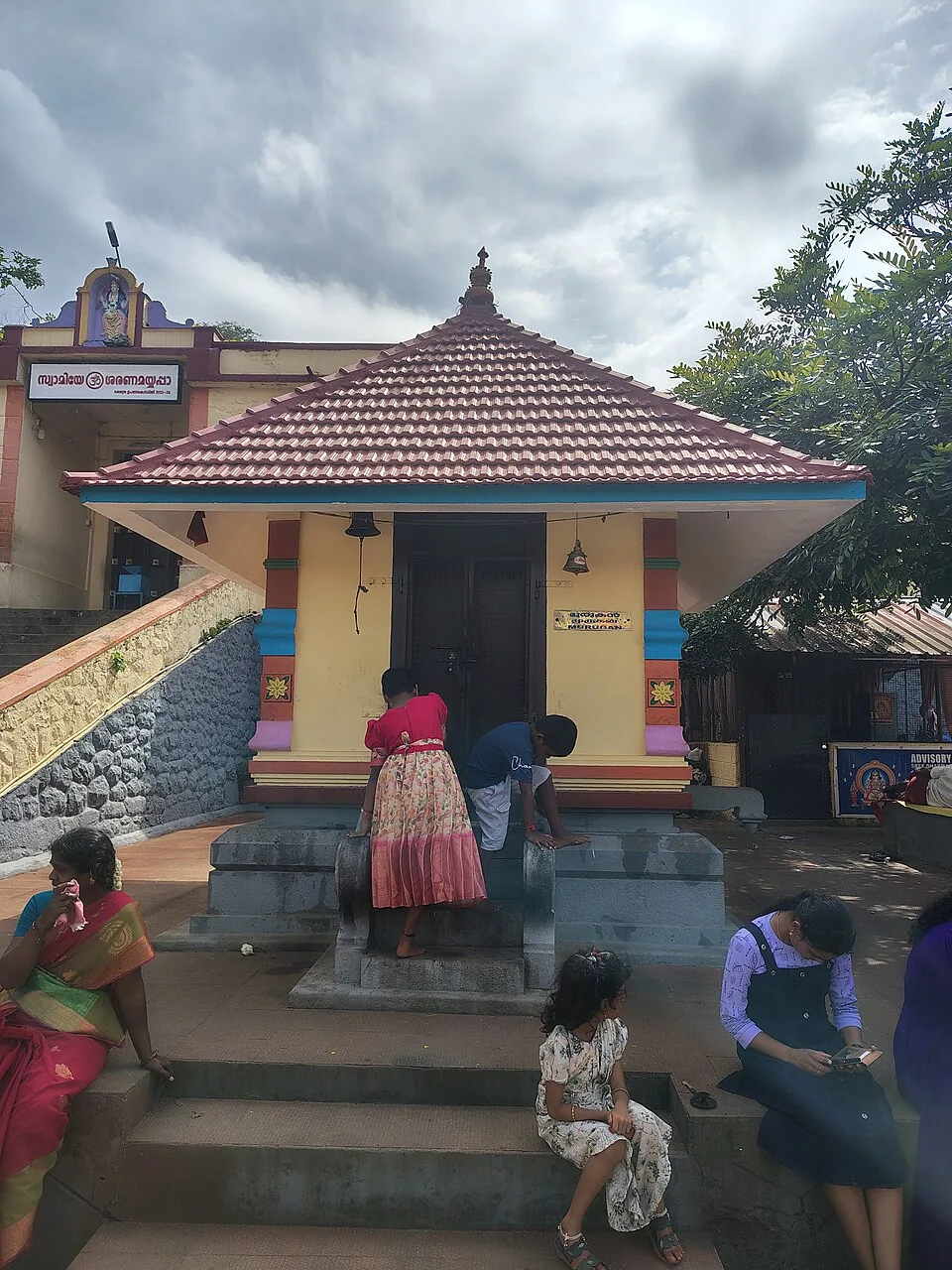
What can be said from evidence rather than assertion is what the photographs show: women and girls of a range of ages in the compound, at the shrines, worshipping. That is an observation, not a rule. Ask at the entrance, and do not travel on the strength of a number that no authority has published.
One related claim we will not repeat at all. Several aggregator pages describe women at Achankovil climbing the eighteen sacred steps. The pathinettam padi is Sabarimala’s defining ritual architecture and carries meaning found nowhere else, and no official source records an eighteen-step structure at Achankovil. There is a broad flight of steps up to the sanctum here — a staircase, which is not the same thing.
Frequently asked questions
Who are Poorna and Pushkala?
The two consorts of the Sastha, installed on either side of him at Achankovil, where he presides in the grihastha ashrama — the householder’s stage of life. Aryankavu, by contrast, has the wedding to Pushkaladevi and its annual Thiru Kalyanam re-enactment; Achankovil has the settled household that follows it.
How can the same god be married here and celibate at Sabarimala?
Because the temples of this circuit hold him at different stages of one life — child at Kulathupuzha, bridegroom at Aryankavu, householder at Achankovil, eternal celibate at Sabarimala. The tradition holds all of them at once, and does not treat it as a contradiction to be resolved.
Is Achankovil one of the Pancha Sastha five?
It is in every list, which is the honest way to put it, because no two lists agree. The Travancore Devaswom Board’s circuit is Pandalam, Kulathupuzha, Aryankavu, Achankovil and Erumeli; devotional accounts give Kulathupuzha, Aryankavu, Achankovil, Sabarimala and Kanthamala. Only Kulathupuzha, Aryankavu and Achankovil appear in all of them.