Kerala temples keep hours. The sanctum opens around dawn, closes through the heat of the middle of the day, opens again in the late afternoon, and shuts for the night after the Athazha Puja, the last service. That rhythm is close to universal and it is why we so often tell readers to go in the morning.
Achankovil has a documented exception, and it is the reason the temple exists in the form it does.
The rule
If you have been bitten by a poisonous snake, you may ring the temple bell at any hour and call for help, and the shrine will be opened at night if necessary — after the Athazha Puja, when everything is shut and everyone has gone.
The Sastha here is regarded as Maha Vaidya, the great physician. The idol’s palm always holds chandanam, sandalwood paste, and theertham, holy water, and these are held to have the property of neutralising snake venom. The sandalwood is given as prasadam, and the person who has been bitten stays three days or five, depending on how severe the poisoning is judged to be.
This is not a piece of colour we found on a travel blog. The married form of the deity, the sandalwood and holy water in the hand, and the temple’s reputation for curing poisonous snakebites are all stated on the Kerala government’s own Sabarimala portal. Kerala Tourism, more cautiously, calls it a powerful site for healing, particularly in the case of poisonous snake bites.
The necessary paragraph
Snakebite in India kills tens of thousands of people a year, and envenoming is a medical emergency whose treatment is antivenom, given as fast as it can be reached. Achankovil is a long way up a forest road from any hospital. We are describing a living religious practice at a specific temple, accurately and because it is the most distinctive thing about the place — not offering an alternative to a hospital, and not suggesting anyone treat it as one.
What is worth appreciating, separately from any question of pharmacology, is the shape of the institution. A shrine at the end of a mountain road, in country where people work in forest and plantation and get bitten, has organised itself around the principle that it can be woken. There is a bell, and there is a rule about the bell, and the rule is that the night does not apply to this. That is a rather beautiful thing for a building to be for.
Which hand?
One detail disagrees with itself across the sources, and since it concerns the single most important object in the sanctum it is worth flagging rather than smoothing.
The Kerala government’s Sabarimala page says the deity’s left hand always holds the chandanam and theertham. The English Wikipedia article says the right palm. We could find no Travancore Devaswom Board statement settling it, and we are not going to pick one and present it as fact. If you go, you will be able to see which it is, and you will then know something two of the most-cited sources on this temple disagree about.
What else is in the compound
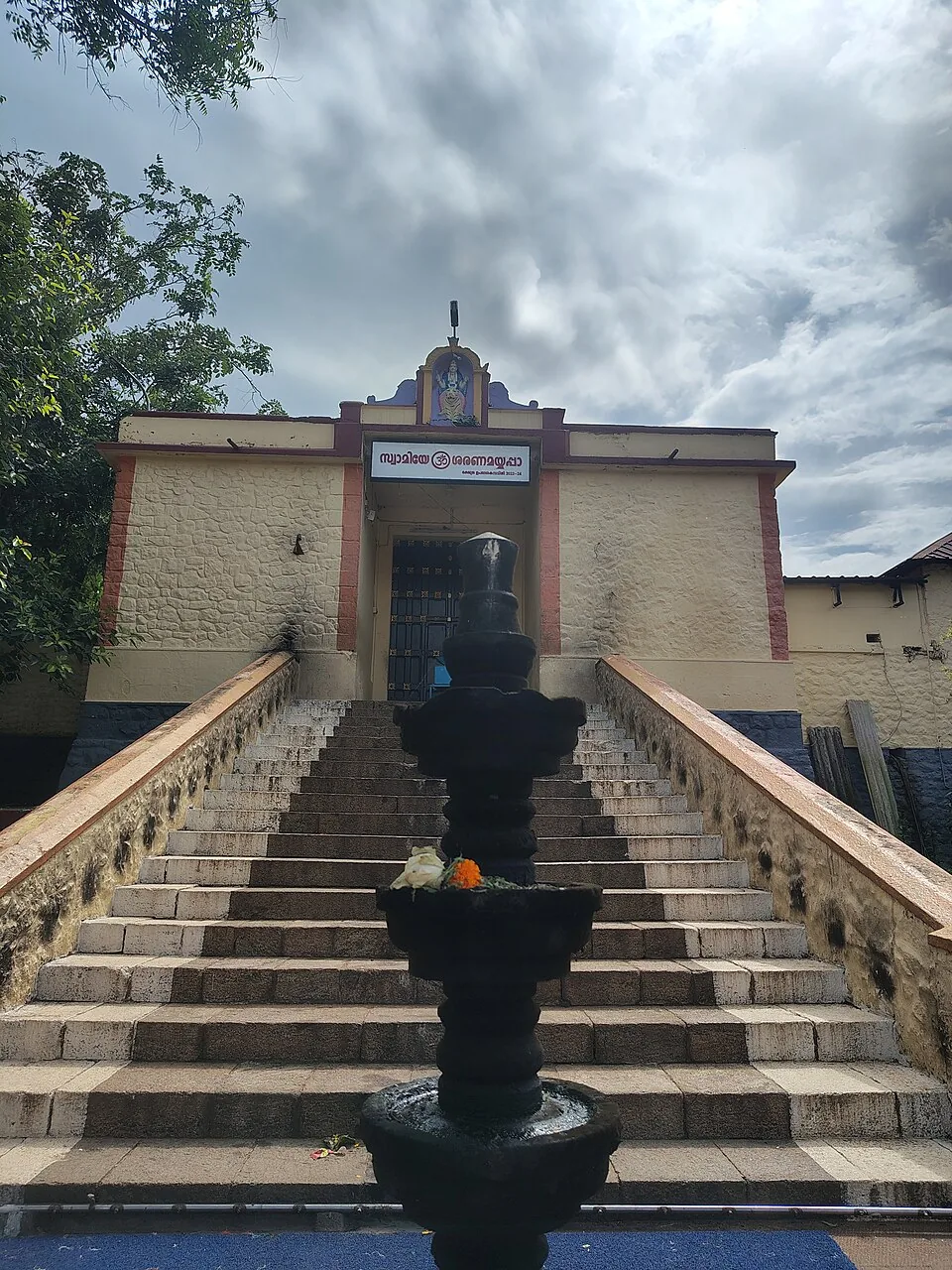
The main shrine stands at the top of a broad flight of steps, its dark timber door closed through the afternoon, with a stone deepa-stambha in front of it. Around the yard are small tiled sub-shrines — one to Murugan, one to Sri Karuppaswamy — a covered hall along one side, and a painted gateway arch out to the village road. Behind all of it, the Western Ghats.
Nobody publishes opening hours. We checked the Travancore Devaswom Board, Kerala Tourism and the Kerala government’s Sabarimala page: the last gives the festival month and says nothing at all about the daily schedule. So go in the morning, on the Kerala convention rather than on any published time — and if you find the door shut in the early afternoon, that is not bad luck, that is the convention working.
Frequently asked questions
Can you really ring the bell at night?
That is what the practice is described as, on the Kerala government’s own Sabarimala portal: a person bitten by a snake may call for help at any hour and the shrine opens at night if necessary, after the Athazha Puja. Sandalwood paste is given as prasadam over a stay of three or five days depending on severity.
Should I go there instead of a hospital?
No. Snakebite envenoming is a medical emergency and antivenom is its treatment, and Achankovil is a long forest drive from a hospital. We describe the temple’s tradition because it is real, documented and the most distinctive thing about the place — not as medical advice.
What are the opening hours?
None are published by anyone — not the Travancore Devaswom Board, not Kerala Tourism, not the Kerala government. The Kerala convention is roughly dawn to mid-morning and late afternoon into the evening, with the sanctum closed through the middle of the day. Go early.