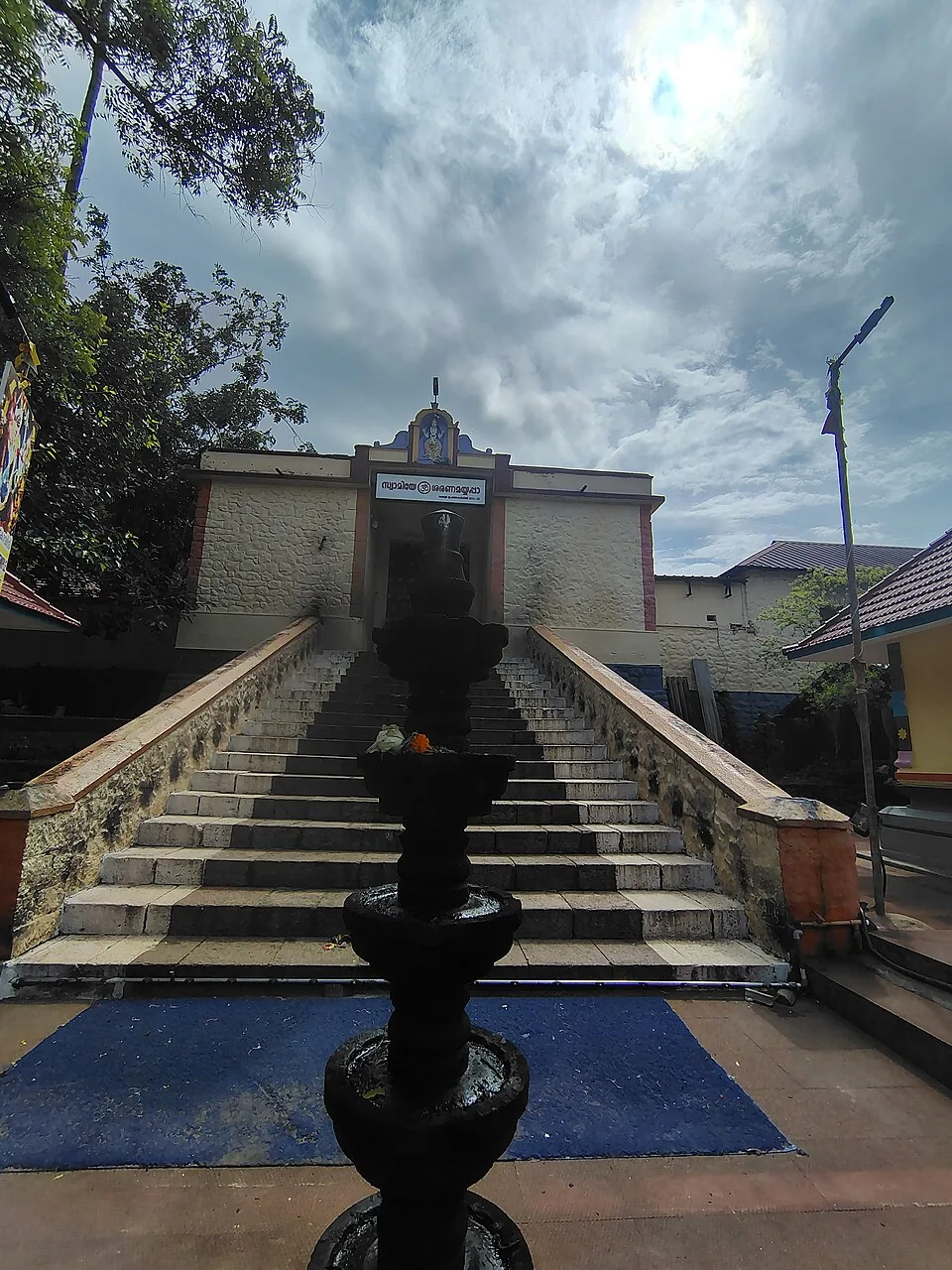
Achankovil is in Kollam district. It is administered by the Travancore Devaswom Board. Its lore, its festivals and its deity are Kerala’s. And when you walk up to the main gateway, the devotional line painted across the arch is in Tamil script.
What the arch says
Across the top of the gate, in English: SRI DHARMASASTHA TEMPLE – ACHENCOVIL. Below it, on a black panel, in Tamil: ஸ்ரீ சாமியே சரணம் ஐயப்பா — அச்சன்கோவில். Swamiye saranam Ayyappa, Achankovil. It is the pilgrim’s chant, the one you hear all the way up to Sabarimala, and here it is set on the temple’s own front gate in the script of the state next door.
Inside the compound the Malayalam appears where you would expect it — the board above the sanctum door reads സ്വാമിയേ ശരണമയ്യപ്പാ. So the temple is not Tamil rather than Malayali. It is running in both at once, and it has chosen to put the Tamil on the outside, facing the road.
Three more signs of the same thing
The god’s local names are Tamil forms: Achankovil Andavan and Achankovil Arasan. Andavan is the Tamil for lord.
The pooja store immediately outside the gate — the Devasthana Pooja Store — carries its signboard in Tamil.
And in the compound stands a shrine to Sri Karuppaswamy, whose board is lettered in Malayalam, English and Tamil together. Karuppaswamy — Karuppanna Swamy — is a Tamil guardian deity, the fierce protector of village and boundary, and he is not a standard fixture of a Kerala Sastha temple. His presence explains two of the temple’s named observances that otherwise look inexplicable in a Kerala calendar: the Karuppanoottu and the Karuppanthullal.
That last one is a small piece of evidence we like, because it works in both directions: the English Wikipedia article lists those two rituals without explaining them, and a photograph of a signboard in the yard explains them. Object and text corroborating each other is worth more than either alone.
The road is the reason
None of this is mysterious once you look at where Achankovil sits. It is at the top of the valley on the road that climbs to the Chenkottai gap — the pass through the Western Ghats that has carried traffic between the Malabar side and the Tamil country for as long as there has been traffic. Tenkasi and Chenkottai are on the other side of it. This is a Kerala temple on the last Kerala stretch of a Tamil road.
Pilgrimage flows the same way. The Sastha circuit — Kulathupuzha, Aryankavu, Achankovil — runs along this belt, and Aryankavu, 25 km away in the same grama panchayat, is the clearest case of all: its annual wedding festival is conducted by the Sourashtra community, a Gujarat-origin people long settled in the Tamil country, who come from Madurai to marry their goddess to this god. A temple in Kerala, a Tamil-facing valley and a Gujarati-origin community in one rite.
Why it is worth noticing
Kerala’s tourism image is a strongly bounded one — its own language, its own architecture, its own calendar, backwaters and tiled roofs and a coastline. Border country complicates that, and Achankovil is border country. The tiled roofs and the deepa-stambha are wholly Kerala. The gateway is a painted, sculpted, brightly coloured arch of a kind you see far more of in Tamil Nadu. The chant on it is Tamil, the guardian deity is Tamil, and the god is shared.
You are eighty-five kilometres from Kollam and a long way up a forest road, and the interesting thing about being there is that the map’s hard line between two states turns out, on the ground, to be a place where two traditions are simply getting on with it.
Frequently asked questions
Why is the writing on the temple gate in Tamil?
Because Achankovil sits at the top of the road to the Chenkottai gap, the pass into the Tamil country, and much of its pilgrim traffic comes that way. The arch carries the saranam chant in Tamil with the temple’s name in English; inside the compound the sanctum board is in Malayalam. Both languages are in use.
Who is Karuppaswamy and why is he here?
A Tamil guardian deity — the fierce protector of village and boundary — with his own shrine inside the Achankovil compound, signed in Malayalam, English and Tamil. He is not a standard fixture of a Kerala Sastha temple, and his presence explains the temple’s Karuppanoottu and Karuppanthullal observances.
What are Achankovil Andavan and Achankovil Arasan?
Local names for the deity, both Tamil forms — andavan is the Tamil for lord. They sit alongside the Malayalam usage rather than replacing it, which is characteristic of this temple.