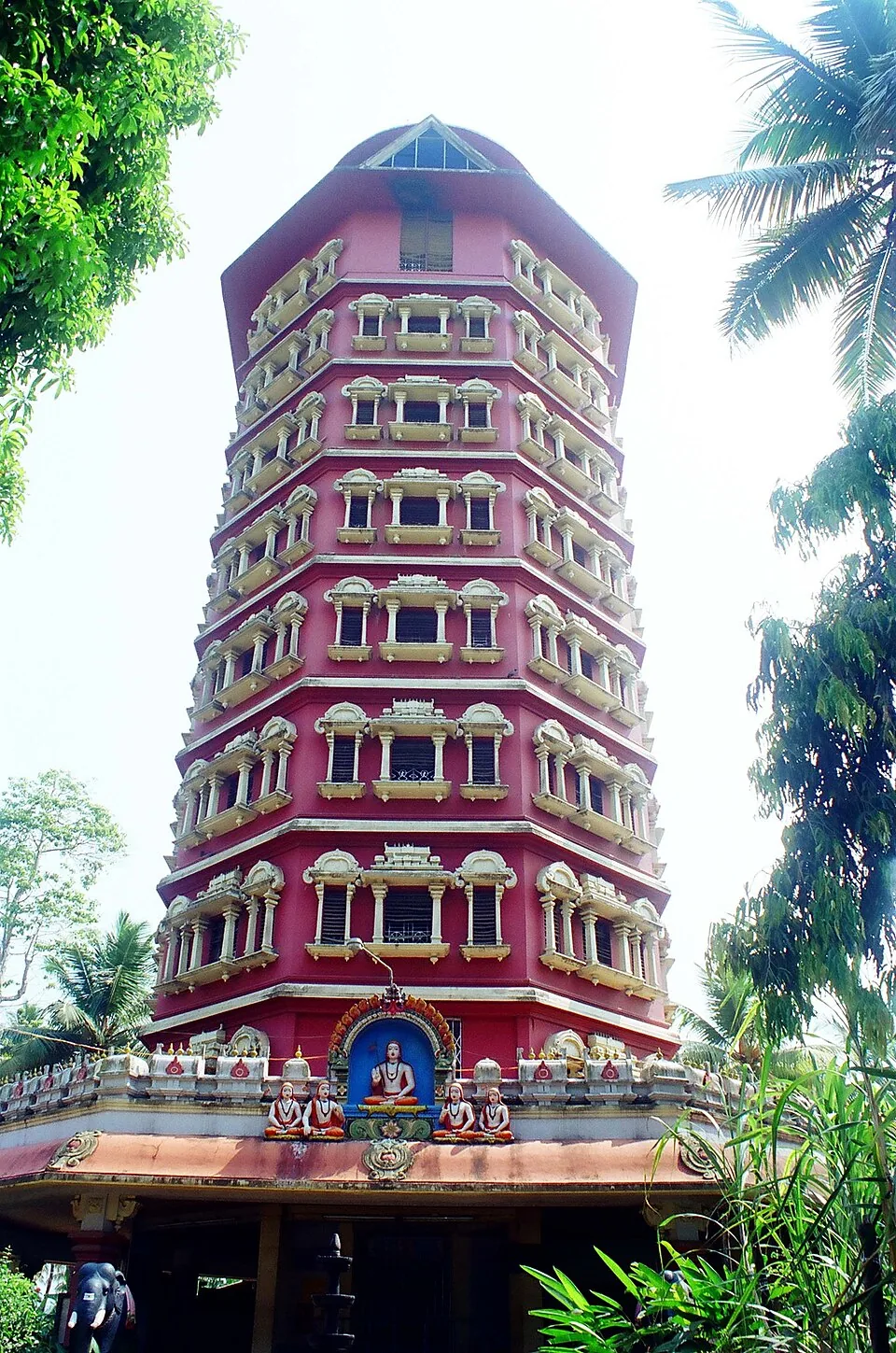
The Adi Shankara Keerthi Sthambha Mandapam tells the life of Adi Shankaracharya across eight floors of murals, in sequence, with confidence. It is a very good building. It also sits on top of two facts that almost nothing at Kalady says out loud: nobody agrees when Shankara lived, and Kalady itself had to be found again in the nineteenth century.
Thirteen centuries of disagreement
The commonly cited dates are roughly 788 to 820 CE — the thirty-two years the tradition insists on. That is the figure most textbooks use and the one you will hear at Kalady.
But it is not agreed. The mathas that Shankara himself is said to have founded maintain their own chronologies, and those diverge from the standard dating and from each other by very large margins — the full spread of proposed dates runs across something like thirteen centuries. Some traditions place him centuries before the common era. Modern scholarship generally clusters him in the eighth century, but the range in circulation is enormous, and each institution has a genuine textual and lineage-based case for its own version.
- The works: the commentaries on the Upanishads, the Brahma Sutras and the Bhagavad Gita exist and are studied.
- The system: Advaita Vedanta as he formulated it demonstrably reorganised Indian philosophy.
- The mathas: four monastic seats claim descent from him and have maintained lineages for centuries.
- The dates: not solid. Not even approximately agreed between the institutions closest to him.
- The biography: hagiography — the digvijayas were composed long after his lifetime.
None of that diminishes him. It is simply the ordinary condition of an early Indian intellectual figure, where the works survive far better than the biography, and where competing institutions have every reason to place a founder in a chronology that suits their own lineage claims.
And the village had to be rediscovered
The second thing is more surprising to visitors, and more interesting. Kalady’s identification as Shankara’s birthplace was not a continuous, unbroken tradition. The site was effectively lost, and re-established only in the late nineteenth century, largely through the efforts of the Sringeri Math — one of the four monastic centres claiming descent from him. The birthplace temple complex was consecrated in 1910.
So the entire visible landscape of Kalady — the temple complex, the ghat markers, this memorial tower — is a modern commemoration, deliberately assembled on a site identified about twelve hundred years after the event it commemorates. That is not a criticism. It is a remarkable act of religious reconstruction, and it is the actual reason there is anything here to visit.
Why we tell you this
Because it makes the visit better, not worse. Walk Kalady believing you are standing in an unbroken eighth-century site and you are getting the tourist version. Walk it knowing that a religious institution went looking for a lost village, made an argument for this one, and then built a landscape of memory on it across the twentieth century, and you are looking at two extraordinary stories stacked on the same ground.
The tower is the top layer of that. It commemorates a philosopher, and it also commemorates the modern determination to have somewhere to commemorate him.
What to do with the uncertainty
Nothing, mostly. Enjoy the murals, take the stairs, look at the river. But if a guide gives you 788 to 820 CE as settled fact, you now know that the mathas descended from the man himself would dispute it, and that the disagreement runs to centuries rather than decades. That is a more interesting thing to carry down eight flights of stairs than a date.
Frequently asked questions
When did Adi Shankara live?
The commonly cited dates are around 788–820 CE, and modern scholarship generally places him in the eighth century. But the mathas founded in his name maintain their own chronologies that diverge widely — the full spread of proposed dates runs across roughly thirteen centuries, with some traditions placing him before the common era.
Why do the dates disagree so much?
Because the biographical sources are hagiographies composed long after his lifetime, and because the monastic institutions claiming descent from him each maintain lineage-based chronologies with genuine internal logic. Early Indian intellectual figures are frequently better preserved in their works than in their dates.
Was Kalady always known as Adi Shankara’s birthplace?
No. The identification was effectively lost and re-established only in the late nineteenth century, largely through the efforts of the Sringeri Math. The birthplace temple complex was consecrated in 1910, which is why everything visible at Kalady is a modern commemoration.
Does that mean Kalady is not really the birthplace?
It means the identification is a nineteenth-century scholarly and institutional conclusion rather than an unbroken local memory. That is how a great many pilgrimage sites work. It is worth knowing, and it does not make the place less worth visiting — arguably the reconstruction is a second remarkable story on the same ground.
Did Adi Shankara really live only thirty-two years?
That is the firm tradition, and it is central to how he is remembered — an enormous body of work compressed into about fifteen years of adult life. Like the dates themselves, it comes from hagiographical sources rather than contemporary record.
What are the four mathas?
The monastic seats traditionally founded by Shankara at the compass points of the subcontinent — Sringeri in the south, Dwarka in the west, Puri in the east and Badrinath in the north. Each maintains a lineage claiming descent from him, and each has its own chronology for his life.