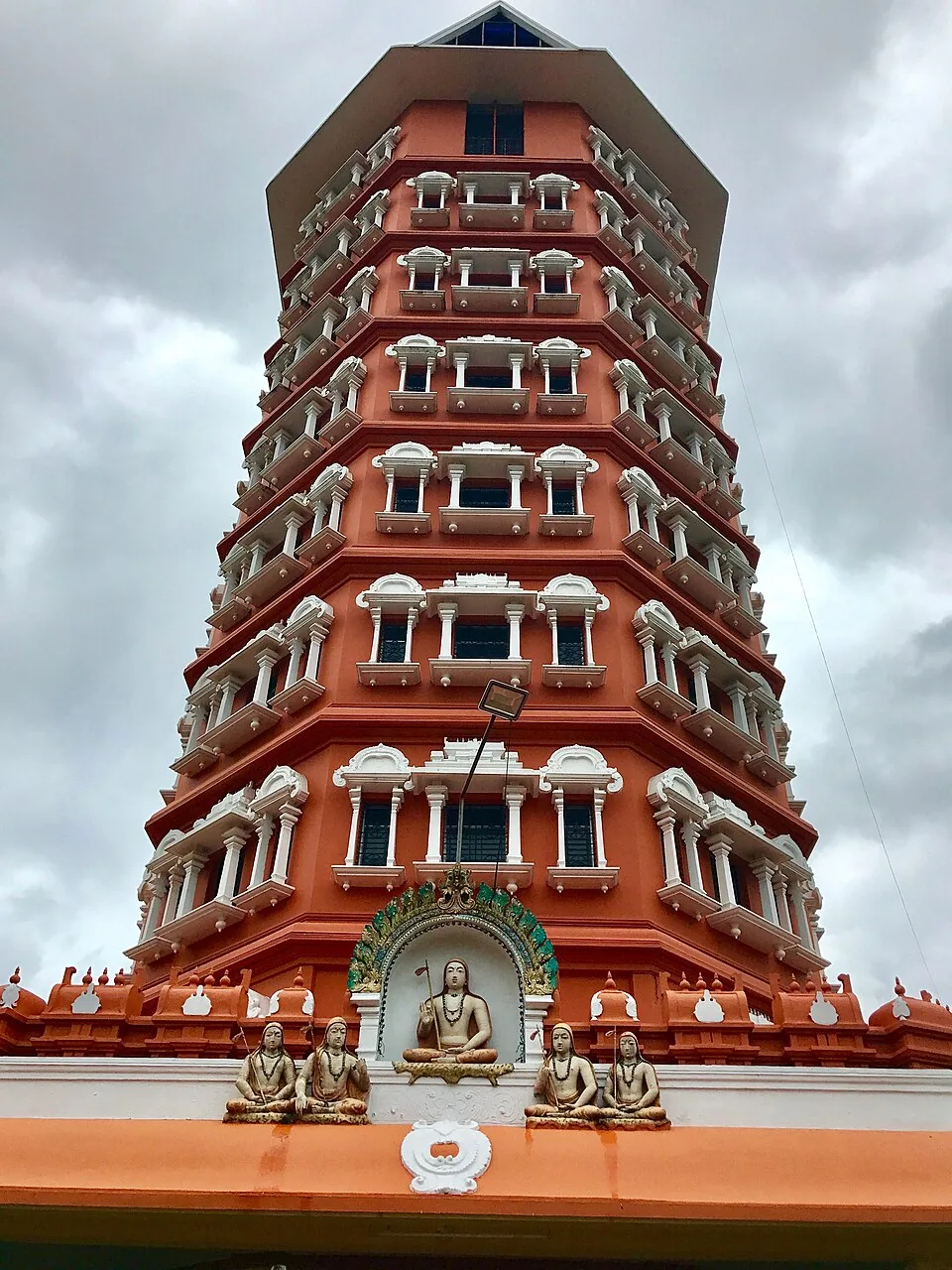
The Adi Shankara Keerthi Sthambha Mandapam at Kalady is an eight-storey octagonal tower on the bank of the Periyar, and it is one of the few buildings in India designed to be read rather than looked at. Each floor carries murals and exhibits covering a stage of the life and teaching of Adi Shankaracharya. You climb it, and by the top you have been walked through a philosophical system.
What a keerthi sthambha is
A keerthi sthambha is a pillar or tower of fame — a commemorative structure raised to honour a person or an achievement, a form with a long history in Indian architecture. What is unusual here is the interior. Most such towers are monuments to be seen from outside. This one is a vertical exhibition.
The octagonal plan matters too. Eight faces, eight storeys, and a tapering ascent, so that the building narrows as you rise through it — a shape that does a fair amount of quiet work for a memorial to a philosophy about the resolution of multiplicity into unity.
What is on the floors
The murals move through the life: the childless vow of Sivaguru and Aryamba, the birth at Kalady, the crocodile in the Periyar and his mother’s consent to his renunciation, the journey north to find his own teacher, the great debates, the founding of the four mathas at the compass points of the subcontinent, and the return to Kalady for his mother’s last rites.
Interleaved with that is the teaching — Advaita Vedanta, non-dualism, the position that the individual self and the ultimate reality are not two things. That is a genuinely difficult argument to render in wall paintings, and the tower does not pretend to have solved it. What it does well is make the biography carry the philosophy, which is how the tradition has always transmitted it anyway.
- Eight storeys, climbed on foot. There is no lift — factor that in.
- Allow 30–45 minutes inside, more if you read the panels properly.
- The view from the top over the Periyar and the village is the reward for the stairs.
- It sits within the Kalady birthplace complex, alongside the Sree Krishna temple and the ghat.
- Dress and behave as you would at a temple; this is a religious memorial, not a museum.
Thirty-two years
The fact the tower is built around is that Shankara is traditionally held to have died at thirty-two. Everything the murals show — the commentaries on the Upanishads, the Bhagavad Gita and the Brahma Sutras, the debates, the four monastic seats at Sringeri, Dwarka, Puri and Badrinath, the reorganisation of a religious tradition across a subcontinent — is compressed into about a decade and a half of adult life.
Whether the thirty-two years is history or hagiography is a separate question, and a real one. But the structure of the story is what the building exists to convey: a very short life, at enormous velocity, beginning in the village outside the window.
Doing it in the right order
The tower is the intellectual summary and it works far better after the physical sites rather than before. Walk the Sree Krishna temple, then the ghat where Aryamba was cremated and the crocodile legend is set, and then climb. The murals stop being illustrations of a story you do not know and become captions for places you have just stood in.
Finish at the top, looking at the Periyar. That is the river the legend says moved so that a boy’s mother would not have to walk so far — and it is a good place to think about how much of a religion can grow out of a small family in a small village.
Frequently asked questions
How many floors does the Adi Shankara Keerthi Sthambha Mandapam have?
Eight. It is an octagonal tower on the bank of the Periyar at Kalady, climbed on foot, with murals and exhibits on the life and teaching of Adi Shankaracharya on each level and a view over the river and village from the top.
What does keerthi sthambha mean?
A pillar or tower of fame — a commemorative structure raised to honour a person or achievement. What is unusual about the Kalady one is that it is designed to be entered and read rather than simply viewed from outside.
How long does it take to visit?
Thirty to forty-five minutes inside, longer if you read the panels carefully. There is no lift, so the eight-storey climb is on foot — worth knowing if stairs are a problem.
What do the murals show?
The life of Adi Shankara in sequence: his parents’ vow, his birth at Kalady, the crocodile in the Periyar and his mother’s consent to his renunciation, the journey north, the great debates, the founding of the four mathas, and his return for his mother’s last rites — interleaved with the teaching of Advaita Vedanta.
Is there a dress code at the mandapam?
Treat it as a religious memorial rather than a museum: dress modestly and behave as you would at a temple. It stands within the Kalady birthplace complex alongside the Sree Krishna temple and the cremation ghat.
Should I climb the tower before or after seeing the rest of Kalady?
After. The murals work far better as captions for places you have already stood in — the family temple and the riverbank ghat — than as an introduction to a story you do not yet know.