The Alathiyur Perumthrikkovil sits about seven kilometres from Tirur on the land between the Ponnani river and the Bharathappuzha, and almost nobody uses its proper name. It is the Alathiyur Hanuman temple, and the paradox in that is the point of the place.
A king with nobody beside him
Sri Rama holds the sanctum: a tall four-armed image in dark stone sheathed in panchaloha, facing east, standing alone. There is no Sita beside him, and the absence is the subject rather than an omission. This is Rama at the anxious hinge of the epic, after Sita has been carried off to Lanka and before anyone knows where she is.
Hanuman is carved just outside the shrine, leaning forward as though listening, holding a stick. He is caught in the instant he is being given his orders and sent across the sea to find her. Few temples in Kerala freeze a single moment of the Ramayana so exactly, and fewer still turn it into something a visitor takes part in.
The leap, and what people bring
A structure on the grounds stands for the leap across to Lanka, and jumping from it is held to bring health, long life and good fortune. It is the one piece of ritual here that is done rather than watched.
The offerings divide the way the temple does. Palpayasam, the slow-cooked milk and rice, goes to Rama in the sanctum. Aval — flattened rice, the plainest thing in a Kerala kitchen — goes to Hanuman outside it, and so do the garlands of vada that hang at every Hanuman shrine in south India. The king gets the sweet; the messenger gets what you can carry.
What the enclosure is like
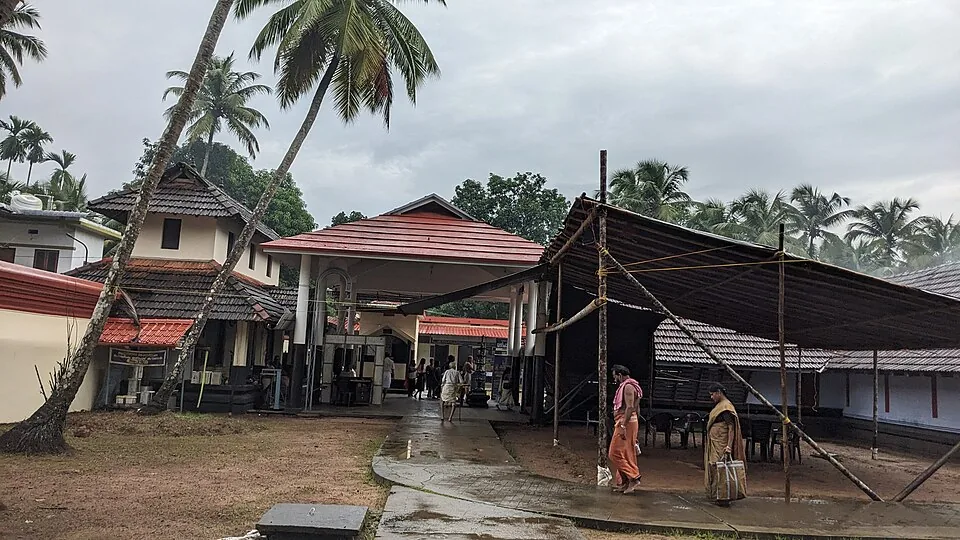
Broader and plainer than the reputation suggests. Long ranges of tiled roof on white walls run round an open court, with a line of red timber posts holding up the eaves; the ground inside is sand, and in the monsoon a good deal of it is standing water. Two small open pavilions of black stone stand at the edge under separate roofs. Nothing about it is ornate, which is normal for a kavu — a shrine grown out of a sacred grove rather than founded as a monument.
It is administered by a trust under the Malabar Devaswom Board, with the Samuthiri as chief trustee. Sub-shrines within the enclosure hold Lakshmana, Ganesha, Mahavishnu, Durga, Bhadrakali, Ayyappan and the serpent deities.
- Karkidakam, mid-July to mid-August, is the Ramayana month: daily recitation, the fullest crowds and the heaviest rain.
- The Thiruvona festival falls in Thulam, mid-October to mid-November, on the Pooradam, Uthradam and Thiruvonam days.
- Tuesdays, Thursdays and Saturdays are held to be Hanuman’s days.
- Early morning or evening; the temple keeps the usual midday close.
- Triprangode, a west-facing Shiva temple with a completely different story, is two kilometres south.
How old is it?
There is no firm documentary date, which is normal for Kerala’s older kavus. The tradition credits the consecration of the Hanuman image to the sage Vasishtha and puts it around three thousand years ago; that is devotional tradition rather than chronology, and the reference accounts state it inconsistently. The fabric now standing is far younger than the claim.
One firmer thing about the ground: Alathiyur is named among the four villages the standard accounts give as the actual seat of the Kerala school of astronomy and mathematics, One of them lived within sight of these fields; who they were and what they worked out belongs to Tirur’s own page.
Frequently asked questions
Is Alathiyur a Rama temple or a Hanuman temple?
Both. The sanctum holds Sri Rama alone, without Sita; Hanuman is carved outside it, leaning as if listening, and he is the figure the crowds and the offerings are for.
What is the leap?
A structure on the grounds standing for Hanuman’s leap to Lanka. Jumping from it is held to bring health, long life and good fortune.
How far is it from Tirur?
About seven kilometres, on the land between the Ponnani river and the Bharathappuzha. Tirur is the practical arrival point and an auto covers the last stretch.