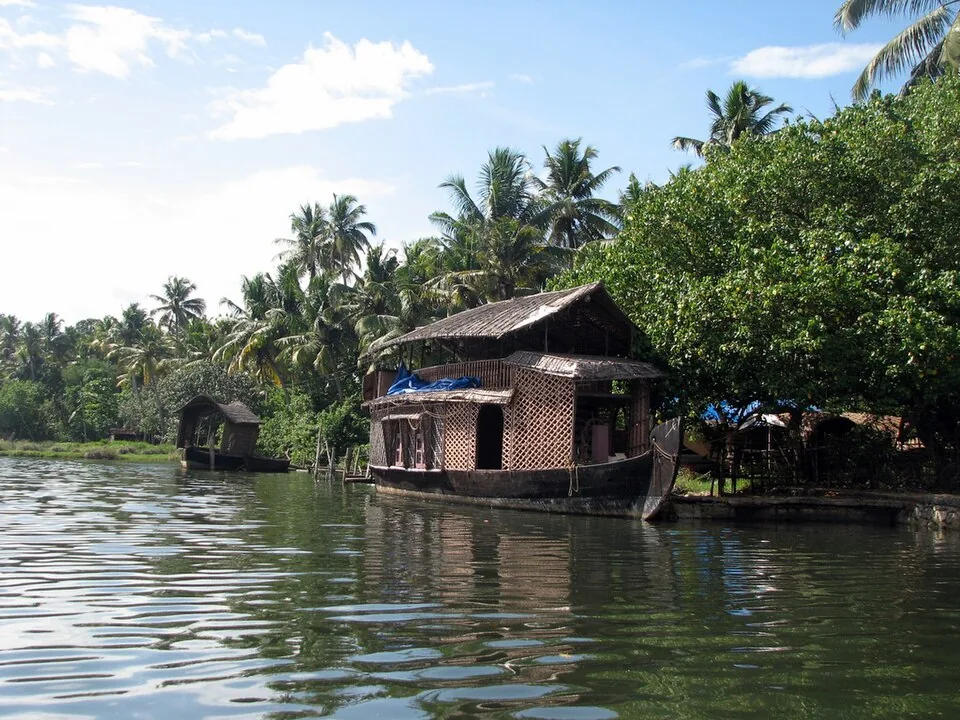
Kerala Tourism keeps a destination page for a village of boatyards three kilometres west of Karunagappally, and on it is a sentence that has been copied outward across the entire Indian travel internet: Alumkadavu is the birthplace of the iconic kettuvalloms, where the first houseboats in India were crafted.
It is not true, and the reason it is not true has nothing to do with Kerala.
The houseboats that came first
India’s first houseboats were built on Dal Lake in Srinagar, and they were built because of a property law. Kashmir in the late nineteenth century was a princely state, and its Maharaja would not permit foreigners to buy land or build houses there. British residents, who wanted to summer in the valley anyway, did the obvious thing and built their houses on the water instead — long timber structures in a hybrid English-Indian idiom, made of local cedar, moored rather than anchored to any plot.
The date is roughly settled. Francis Younghusband records a man named M. T. Kennard establishing a floating house on the lake somewhere between 1883 and 1888; a competing local account credits a shopkeeper who moved his business onto a boat after a fire and later sold it to a European. Either way the houseboat existed in India in the 1880s, and the Srinagar boats had been a fixture of the tourist economy for a full century before anything comparable floated in Kerala.
So the claim as printed fails by about a hundred years. What is irritating about this is that Alumkadavu has a genuinely remarkable story and does not need the borrowed one.
What actually happened, and when
The real story starts with a boat going out of business. The kettuvallam — kettu, to tie; vallam, a boat — was the freight barge of the central and southern Kerala backwaters: a long hull of anjili and jackwood planking drawn together with coir, with an arched palm-thatch roof over the cargo, poled and punted along the canal chain that carried rice out of Kuttanad, coir out of the Kollam belt, lime, timber and stone. Alumkadavu built them, and had built them for as long as anybody could account for.
Then the roads arrived. Across the second half of the twentieth century, road freight took the work off the water in Kerala as it did nearly everywhere else, and by the 1980s the cargo kettuvallam was an obsolete vehicle. The men who could still build one were ageing out of a trade that had stopped receiving orders.
Into that came Babu Varghese, a tour operator from Thiruvananthapuram who ran a company called TourIndia and who had been researching backwater tourism since the early 1980s — canal routes, boat designs, the practical question of how you would put a visitor on this water overnight. His answer was to take the obsolete barge and refit it: sleeping quarters, a bathroom, a kitchen, a deck, in a hull designed to carry sacks of rice.
He could not do it alone, because he was not a boatbuilder. He went to Alumkadavu and found Mannasseril Padmanabhan, a carpenter of that village who excelled in country boat making, and the two of them worked the design out together. The first Kerala houseboat launched in 1991.
The scale of what followed
By 2017 there were more than three thousand tour boats on the Kerala backwaters. Effectively all of them descend from that one conversion — the arched roof, the thatch, the shape you see on every poster of Kerala ever printed, is the shape of a rice barge that somebody decided to put beds in.
Varghese died in 2011, at sixty. Padmanabhan is named in the record almost exclusively through that single collaboration, which is a familiar asymmetry: the entrepreneur is remembered in English, the craftsman in a subordinate clause.
The thing worth holding onto is that this was not an invention. It was a reanimation. The craft knowledge at Alumkadavu did not survive because it was protected or subsidised or listed; it survived because somebody found a new reason to need it in the decade it would otherwise have died. Kerala’s entire backwater tourism industry — a substantial slice of the state’s visitor economy — rests on the fact that in 1991 there was still one village where you could find a man who knew how to tie a hull together.
Why the bigger claim keeps getting made
It is not hard to see how "the first Kerala houseboat" became "the first houseboat in India". The Kerala boat is by far the more photographed of the two; it is the one that appears in national tourism campaigns; and Srinagar’s houseboats spent much of the period after 1989 out of the reach of most Indian holidaymakers, which is a long time for a fact to go unrehearsed. Add the ordinary compression of brochure copy and you get a village credited with a century it did not have.
The correction costs Alumkadavu nothing. Srinagar’s houseboats are moored buildings — floating hotels that do not travel. What was designed here in 1991 was a moving vessel, built by hand out of a working freight craft, and it went on to define how an entire state is pictured. That is the sentence Kerala Tourism should be printing.
Standing there now
The yards are still along the bank, roofed in palm thatch, open at the sides. There is no gate and no ticket, because there is nothing here that has been converted into an attraction: this is somebody’s worksite, and the hull propped on timber blocks with its ribs showing is somebody’s order. People stop and watch and the builders are generally relaxed about it, but the courtesy is real — ask before you walk in, ask before you photograph anyone, and stay well clear of anything being moved.
It is a strange feeling to stand in front of a half-finished boat and realise you are looking at the origin of an image you have seen a hundred times. It is stranger still to realise how nearly it did not happen.
Frequently asked questions
So who invented the Kerala houseboat?
The design is credited to Babu Varghese (1951–2011) of TourIndia, working with Mannasseril Padmanabhan, a boat carpenter of Alumkadavu. The first boat launched in 1991. Both names appear in the Wikipedia record of Varghese’s work, which explicitly places the carpenter at Alumkadavu near Karunagappally.
Were there really no houseboats in India before 1991?
There were plenty. The houseboats of Dal Lake in Srinagar date from the 1880s and were a mainstay of Kashmir tourism for a century before Kerala had anything comparable. The Kerala claim is specific: the first conversion of a cargo kettuvallam into a cruising houseboat, in 1991.
What is a kettuvallam, exactly?
A tied boat — kettu, to tie; vallam, a boat. It is named for its construction, not its use: planks of anjili and jackwood edge-joined and drawn together with coir cord rather than fastened with metal, with coir fibre packed into the seams. It was a freight barge, carrying rice, coir, lime and building material along the backwater canals before roads reached the interior.
Can I watch a boat being built?
In practice, yes — the yards are open-sided and along a public bank, and people do stop. But they are private worksites with no visitor arrangement, so ask first. If you want a proper look with someone to explain it, arrange it through DTPC Kollam (+91 474 2745625 / 2750170) or through the resort on the bank.