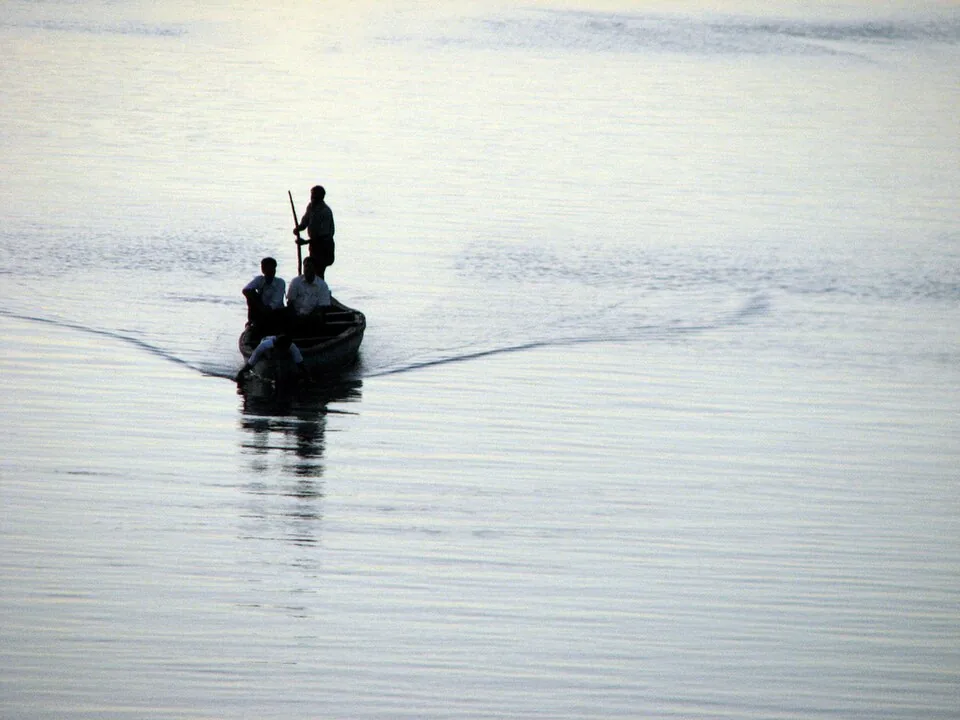
Kerala Tourism’s destination page for Alumkadavu opens by placing the village on the backwaters of Ashtamudi Lake. Its separate article page says the same. So does the listing for the DTPC-licensed resort on the bank here, which promises a lakefront facing Ashtamudi, "very wide with natural breeze".
The water at the end of the village is Kayamkulam Kayal. Ashtamudi is ten and a half kilometres away, in the other direction.
How we know
Alumkadavu village stands beside the Kayamkulam backwater system, near the southern end of Alappuzha district. Sasthamkotta is a separate freshwater lake inland in Kollam district, so its visitor information, routes and ecology should not be applied to an Alumkadavu trip.
The mapped shoreline of Kayamkulam Lake comes within about 0.25 km of Alumkadavu, while the nearest mapped edge of Ashtamudi Lake is about 10.6 km south. More decisively, Alumkadavu lies north of Ashtamudi’s northernmost mapped latitude. The village is therefore on Kayamkulam Kayal, not on Ashtamudi Lake.
One honest caveat, because the measurement deserves it: Ashtamudi is an eight-armed lake and a 117-node outline is a coarse one, so it is possible that some narrow arm is under-mapped. That does not change the answer. The load-bearing number is the other one — a quarter of a kilometre to Kayamkulam — and no amount of under-mapping makes a lake ten kilometres away the lake at the end of your street.
Why the mistake is so persistent
Because Ashtamudi is the name that sells. It is Kerala’s second-largest backwater lake, a Ramsar wetland, the celebrated gateway to the backwaters, and the water that Kollam town is built around. Kayamkulam Kayal is the long, thin lagoon to the north of it, straddling the Kollam–Alappuzha district line, and outside the region it is close to anonymous. If you are writing promotional copy about a backwater village in Kollam district, "on Ashtamudi Lake" is the phrase that arrives without being sent for.
There is also a real geographical excuse. The two lakes are joined. The canal chain that threads them is the old Thiruvananthapuram–Shoranur canal, cut and extended by the Travancore state through the nineteenth century and now the spine of National Waterway 3, the West Coast Canal. A boat leaving Alumkadavu can be on Ashtamudi within the hour without ever touching the sea. In the sense that matters to a boatman, it is all one system — which is exactly how a copywriter ends up describing the wrong part of it.
Why it matters anyway
Partly because it is the kind of error that reproduces. Kerala Tourism is the source everyone else copies, and once a state tourism board has put a village on the wrong lake, every aggregator, every hotel listing and every AI summary inherits it.
But mostly because it makes the place harder to find and harder to understand. If you plan a day expecting to be on the famous lake with the eight arms and the Ramsar designation, you will be disappointed by a narrow working lagoon with boatyards on it. If you know what you are looking at, you get the better experience: this is not the tourist lake, and that is why the tourist fleet is not on it.
What Kayamkulam Kayal actually is
It is a long, shallow, brackish lagoon running roughly north-south behind the coast, opening to the sea at Kayamkulam pozhi and separated from the Arabian Sea for most of its length by a strip of land a few hundred metres wide in places. It is a working water: fishing, small ferry traffic, the freight and tourist boats of NW3, and the Chinese-style dip nets that stand along its edges. It is quieter than Vembanad and quieter than Ashtamudi, because it has never been the postcard.
The best way to understand it is to travel it. DTPC Kollam runs an eight-hour public boat between Kollam and Alappuzha — leaving around 10:30 in the morning, arriving early evening — which threads all three great lakes of this coast in one day: Ashtamudi, then Kayamkulam, then Vembanad. It stops for lunch at Alumkadavu. That is a well-chosen halt, and not only for the food: the slowest scheduled journey in Kerala pauses, roughly at its midpoint, in the village where the boat it is descended from was redesigned.
A note on our own pages
We have written a good deal about Ashtamudi — its eight arms, its single outlet at Neendakara, its Ramsar listing and the clam-fishery certificate it no longer holds. None of that belongs to Alumkadavu, and we have been careful not to lend it here. The village’s own water is smaller, plainer and busier, and the story it supports is a working one rather than a scenic one.
Frequently asked questions
Is Alumkadavu on Ashtamudi Lake?
No. It is on Kayamkulam Kayal. Measured against OpenStreetMap geometry, the nearest mapped edge of Kayamkulam Lake is about 0.25 km from the village and the nearest mapped edge of Ashtamudi Lake is about 10.6 km south — and the entire Ashtamudi outline lies south of this village’s latitude. Kerala Tourism, its article pages and the local hotel listings all say Ashtamudi.
Are the two lakes connected?
Yes, by the canal chain that carries National Waterway 3, the West Coast Canal — historically the Travancore state’s Thiruvananthapuram–Shoranur canal. That connection is almost certainly why the two get confused, and it is why a boat can leave Alumkadavu and be on Ashtamudi without going to sea.
Can I take a boat from Alumkadavu?
Yes. DTPC Kollam’s Kollam–Alappuzha public boat — roughly eight hours, departing about 10:30 — stops here for lunch, and local canoes and small boats can be hired on the bank or through the resort. Check the DTPC service is running before building a day around it.
Which is the better backwater to actually be on?
Different things. Ashtamudi is wider, more scenic and far better served for cruises; Kayamkulam is narrower, working and quiet. If you want the classic backwater day, go from Kollam onto Ashtamudi. If you want to see boats being built and a lagoon without a fleet on it, come here.