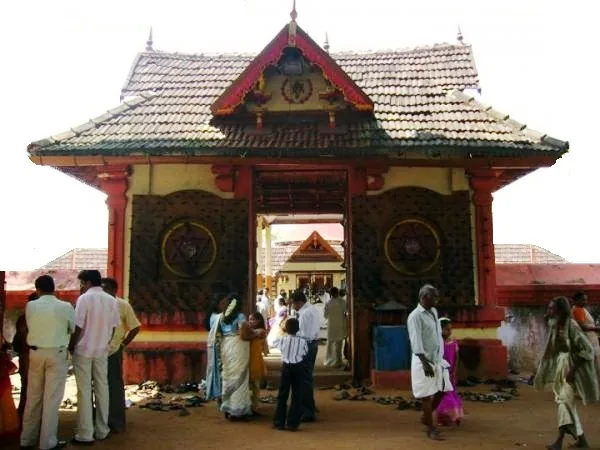
Every description of this temple arrives at the same sentence, and it is always phrased as the headline fact. The sreekovil at Anandavalleeswaram, says Kerala Tourism’s own temple page, is the only Hindu shrine in India which has the idols of Sree Krishna, Lord Vishnu, Bhoomi Devi and Lakshmi Devi consecrated and installed under a single roof.
Wikipedia says it in almost identical words. And one of the larger Kerala temple websites has already promoted it: the sole temple globally featuring that combination, and, for good measure, the only temple in Kerala housing both Shiva and Vishnu alongside their consorts.
The tell
A claim that gets larger each time it is restated, without a new authority appearing at any step, is behaving the way an unsourced claim behaves. India became the world in one hop, and nothing was added to justify the hop.
We have seen this pattern in this district before. Kollam’s police museum is described by both Kerala Tourism and the district tourism council as the only museum of its kind in the country; the Delhi Police Museum was established eight years before it. Poruvazhy Malanada is billed as India’s only Duryodhana temple, and there is a Dussasana shrine of near-identical form in the same taluk. Superlatives of the form "the only X in India" are, in our experience of writing this site, wrong far more often than they are right.
What we could not do
We could not kill this one, and it would be dishonest to pretend otherwise.
The obvious line of attack is that Vishnu attended by Sridevi and Bhudevi is not unusual at all — it is the standard South Indian configuration, repeated in hundreds of Perumal temples. Add Krishna somewhere in the same complex and you would think counterexamples would be everywhere. But the claim as worded is narrower than that: all four, as consecrated idols, under a single roof, in one sreekovil. The nearest thing we found — Thriprayar, where Rama stands flanked by Sridevi and Bhudevi in the sanctum and Krishna is in the outer prakara — fails on exactly the point at issue.
And there is no register to check it against. Nobody maintains a national inventory of sanctum configurations. A negative claim across every Hindu temple in India is not the sort of thing that can be verified by anyone, including the person who first made it — which is itself the strongest argument for treating it as folklore rather than fact.
So what we do
We print it as a claim, attributed, with the escalation noted, and we neither endorse nor refute it. That is not a hedge; it is the accurate report of the evidence. If a reader can name a temple that breaks it, we would like to hear from them, and the sentence will change.
The thing that is actually interesting
Strip the superlative away and something better is left, which is what usually happens.
This is a Shaiva temple carrying a substantial Vaishnava household. Shiva is here as Ananda Swaroopan, bliss embodied, facing west; Parvati is Swayamvara Parvathy, the goddess at her own choosing of a husband, facing east — the two principal deities of one sanctum looking in opposite directions. Around them are Ganapathy, Murugan, Krishna, Hanuman, Ayyappan, Maha Vishnu, Lakshmi Devi, Bhoomi Devi and the naga deities.
That is a crowded roll, and the honest reading of it is not doctrinal but historical. Kerala temples accumulate. Sub-shrines are added by donors, by families, by communities moving into a neighbourhood and wanting their own deity present, across centuries during which nobody was keeping minutes. A sanctum with an unusual list is usually a record of who worshipped there rather than a theological statement — and at a temple whose two origin traditions both involve merchant communities settling in Kollam from outside, an accumulated pantheon is exactly what you would predict.
The register the temple is actually in
And there is one thing here that needs no superlative at all. This is a temple of the honeymoon. Kerala’s Shiva shrines are usually shrines of the ascetic, the destroyer, or the linga in its abstraction. Anandavalleeswaram is a shrine to a couple in the first happiness of their marriage, and the whole name is built out of it: ananda, bliss; valli, the goddess; eeswaram, the lord. That is unusual, it is legible in the iconography, and nobody has to claim it is the only one in the world for it to be worth crossing town for.
Frequently asked questions
Is the sanctum really unique in India?
Unknown, and unknowable in the form the claim is made. Kerala Tourism and Wikipedia say only in India; one temple website says only in the world. No authority is cited at any step and there is no national register of sanctum configurations to check against. We could not find a clean counterexample either, so we print it as a widely repeated claim rather than as a fact.
What is actually in the sanctum?
Shiva as Ananda Swaroopan facing west and Parvati as Swayamvara Parvathy facing east, with Krishna, Maha Vishnu, Lakshmi Devi and Bhoomi Devi also present, plus sub-shrines to Ganapathy, Murugan, Hanuman, Ayyappan and the naga deities.
Why do so many temples claim to be the only one of something?
Because it is an effective line and because nothing checks it. In this district alone we have had to correct the police museum’s "only one in the country" (Delhi’s was eight years earlier) and qualify Poruvazhy’s "India’s only Duryodhana temple" (a Dussasana shrine of the same form stands in the same taluk). Treat any "only in India" as unverified until somebody names the register it was checked against.
What makes this temple genuinely unusual, then?
The register it worships in. Shiva as bliss embodied and Parvati as the bride at her swayamvara is a marriage theology, not the ascetic or destroyer theology most Kerala Shiva temples run on — and the name of the place is built out of it. That needs no superlative.