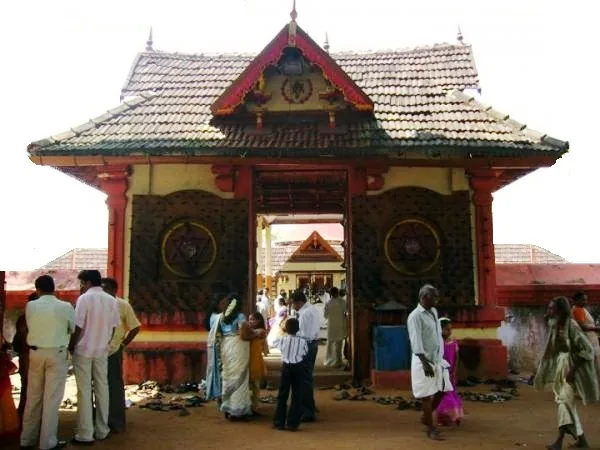
Almost nothing about this temple can be dated. Its age is guessed at across a two-hundred-year spread, its founders are two mutually exclusive traditions, and no inscription has been produced for any of it. And then, quite suddenly, there are four hard dates in a row — all of them between 1806 and 1823, all of them attached to a war.
1806
The temple was renovated, and a new idol was cast in panchaloha: the alloy of iron, copper, tin, silver and gold used for the metal images that are carried in procession at Kerala temples. A renovation and a new processional idol is a substantial undertaking and implies a substantial patron, though the accounts do not name one.
Two years later the ground moved under everybody.
1808–09
Velu Thampi Dalawa was the Diwan of Travancore, the state’s chief minister, and he had spent several years watching the East India Company convert a subsidiary alliance into control. In 1808 he moved against it. His call to arms is remembered by the name of the town where it was issued — the Kundara proclamation, Kundara being in this district, about fifteen kilometres from here.
The rising was over within months. Company forces took the country, Velu Thampi died in March 1809, and Travancore emerged from the affair considerably less independent than it had entered. It is one of the founding episodes of the modern politics of this coast, and it was fought, in part, along this road.
Anandavalleeswaram was damaged in the fighting. The accounts do not say how badly or by whom, which is frustrating and also fairly normal for a building that was not the point of the battle.
1823
Fourteen years later the temple was repaired, and the temple’s own history says the repairs were paid for by the British government — the government whose forces had done the damage.
We should be careful here, because this is the detail we would most like to be true and the one we can least verify. It is printed consistently across the temple listings, in near-identical wording, which usually means one source copied several times rather than several sources agreeing. We could not trace it to an archival citation. So it goes on this page as the temple’s own account of itself, which is a real kind of evidence and not the same as a proved fact.
Why it is plausible anyway
Because of who was in charge. Colonel John Munro arrived in Travancore as British Resident in 1810, in the immediate aftermath of the rebellion, and proceeded to do something that had no business being possible: he became Diwan of Travancore as well, holding simultaneously the office of the state’s chief minister and the office of the foreign power’s representative. He was Diwan of Cochin too. Our page on the British Residency at Asramam, four kilometres north of here, is about that man and that arrangement.
Munro’s administration is remembered for exactly this kind of intervention — reorganising the Devaswom temple establishments, taking their lands and revenues under state management, and spending on their fabric. A grant to repair a war-damaged shrine on the main road out of Kollam is entirely in character for the settlement that followed the rising, and 1823 sits squarely inside it.
How to read it
You can read the 1823 repairs as restitution, as pacification, as bureaucratic tidiness or as the ordinary business of a state that had just made itself responsible for a great many temples. All four readings are available and none of them is obviously right.
What is not in doubt is the shape of the thing: a shrine of unknown antiquity, standing on a road, gets caught in somebody else’s war, and the only reason we know a single dated fact about it is that the war happened. The eleven or twelve centuries before 1806 have left nothing at all. Two decades of colonial conflict left a paper trail.
And 2015
The last dated event in the temple’s record is more recent and more mundane. On 2 August 2015 a panchaloha Krishna idol was stolen from the temple, and on 11 August it was recovered at Pothencode near Thiruvananthapuram. Metal images at a shrine like this are devotional objects and, to somebody, portable bullion; the 1806 casting and the 2015 theft are the same fact seen from two directions.
Frequently asked questions
Was the temple really damaged in a war?
That is the temple’s account: it was damaged during the conflict between Velu Thampi Dalawa, Diwan of Travancore, and the East India Company in 1808–09, and repaired in 1823. The account is printed consistently across temple listings but we could not trace it to an archival source, so we record it as the temple’s own history rather than as an established fact.
Who was Velu Thampi Dalawa?
The Diwan of Travancore who led the 1808–09 rising against the East India Company. His call to arms is known as the Kundara proclamation, after the town in Kollam district where it was issued. The revolt was crushed and he died in March 1809.
Why would the British pay to repair a temple they had damaged?
The record does not say, and any answer is interpretation. But it fits the period: Colonel John Munro arrived as Resident in 1810 and held the Residency and the Diwanship of Travancore at the same time, and his administration reorganised the temple establishments and spent on their fabric. A repair grant in 1823 is in character for that settlement.
What else on this coast is from the same moment?
The British Residency at Asramam, about 4 km north, is the house built for Munro himself and is still in public use. Thevally Palace, 1.2 km from the temple, is from the same decades of Travancore history. The three together make an unusually coherent half-day.