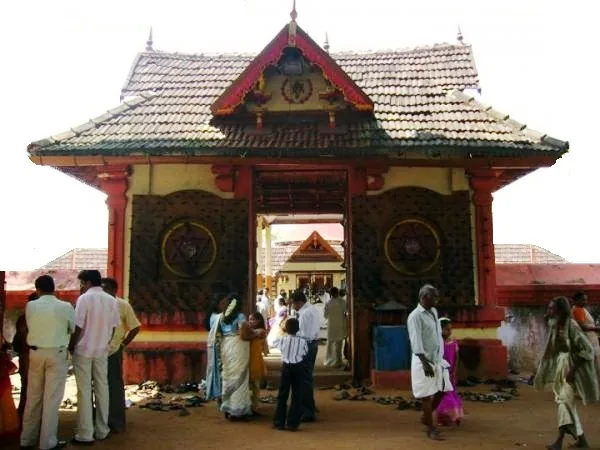
Ask how old Anandavalleeswaram is and you will get a confident answer. The trouble is that you will get three of them.
The three figures
The most widely repeated is that the main sreekovil, built of teak, is approximately twelve hundred years old. That is what the Wikipedia article says in its prose, it is what the temple listing sites say, and it is what most published descriptions of the temple carry.
The same Wikipedia article carries an infobox, and the infobox gives the construction as the eleventh century. That is a gap of two hundred years or more, sitting inside one document, unremarked.
And a third family of listings — the ones that also carry the temple’s Venad history — say eleven hundred years rather than twelve hundred.
None of the three is sourced. Not one of the accounts cites an inscription, a copper plate, a grant, an architectural survey or a dated renovation record for any of these figures.
Why twelve hundred is the suspicious one
Twelve hundred years before now is roughly AD 826. Kollam’s conventional founding is AD 825, and that year is not an ordinary date in Kerala: it is the epoch of the Kollam Era, the Malayalam calendar that the state still counts by. It is the single most rehearsed number in this city’s history, and it appears on our own page for the Port of Kollam.
A round age for an undated temple that happens to land within a year of the founding of the town it stands in is not evidence. It is the shape of a borrowed number. That does not make it wrong — a shrine in the capital of Venad could perfectly well be as old as the capital — but it means the figure carries no independent weight, and it explains rather neatly why an infobox compiled from a different assumption would land two centuries away.
What one source says plainly
The most useful sentence written about this temple appears on one of the temple listing sites, and it is refreshingly blunt: there is no historical document showing the antiquity and origin of the temple.
That is almost certainly correct, and it is the honest starting point. What follows from it is that everything before the nineteenth century here is tradition rather than record — and the traditions are worth having, so long as they are labelled.
What the traditions say
The consecration of the Shiva idol is attributed to Parashurama, the axe-bearing avatar who in Kerala’s founding narrative raised the coast out of the sea and studded it with shrines. Kerala Tourism records it, Wikipedia records it, and every listing repeats it. It is belief, and it is attached to a great many Kerala temples including several on our own Kollam and Pathanamthitta pages.
The temple is counted among the 108 Shivalayas of Kerala, and among the three in Kollam city that appear in the Shivalaya Stotram — the others being Kollam Rameswaram and Thrikkadavoor. It is worth being clear about what that means, because temple websites tend to present it as a rank. It is not one. Membership of the 108 is a place in a statewide devotional network, part of the same Parashurama tradition; it says the temple was significant enough to be counted, not that it was significant above others. Three of them inside one small city, however, is a real observation about how important Kollam once was.
And there are two rival accounts of who built it. One says Sri Lankan merchants who traded with Kollam. The other says Navakody Narayana Chettiar, an industrialist from Thanjavur who settled in the city. There is no way to adjudicate between them and we are not going to try — but notice that they are both saying the same thing in different accents. Both say the temple was built by outsiders who came here to trade and stayed. For a medieval Indian Ocean port whose seabed has produced Chinese coins, that is not a story that needs choosing between; it is a description of the ordinary condition of the place.
What can be dated
The nineteenth century, and only the nineteenth century. In 1806 the temple was renovated and a new idol cast in panchaloha, the five-metal alloy. In 1808–09 it was damaged in the war between Velu Thampi Dalawa and the East India Company. In 1823 it was repaired, and the accounts say the British government paid for it. In August 2015 a panchaloha Krishna idol was stolen and recovered nine days later at Pothencode.
Four dates in twelve hundred claimed years. That is not a criticism of the temple, which is a working shrine and not an archive. It is a caution about the confidence of everything you will read about it.
Frequently asked questions
So how old is the temple, really?
Unknown. The published figures are 1,200 years, 1,100 years and the eleventh century — and the last two of those appear in the prose and the infobox of the same Wikipedia article. None is sourced to an inscription or a record, and one temple site states outright that no historical document establishes the antiquity or the origin.
Why is 1,200 years treated with suspicion here?
Because it lands within a year of AD 825, the founding of Kollam and the epoch of the Malayalam calendar — the most rehearsed date in the city. A round, unsourced age that coincides exactly with the town’s own founding year is more likely borrowed than measured.
What are the 108 Shivalayas?
A statewide set of Shiva temples in the Parashurama tradition, counted in the Shivalaya Stotram. Anandavalleeswaram is one of three in Kollam city, with Kollam Rameswaram and Thrikkadavoor. Membership is a place in a network rather than a rank — but three in one city says something real about Kollam’s former importance.
Who built it?
Two traditions, neither documented: Sri Lankan merchants who traded with Kollam, or Navakody Narayana Chettiar, a Thanjavur industrialist who settled in the city. We record both. They agree on the more interesting point — that the founders were traders from outside who made their lives here.