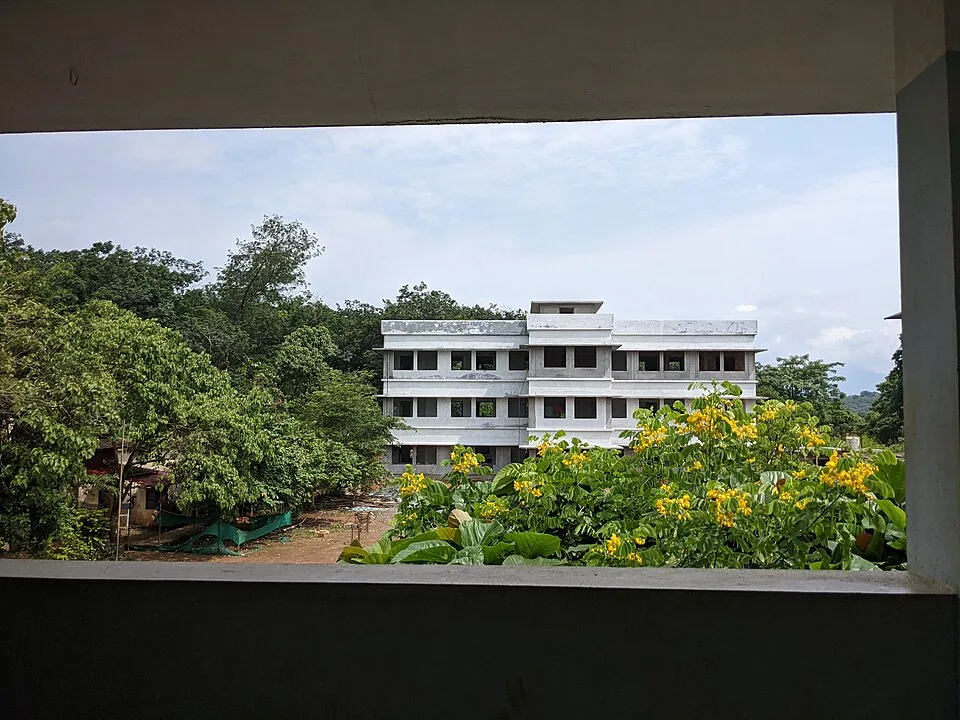
Drive east from Iritty towards the Aralam sanctuary and the last stretch runs through plantation — coconut, cashew and areca in long rows, with houses and schools among them. It looks like ordinary Kerala farmland and it is nothing of the kind. It is a federal state farm built at the height of the Cold War, given away in the twenty-first century, and it explains most of what a visitor to the sanctuary sees and hears.
A farm built with Soviet help
The Government of India established the Central State Farm at Aralam in 1970 with technical assistance from the erstwhile Soviet Union. Forest was cleared for plantation crops between 1970 and 1975, and for decades the farm was one of the country’s significant sources of hybrid coconut seed, alongside cashew and other crops. India had a number of such large mechanised state farms in that period; this one happened to be laid out against the flank of what would, in 1984, be declared a wildlife sanctuary.
The handover, and an acre each
On 20 June 2004 the farm was transferred to the Government of Kerala, bought with the Scheduled Tribes rehabilitation fund for the purpose of settling landless Adivasi families. The arrangement was a split down the middle: roughly half the land distributed to families, the other half kept as a working farm whose returns were meant to support them. The farm that remains is described by its own corporation as about 1,500 hectares, and the corporation itself — Aralam Farming Corporation (Kerala) Limited — was formally constituted on 10 June 2010.
Around 3,335 families were assigned an acre apiece. About 1,717 of them actually moved, the first arriving in 2006 and 2007. That gap between allotment and arrival is the single most telling number in the whole story, and it has been examined at length in the research literature — the Economic and Political Weekly carried a study of it, “Challenges before Kerala’s Landless: The Story of Aralam Farm”, in May 2010. An acre of cleared plantation an hour from anywhere is a title deed; it is not by itself a livelihood.
Why the elephants matter to your day out
Putting a large settlement of small holdings directly against the boundary of a wildlife sanctuary has had the consequence that anyone could have predicted. Elephants leave the forest at night into standing crops, and people who live and work in those crops meet them. Deaths here are counted in the double figures over the past decade or so, and they continue — a man was killed in a suspected elephant attack on the farm as recently as February 2026. Local residents have protested repeatedly for action, and the conflict is one of the best-documented in Kerala precisely because the settlement is the state’s largest.
For a visitor this is not background colour. It is the reason the sanctuary programmes are escorted rather than open, the reason the guide will tell you to stay with the group on ground that looks entirely tame, and the reason the plantation belt on the drive in deserves the same attention as the forest beyond the gate. The animals you have come hoping to see are, a kilometre back down the road, somebody’s standing problem.
- 1970 — the Central State Farm at Aralam is established by the Government of India with Soviet technical assistance; forest is cleared for plantation through to 1975.
- 15 October 1984 — the neighbouring forest is constituted a wildlife sanctuary.
- 20 June 2004 — the farm is transferred to the Government of Kerala for Adivasi rehabilitation.
- 2006–2007 — the first settler families arrive; around 3,335 allotments were made and about 1,717 families came.
- 10 June 2010 — Aralam Farming Corporation (Kerala) Limited is constituted to run the retained half.
- 18 June 2025 — the sanctuary next door is renamed a butterfly sanctuary.
What you can actually see of it
There is no monument and no visitor centre to the farm’s history; there is the landscape itself, which is legible once you know what you are looking at. Rows rather than random growth. Houses at regular intervals on plots of a consistent size. Schools that are too large for a hamlet. And then, at Valayamchal, a hard edge where the planted ground simply stops. The corporation sells its own cashew, honey, coconut oil and mushrooms, which is the most direct way a passing visitor can put money into the place.