Most accounts of Arthunkal describe the January feast and the crowds and leave it there. What they tend to leave out is what individual pilgrims actually do here, which is more specific and considerably harder.
The knee-crawl
People who believe they have been delivered from a grave illness or from a serious danger come to give thanks. Some of them do it by crawling on their knees the whole distance from the seashore to the church.
It is worth being concrete about that. The sea is a few hundred metres away across open, sun-hard ground. The crawl is done in public, in the middle of a working coastal town, usually in the heat, and it is not a ceremony anyone organises — it is a vow being discharged. If you are at Arthunkal outside the feast and you see someone doing it, the correct response is to leave them alone and not photograph them.
Limbs of gold and silver
The other form the vow takes is an object. Pilgrims offer models of human limbs, made in gold and in silver — an arm, a leg, whatever part of the body the healing concerned — and, particular to this shrine, models of arrows and of bows.
The limb offering is one of the oldest votive practices in Christendom and long predates it: anatomical ex-votos hang in Mediterranean shrines by the thousand, and in Greek and Roman sanctuaries before that. What is startling is to find the practice intact on the Alappuzha coast, and then to find it has grown a local addition — the arrows and the bow, because the saint being petitioned is the one who was shot with them.
That is what a living tradition looks like from the inside: an imported form, kept exactly, with one thing added that only makes sense here.
Where the vow ends
And there is a third thing, which belongs to the other half of Arthunkal’s congregation. Sabarimala pilgrims returning from the forest shrine come to Veluthachan to make their offerings — and, for many, this is where the mala comes off.
The mala is the garland worn through the weeks of the Ayyappa vow, and removing it ends the vow. So for a good number of Hindu pilgrims, the formal conclusion of one of the great Hindu pilgrimages of India takes place in the yard of a Catholic basilica. Not a visit in passing. The end of the thing itself.
The flag that comes from Pala
The feast has its own journey before it starts. The flag for the Perunnal is brought from Pala, up in the Kottayam hills; it is taken first to the cathedral at Alappuzha; and it is then carried on to Arthunkal, receiving the blessing of Thumboli Matha on the way.
The feast runs from 10 to 27 January, with the main day on 20 January, and its centrepiece is a procession lasting about four hours. So by the time the crowds gather, the feast has already crossed three places and been blessed at a Marian shrine on the coast road.
What to expect if you come
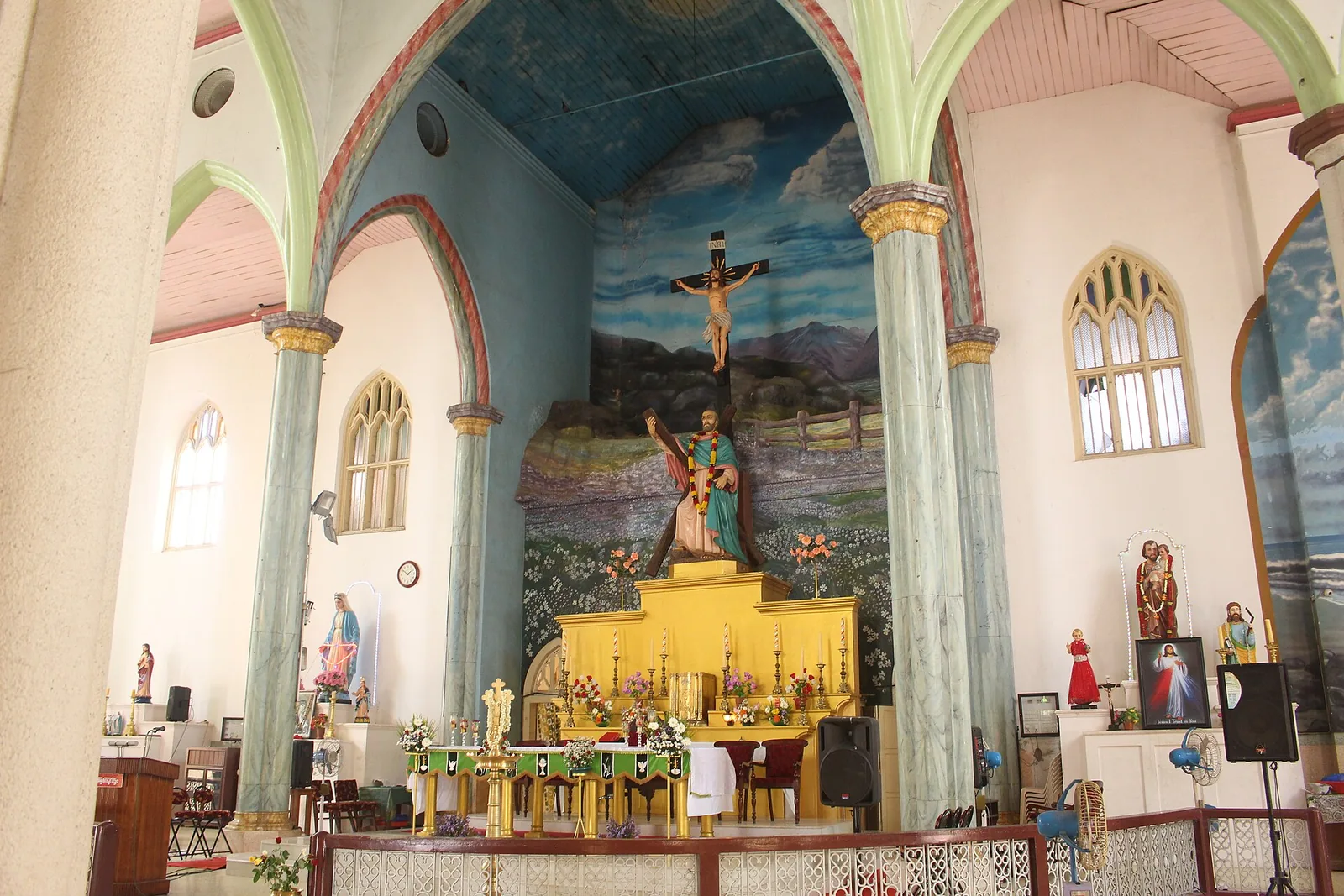
Outside the feast, Arthunkal is quiet and you can walk in. The interior is worth slowing down for and is not what the Veluthachan name suggests: cream columns, pale green pointed arches, ochre side walls, a dark boarded ceiling, and a large painted Crucifixion landscape filling the sanctuary arch, with a garlanded St Andrew embracing his saltire cross in front of it.
During the January feast the town is at capacity, the roads are congested and parking is a genuine problem. Come early, follow the crowd management, and keep in mind that a large share of the people around you are not sightseeing.
Frequently asked questions
What offerings are made at Arthunkal?
Models of human limbs in gold and silver, for the part of the body a healing concerned, and — particular to this shrine — models of arrows and bows, for the saint who was shot with them. Some pilgrims also fulfil vows by crawling on their knees from the seashore to the church.
Do Sabarimala pilgrims really end their vow here?
Many do. Returning Ayyappa devotees come to Veluthachan at Arthunkal to make offerings, and for a good number this is where the mala — the garland worn through the weeks of the vow — is removed, which is the act that ends the vow.
When is the Arthunkal Perunnal?
From 10 to 27 January, with the main feast day on 20 January and a procession lasting about four hours. The feast flag is brought from Pala, taken to the Alappuzha cathedral, and carried on to Arthunkal with the blessing of Thumboli Matha on the way.
What is the church like inside?
Not white, despite the Veluthachan name. Cream columns, pale green pointed arches, ochre side walls, a dark boarded ceiling and a terrazzo floor, with a painted Crucifixion landscape filling the sanctuary arch and a garlanded statue of St Andrew with his saltire cross in front of it.