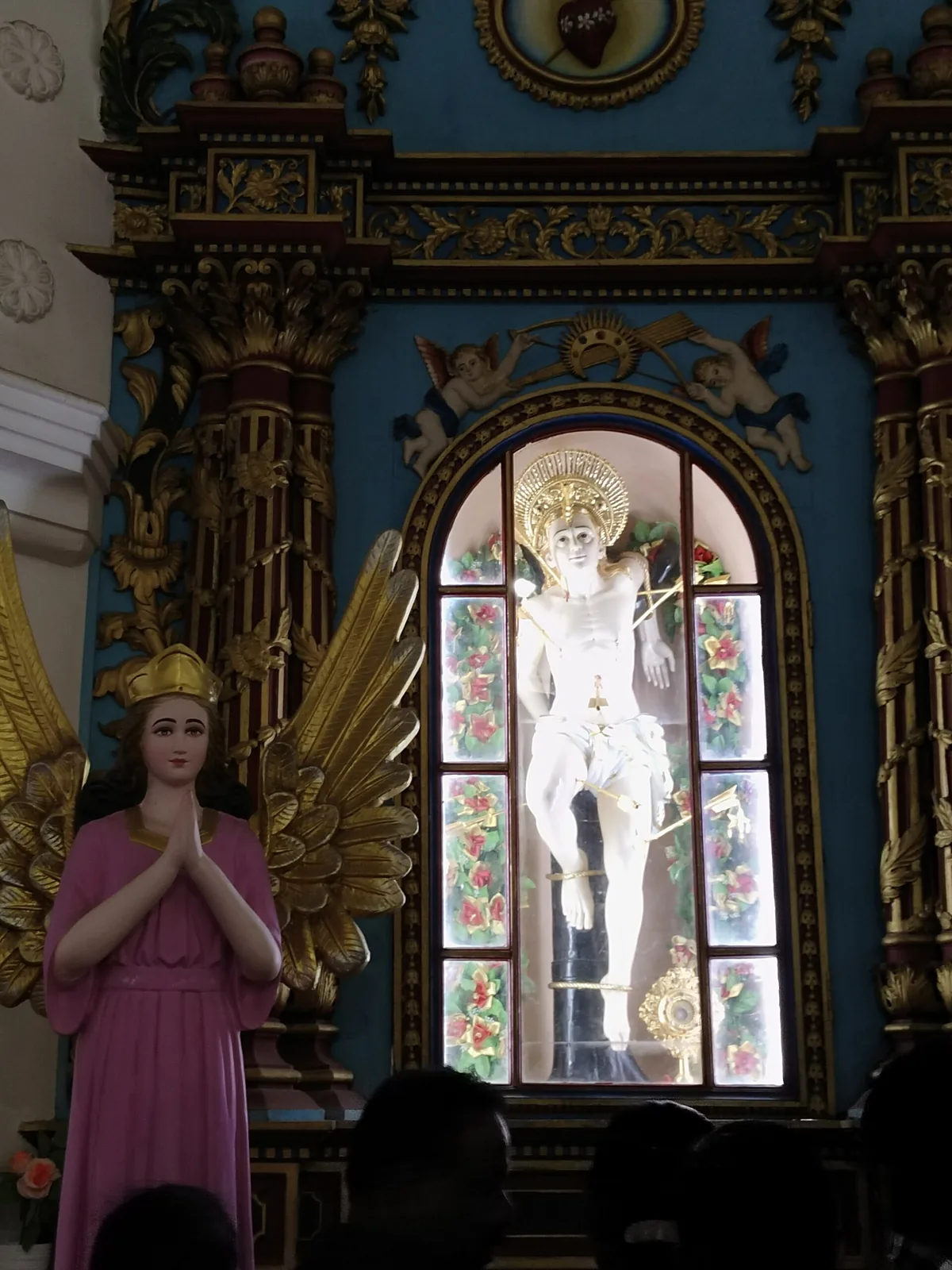
Nobody at Arthunkal says “St Andrew’s Basilica”. They say Veluthachan — the white father, or the fair father. The church is formally dedicated to St Andrew, the overwhelming devotion inside it is to St Sebastian, and the name everybody actually uses belongs to neither of them unambiguously.
The Malayalam sources are unusually good on this, because rather than choosing they set out both answers and let them stand.
Answer one: the saint
The first is documentary and old. Francis Day, writing in 1863, recorded that St Andrew — the church’s formal patron — was a close friend of Ayyappan and of Vavar.
That is a striking sentence to find in a nineteenth-century English source, because it means the friendship tradition that brings Sabarimala pilgrims to this church was already established and already being written down more than a hundred and sixty years ago. It is not a modern tourist-board invention about communal harmony. Somebody was recording it when the Travancore state was still a going concern.
Answer two: the priest
The second identifies Veluthachan with a specific man: Fr Jacome Fenicio, the Italian Jesuit who was vicar at Arthunkal from 1584 and who rebuilt the church in stone and lime. He was, the account says, a priest with an interest in the arts and in visions — and people called him the white priest, veluthachan, for the obvious reason.
And then the story goes further than a nickname. Fenicio is said to have gone to Cheerappanchira to learn kalarippayattu, the martial art of Kerala. Ayyappan’s own gurukulam, in the tradition, was also at Cheerappanchira. The two of them are said to have lived and studied there together, in brotherly affection.
⚠ Cheerappanchira is not a legendary location. It is at Muhamma, where the Malayalam sources name the kalari-famous tharavadu of Pachayil Chira — about 9 km east of Arthunkal, close to Pathiramanal. That is checkable, and it is also far enough away that no honest account should call it nearby.
Why the difference matters
These are not two versions of one story. They are doing different work.
The first makes the bond a matter between a saint and a god — theological, distant, and safely in the realm of devotion. The second makes it a matter between two young men sweating in a kalari pit, one of whom happened to be a Jesuit and one of whom happened to become Ayyappan. That is a much more human, much more local, and much more surprising claim, and it explains the peculiar warmth of the Sabarimala connection here in a way the first cannot.
The Malayalam article prints both as “their interpretation” and does not adjudicate. Neither will we.
The grave
There is one hard fact under all of this. Fenicio died in 1632, and he was buried, before a great crowd, inside the church itself.
So whichever answer you prefer, the priest at the centre of the second one is under the building. He is not commemorated at Arthunkal; he is in it.
The statue everyone means
And in practice, when pilgrims say Veluthachan, what they are standing in front of is the St Sebastian: a white figure bound to a dark post and pierced with gilt arrows, inside a glazed arched case set in a carved and gilded baroque reredos on deep teal, with cherubs holding a sunburst above the arch.
It is a striking coincidence, and worth stating carefully as a coincidence rather than an etymology: the saint everyone calls the white father is, in the object itself, painted white.
Frequently asked questions
Who is Arthunkal Veluthachan?
Two answers are recorded and neither is settled. Francis Day wrote in 1863 that St Andrew, the church’s patron, was a close friend of Ayyappan and Vavar. The other identification is Fr Jacome Fenicio, the Italian Jesuit vicar from 1584, called the white priest, who is said to have learned kalarippayattu at Cheerappanchira alongside Ayyappan. Malayalam sources print both without choosing.
Where is Cheerappanchira?
At Muhamma, about 9 km east of Arthunkal and close to Pathiramanal, where Malayalam sources name the kalari-famous tharavadu of Pachayil Chira. It is a real and checkable place — but it is not nearby.
Is Fr Fenicio buried at Arthunkal?
Yes. He died in 1632 and was buried inside the church itself before a great crowd.
Is the church dedicated to St Sebastian?
No — formally it is St Andrew’s, consecrated on St Andrew’s day, 30 November 1581. The devotion inside it is overwhelmingly to St Sebastian, whose Milan-sculpted statue is the focus of pilgrimage.