Stand at the ghat below the Devi temple at Aruvikkara with a paper cone of puffed rice and the water in front of you will boil. Large fish, a great many of them, entirely unafraid, pushing against the steps for food.
It is the thing everyone remembers about the place. It is also, when you try to write it down precisely, a surprisingly under-documented thing. Nobody appears to have published what these fish are.
What is well established
The custom is not in doubt. The fish in this stretch are held to be under the goddess’s protection; harming them is understood to bring misfortune; they are fed by devotees as an offering to the deity; and they are not taken. Feed is sold at the ghat and the practice is organised rather than improvised.
The behaviour follows directly from the rule. A fish population that has not been fished for generations, in water where people arrive daily carrying food, loses its flight response entirely. What a visitor reads as tameness or as the goddess’s influence is a straightforward consequence of a sanctuary that has been enforced by belief rather than by a warden.
The pool is younger than it looks
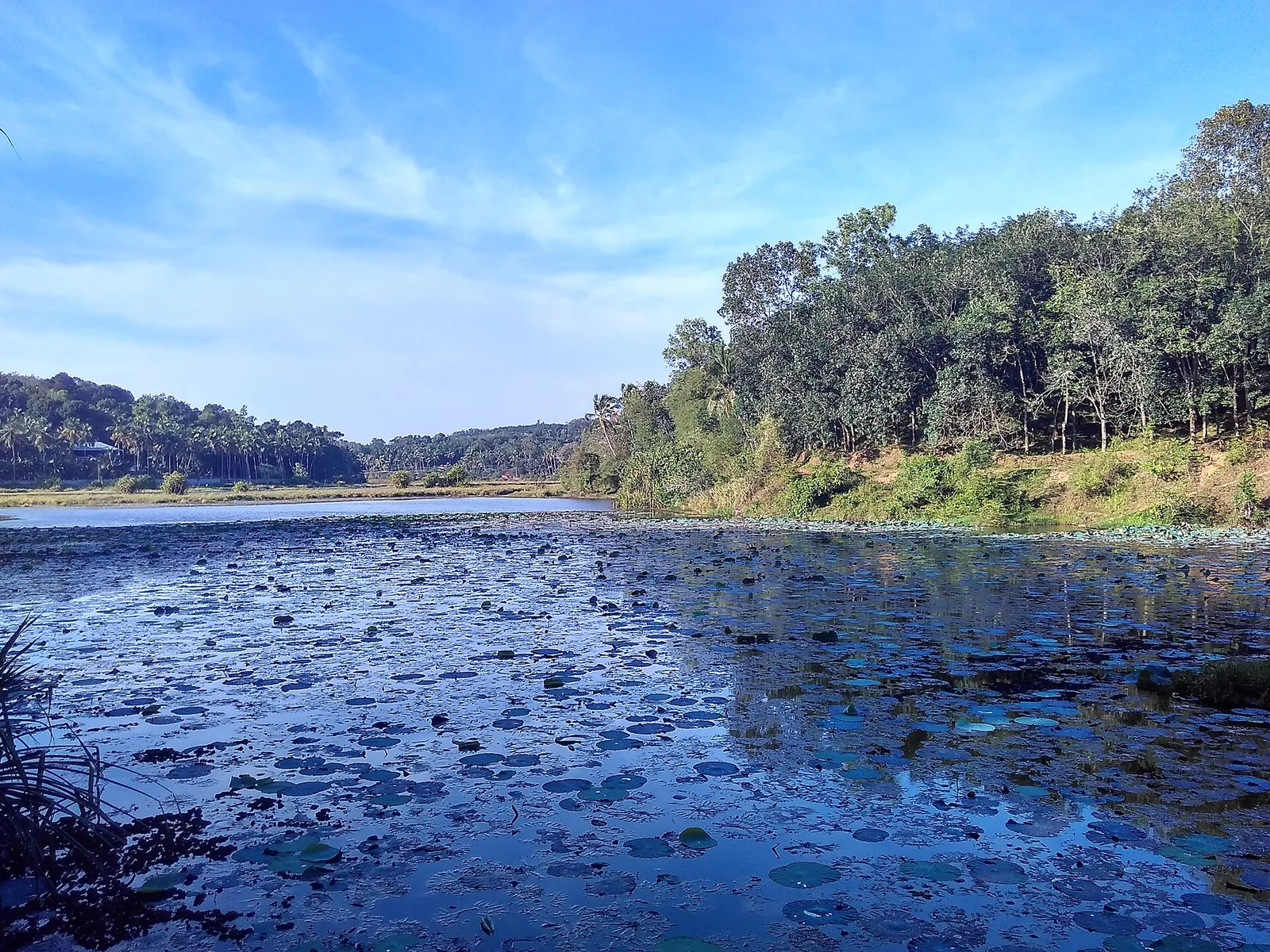
One physical detail is worth getting right, because it changes the picture. The still, deep water in front of the shrine is not an ancient temple tank. It is impounded water — the reservoir behind the dam.
The custom may well be far older than the wall; the Devi temple certainly is. But the calm sheet the shoal occupies today exists because a masonry gravity structure was completed across the Karamana in 1972. What reads as a timeless arrangement of shrine, pool and fish is partly a twentieth-century engineering outcome that a much older practice has settled comfortably into. That is not a debunking. It is a reminder that a river was running through here fast, and now it is not.
The comparison that shows the gap
India has other temple fish sanctuaries, and the best known are on the Cauvery in Karnataka, where stretches of river below temples have been protected by the same mechanism — belief, not law — for a very long time.
The difference is that those shoals have been identified. They are mahseer, the great river carp of the Indian subcontinent, and that identification is what turned a devotional custom into a conservation asset: once you know the temple reaches hold breeding populations of a threatened species, the sanctuaries stop being folklore and start being data. Anglers, researchers and forest departments have all built on it.
At Aruvikkara there is no equivalent in the accessible record. Every account calls the fish large and sacred; none names a species. For a population that has been protected for generations, sits in the intake reservoir of a state capital’s water supply, and is fed daily at a fixed point where it could be observed with no effort at all, that is a strange absence.
Why it would be worth knowing
Because the Western Ghats rivers are among the most endemic-rich freshwater systems in the world and among the most damaged. Barbs and carps in these catchments have been squeezed by dams that fragment migration, by sand mining that strips spawning substrate, and by pollution downstream of every town. Refuges matter disproportionately.
And an unfished pool with a reliable food supply and a community that will not tolerate anyone touching it is close to an ideal refuge — accidentally, and for entirely non-scientific reasons. Whether what it is holding is common or significant is a question that could be answered in an afternoon by someone qualified to look.
How to behave at the ghat
Buy the feed sold there — puffed rice and similar — rather than bringing your own, and do not bring bread. This is an offering at a working shrine and a protected shoal in a drinking-water reservoir, not a park pond, and the two reasons reinforce each other.
And treat the feeding as what the people around you are treating it as. There is a widely repeated belief here that it brings relief from illness, skin conditions most often. We report that because it is genuinely part of why the ghat is busy. It is not a medical claim: see a doctor about a skin condition, and feed the fish because it is a fine thing to do at a beautiful place.
Frequently asked questions
What kind of fish are the sacred fish at Aruvikkara?
No accessible published source identifies the species. Accounts describe large fish, sacred and never taken, without naming them. That is a real gap: at comparable temple fish sanctuaries on the Cauvery in Karnataka the protected shoals are documented as mahseer, and that identification is what gave those sites conservation weight alongside their religious standing.
Why are the fish so tame?
Because they have not been fished for generations and are fed daily at a fixed point. A population under no predation pressure from people, in water where people arrive carrying food, loses its flight response entirely. The sanctuary is enforced by belief rather than by a warden, and it works.
Is the pool at the temple a natural tank?
No. It is the reservoir behind the dam. The Devi temple and the custom of protecting the fish are much older, but the still water the shoal occupies today is impounded by a masonry gravity dam completed in 1972.
What should visitors feed the fish?
Buy the feed sold at the ghat — puffed rice and similar. Do not bring bread or scraps from elsewhere. This is an offering at an active shrine and a protected shoal in a drinking-water reservoir.
Does feeding the fish cure skin disease?
That is a belief held and widely repeated here, and it is genuinely part of why people come — the feeding is understood as an offering to the deity, with relief from illness, skin conditions in particular, often mentioned. It is not a medical claim and should not be treated as one.
Can the fish be caught?
No, and by long custom nobody attempts it. The fish are held to be under the goddess’s protection and harming them is understood to bring misfortune. In practice this has functioned as an unbroken fishing ban for generations.