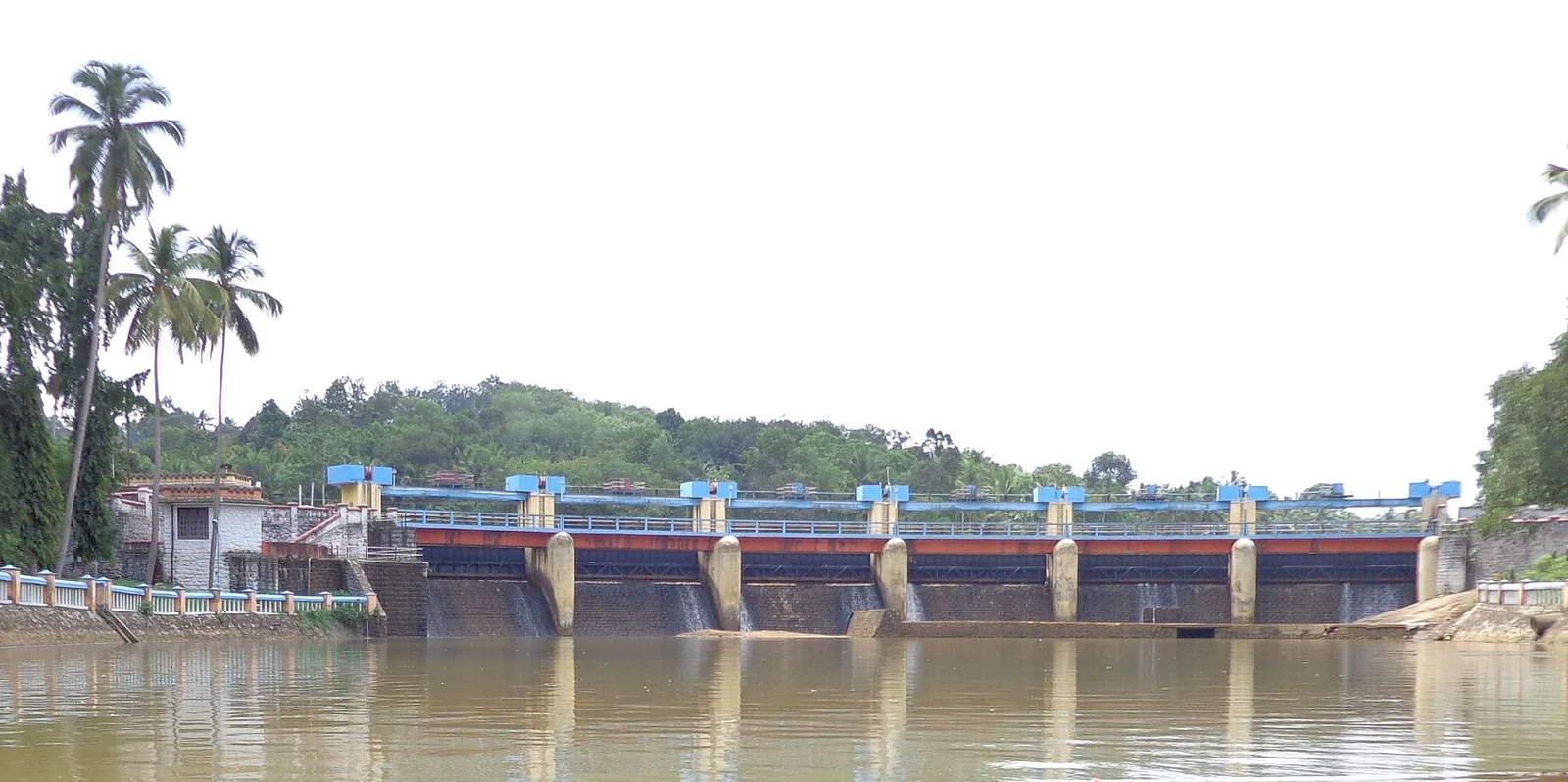
People come to Aruvikkara for the fish. Almost nobody comes for the dam, which is understandable — it is 14.01 metres high and 83.21 metres long, a low gated wall you could walk past without registering it as a structure.
It is also the point at which most of the drinking water for a state capital of nearly a million people is taken out of a river.
Named after a Viceroy
The organisation was founded in 1933 as the Trivandrum Water Works, named for Lord Willingdon, then Viceroy and Governor-General of India, and it has drawn on the Karamana ever since. That is the date most worth knowing about this site, and it is almost never the one quoted.
Three dates circulate as though they were interchangeable, and they describe three different things: the scheme, from the 1930s; the masonry gravity dam standing today, generally given as completed in 1972; and Peppara, the reservoir upstream inside the wildlife sanctuary, finished in 1983 to augment the same supply. Nearly fifty years separate the first from the last. Quoting any one as "the date of Aruvikkara dam" misdescribes the other two.
What a masonry gravity dam is
It is the least clever kind of dam, in the good sense. An arch dam is a structural argument: it transfers the water load sideways into the valley walls, and it needs a narrow site and sound rock to do it. A gravity dam makes no argument at all. It is heavy enough that the water cannot push it over.
That means a lot of stone for the height achieved, and it means the thing is close to indestructible by neglect — which for a wall that has been holding a capital’s water supply since before Independence is exactly the right property. The blue-painted gates on top do the work of regulating flow; the mass below simply sits there.
What comes out of it
Water leaves Aruvikkara down four pipelines. In 2010 a treatment plant of about 74 MLD — million litres a day — was built here under a Japanese-assisted (JICA) scheme, feeding the service reservoirs at Nettayam, Malamukal, Thirumala, Attukal and Nelliyodu, using pulsating clarifiers and rapid gravity sand filters. A further plant of roughly 75 MLD has been taken forward since as part of the modernisation of the site.
And it is still not enough. The city’s demand has been estimated at around 217 MLD against roughly 203 MLD actually supplied — a shortfall that is small as a percentage and total for whoever is at the end of the line when a summer runs long. That gap is the reason Aruvikkara keeps appearing in state capital-works budgets for a site most residents think of as a picnic spot.
Why the river above it is protected
Peppara, 1983, sits upstream inside the Peppara Wildlife Sanctuary — a dam about 423 metres long with a 3 MW hydroelectric station attached. The sanctuary and the reservoir are not a coincidence: protecting the forest catchment above an intake is the cheapest water treatment available, because every hectare of forest that stays forest is silt and nutrient that never reaches the wall.
That is also why Aruvikkara is clean and the Karamana below the city is not. This river is fenced, gated and managed at the top, and receives a city’s drainage at the bottom. Twenty kilometres downstream, past Thiruvananthapuram, studies have recorded heavy bacterial contamination and effluent arriving through the Parvathy Puthanar canal before the river reaches the estuary at Thiruvallam — where, at the Karkidaka Vavu new moon, thousands perform ancestral rites in it.
Standing on the bridge
Look upstream at the reservoir and you are looking at the pool the sacred fish live in. Look downstream and you are looking at what the gates let through. Between the two is a wall built by a colonial-era water works, upgraded with Japanese money, still doing the single most important job any structure in this district does.
It is not a spectacular dam. It does not need to be.
Frequently asked questions
When was Aruvikkara Dam built?
Three dates get quoted for three different things. The Aruvikkara water-supply scheme belongs to the 1930s — the Trivandrum Water Works was founded in 1933; the masonry gravity dam standing today is generally given as completed in 1972; and Peppara, upstream, was finished in 1983 to augment the same supply.
How big is the dam?
About 14.01 metres high and 83.21 metres long — a masonry gravity structure, meaning it resists the water by sheer weight of stone rather than by transferring the load into the valley walls.
Why is it called the Trivandrum Water Works?
The organisation was founded in 1933 and named for Lord Willingdon, then Viceroy and Governor-General of India. It has been responsible for supplying and distributing water from the Karamana river ever since.
How much water does Aruvikkara supply?
Water leaves down four pipelines. A treatment plant of about 74 MLD was added in 2010 under a Japanese-assisted (JICA) scheme, serving the Nettayam, Malamukal, Thirumala, Attukal and Nelliyodu reservoirs, and a further plant of roughly 75 MLD has followed. City demand has been estimated at about 217 MLD against roughly 203 MLD supplied.
What is the connection between Aruvikkara and Peppara?
The Karamana river and one supply system. Peppara, about 423 m long with a 3 MW hydroelectric station, was completed in 1983 inside the Peppara Wildlife Sanctuary to augment the Aruvikkara scheme. Protecting the forest catchment above the intake is also the cheapest form of water treatment available.
Can you swim at Aruvikkara?
No. It is a drinking-water intake and an active temple bathing site, and neither use makes it available for casual swimming.