In 1891 a forest officer planted teak in the hills behind Palaruvi in a way nobody had tried at scale before. He did not sow seed and he did not transplant seedlings. He planted stumps.
The plot is still there, it is still called Bourdillon’s Plot, and the technique became standard practice for teak across the tropics.
What a stump is, and why it mattered
Teak plantations had a practical problem that made them expensive and unreliable. Direct sowing gives poor survival. Seedlings transplant badly — dig one up, carry it, and a large proportion die.
A stump is the answer: a young plant cut back to a short length of root and shoot, with the leaves and most of the stem removed. It is small, it is tough, it stores, it travels, and it takes when it is put in the ground.
That is the whole innovation, and it is the kind that sounds obvious afterwards. It turned teak planting from a delicate operation into a logistical one.
Who Bourdillon was
T. F. Bourdillon was appointed Conservator of Forests of Travancore in 1891 and held the post until his retirement in June 1908. In 1892 he wrote the Report of the Forests of Travancore, the document that begins large-scale teak planting in the kingdom.
The 1891 planting at what is now called Bourdillon’s Plot, in the forest at Aryankavu, is described as the world’s first stump-planted teak plantation. During his conservatorship 6,793 hectares of teak plantation were laid out.
His name is all over this landscape in another register too. Two of the signature endemic trees of neighbouring Shendurney — Cynometra bourdilonii and Palaquium bourdillonii — carry it, and so does the great eared nightjar subspecies recorded in these hills. The botany of this corner of the Ghats was substantially documented by one man’s survey work, on foot, a century before anyone declared a sanctuary.
The part that should not be dodged
The same conservatorship that produced a genuine world first is the one that began converting Western Ghats evergreen forest into monoculture plantation at scale. Both things are true and they are the same programme.
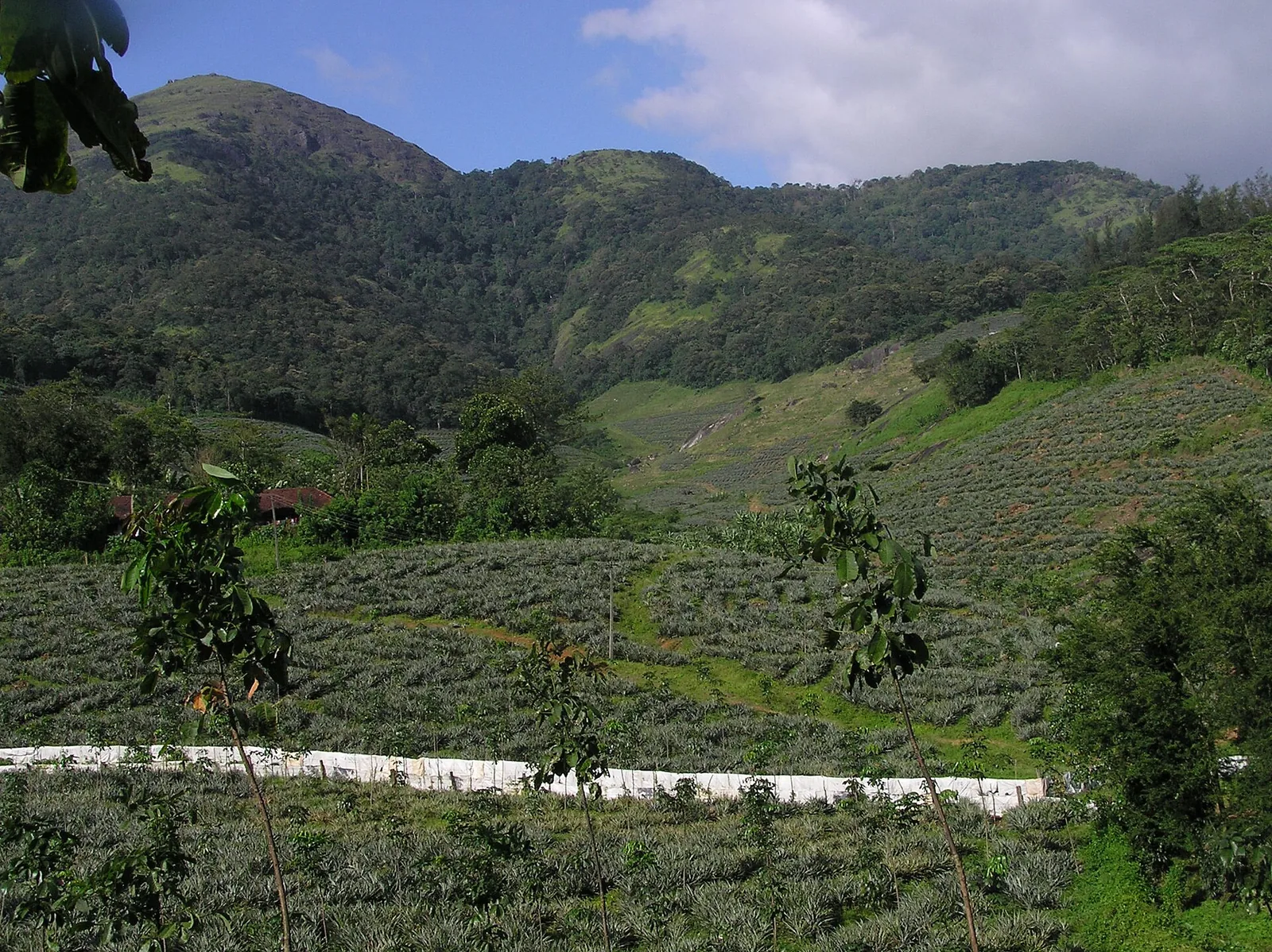
You can see the legacy from the road. The photograph at the top of this page was taken at Ariyankavu in 2007 by an ecologist, and it shows a pineapple field running up to the foot of standing rainforest. There is a companion frame of rubber plantations from the same day. They are filed on Wikimedia Commons under a category called Linear infrastructure intrusions — documentary photographs, not scenery.
Aryankavu today is a mosaic of exactly that inheritance: reserve forest, teak, rubber, pineapple, cardamom and clove, with evergreen forest above and behind it. The plot in the trees is both an origin point of modern tropical forestry and an origin point of what modern tropical forestry costs.
What else is up there
A few local claims worth passing on with their attribution attached, because they all trace to a single Wikipedia paragraph and we could not independently confirm them: the Kadamanpara sandal forest near Aryankavu is described as the second-largest natural sandalwood forest in Kerala after Marayur, and the Ambanad Hills are said to hold Kollam district’s only tea estate along with one of Kerala’s largest clove plantations.
Treat those as reported. What is not in doubt is the general character: this is a working forest landscape of plantations and reserve, not a wilderness, and it has been for a hundred and thirty years.
Do not go looking for it
This is the honest ending, and it is a small disappointment.
We could find no Forest Department page confirming that Bourdillon’s Plot is open to visitors, signposted, or reachable without permission. It stands in reserve forest. We are not going to send readers up a forest track after a plantation plot on the strength of a good story.
If you want to see it, ask at the Thenmala forest office — the same office that controls access to Shendurney — and take their answer as the answer. What you can do without asking anyone is drive the road and look at the hillsides, which is where the argument this story is about is still visibly running.
Frequently asked questions
What is Bourdillon’s Plot?
A teak plantation raised in 1891 in the forest at Aryankavu, near Palaruvi, by T. F. Bourdillon, Conservator of Forests of Travancore from 1891 to 1908. It is described as the world’s first teak plantation grown from stumps rather than seedlings or direct sowing.
Why does stump planting matter?
Because it solved the problem that made teak plantations expensive and unreliable. Seedlings transplant badly and direct sowing has poor survival; a stump — a plant cut back to a short length of root and shoot — stores, travels and takes. The technique became standard for teak across the tropics.
Can I visit the plot?
We would not plan on it. It stands in reserve forest and we could find no Forest Department confirmation that it is open, signposted or reachable without permission. Ask at the Thenmala forest office before setting out to look for it.
What else grows around Aryankavu?
Teak, rubber, pineapple, cardamom and clove alongside reserve forest. Local sources describe the Kadamanpara sandal forest as Kerala’s second-largest natural sandalwood forest after Marayur, and the Ambanad Hills as holding Kollam district’s only tea estate — both claims trace to one source and we pass them on attributed rather than asserted.
Is Bourdillon connected to anything else here?
Yes — two of neighbouring Shendurney’s signature endemic trees, Cynometra bourdilonii and Palaquium bourdillonii, and the local great eared nightjar subspecies all carry his name. His survey work documented much of this landscape’s botany a century before it was protected.