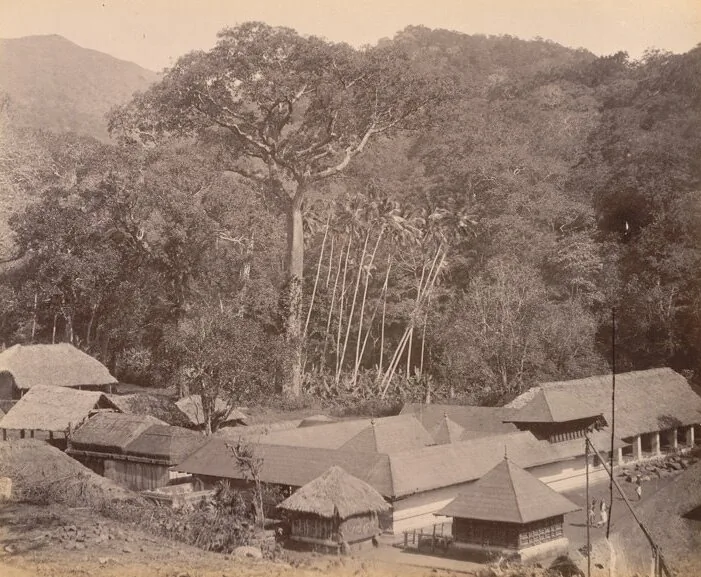
The temple at Aryankavu is usually introduced by its theology: this is the Ayyappa who has a wife, unlike the celibate god of Sabarimala. That is true and it is only half the interest.
The other half is who turns up to the wedding.
The bride is not local
The deity here is Sastha as a youth seated on an elephant, right leg hanging and left leg folded, with his consort Pushkala and with Shiva. Locally he is Aryankavu Ayyan, or Tiruaryan. This is the young married aspect, not the eternal celibate.
Temple tradition holds that Sastha married Pushkaladevi, a princess of the Saurashtra community — and at the annual Thiru Kalyanam the marriage rituals are performed according to Saurashtra custom, in a mandapa set aside for it, rather than by Kerala Nambudiri rite.
That single sentence is doing an enormous amount of work, and it is worth unpacking.
Who the Saurashtrians are
They are a community of silk weavers whose migration tradition takes them from Saurashtra — Gujarat — through the Deccan to Madurai, where they settled in numbers and became the city’s weaving caste. They speak Saurashtra, an Indo-Aryan language, in a Dravidian-speaking city.
So the wedding party at this Kerala forest temple is Gujarat in origin, Tamil in domicile and Indo-Aryan in speech. Three cultural layers, one rite, in a village of ten thousand people at the top of a ghat road.
And the organisation matches. The festival is described as conducted by the Brahmana Sangam of Madurai together with the Travancore Devaswom Board — a Tamil Nadu religious body and a Kerala statutory board running one event between them.
When it happens
In the Malayalam month of Dhanu, mid-December to mid-January, over about ten or eleven days, with the wedding itself on the tenth of Dhanu — which usually falls around 25 or 26 December.
That timing is not accidental. It sits deliberately inside the Sabarimala Mandala–Makaravilakku season, when this entire route is already a pilgrim road. The dates shift year to year with the Malayalam calendar, so confirm before travelling; the rule to remember is the tenth of Dhanu, not a Gregorian date.
Two other observances fall in the temple’s calendar: Pandiyan Mudippu, described as an engagement ceremony — the Pandya name is itself a Tamil-dynasty thread — and the Kumbhabhishekham consecration.
The threshold
The most visible thing about all this is something you can stand in front of.
During the festival, Kerala rituals are followed inside the temple and Tamil rituals outside it. The daily puja practice follows Tamil rather than Kerala custom. Cross the threshold and the ritual grammar changes.
The pilgrim majority here is Tamil, most of them from the Saurashtra community. This is not a Kerala crowd at a Kerala temple; it is a Tamil crowd at a temple that is administratively Kerala’s, doing a wedding by the customs of a community from Gujarat.
It sits about eleven metres below road level, so you come to it downwards, and it has eighteen steps as at Sabarimala. Dravidian elements sit alongside Kerala ones in the architecture. Nothing here belongs cleanly to one side.
The line we are not going to print
There is a detail repeated across a great many websites about this festival, and it is the best line in the story if it is true: that the deities are brought together for the wedding but the wedding is never completed — enacted and stopped, year after year.
The claim does not appear in Devaswom or other primary material and circulates in near-identical wording across secondary sites. Treat it as a local story rather than an established ritual rule, and ask at the temple if it matters to your visit.
What is well attested is enough: an annual divine wedding, in a forest village, run jointly by a Madurai sangam and a Kerala board, by the customs of a weaving community whose ancestors came from the other side of India.
Frequently asked questions
What is the Thiru Kalyanam at Aryankavu?
The temple’s principal festival — the annual re-enactment of the marriage of Sastha and Pushkaladevi, held in the Malayalam month of Dhanu over about ten or eleven days, with the wedding itself on the tenth of Dhanu, usually around 25–26 December.
Who conducts it?
It follows the customs of the Saurashtra community, in a mandapa set aside for it, rather than Kerala Nambudiri rite — and it is reported to be run jointly by the Brahmana Sangam of Madurai and the Travancore Devaswom Board.
Who are the Saurashtrians?
A community of silk weavers whose migration tradition traces from Gujarat through the Deccan to Madurai, where they became the city’s weaving caste. They speak Saurashtra, an Indo-Aryan language, in a Tamil-speaking city. Temple tradition holds that Pushkaladevi, the bride, was a princess of theirs.
Is the ritual Kerala or Tamil?
Both, divided by the threshold. During the festival Kerala rites are followed inside and Tamil rites outside, and the daily puja practice follows Tamil custom. Most pilgrims here come from Tamil Nadu.
Is it true the wedding is never completed?
The story is widely repeated online but does not appear in the available Devaswom or primary material. Treat it as local tradition and ask at the temple for its current interpretation.