The Marine Stewardship Council database entry for the Ashtamudi fishery names the animal it certified. It reads: short neck clam, Paphia malabarica. Both units of certification — the one for clams taken by traps and the one for clams taken by hand dredges — carry that binomial. It is still printed there today.
It is the wrong animal. Not a spelling variant, not a synonym: a different species, from a different genus, that does not live in this lake.
The paper
In November 2018, four years after the certificate was handed over at Kochi, the journal ZooKeys published a study by Arathi A. R., P. Graham Oliver, R. Ravinesh and A. Biju Kumar with a title that gives the game away: “The Ashtamudi Lake short-neck clam: re-assigned to the genus Marcia H. Adams & A. Adams, 1857 (Bivalvia, Veneridae).”
Their abstract states the position plainly. The fishery carries an MSC certification for sustainability, and it — along with all previously published reports — identifies the short-neck or yellow-foot clam as Paphia malabarica. That name, they note, does not conform with current nomenclature and is now correctly referred to Protapes gallus. And then the second finding: the identification is also incorrect. Comparative shell morphology of venerid clams from the south Indian coast shows that the short-neck clam in Ashtamudi Lake is Marcia recens.
Two errors, stacked
This is worth slowing down over, because it is not one mistake but two sitting on top of each other.
The first is a nomenclatural error. Paphia malabarica had already ceased to be the valid name for the species it was attached to; under current rules that animal is Protapes gallus. Anyone using the old name was, at best, out of date.
The second is a straightforward misidentification, and it is the serious one. The authors report that Protapes gallus — and its relative P. ziczac — are not found in Ashtamudi Lake at all. They live in the shallow coastal waters of south India, outside the estuary. So correcting the name properly would not have fixed anything: it would have moved the certificate from a defunct name to a species that has never been in the lake.
Small numbers of a second Marcia, M. opima, were found in the lake, but the authors say it does not appear to be part of, or contribute significantly to, the fishery. What is actually being raked off the bed is Marcia recens.
Not everyone agreed about the fix
It would be neat to say the matter was settled, and it was not. A separate molecular study linked to CMFRI argued from a genetic distance of 28.9 per cent that Paphia malabarica and Protapes gallus were too far apart to be treated as synonyms, and that the older name should therefore be retained.
That is a real scientific disagreement about nomenclature, and this page is not going to adjudicate it. What is worth noticing is that the disagreement is about which correction to make. Nobody in it argued that the clam on the certificate was the clam in the bucket.
Does it matter?
Practically, for the fisher standing chest-deep in the water with a hand rake, no. The beds are the same beds, the closed season is the same closed season, and the minimum export size does not care what Latin is on the paperwork.
But an ecolabel is a promise about a specific stock of a specific animal, assessed against specific biological reference points. If the species on the certificate is not the species being fished, then every published report underlying that assessment inherited the same error — which is precisely what the authors say, in the phrase “all hitherto published reports.” The paperwork was about one clam and the fishery was about another, for as long as anyone had been writing it down.
We could find no MSC statement responding to the paper, and it would be wrong to imply the Council either accepted or rejected it. By the time this became a live question, the certificate was already on its way out — suspended in February 2020 over an unpaid invoice and an unfunded audit, and now listed as withdrawn. The species problem and the paperwork problem never quite met.
The picture
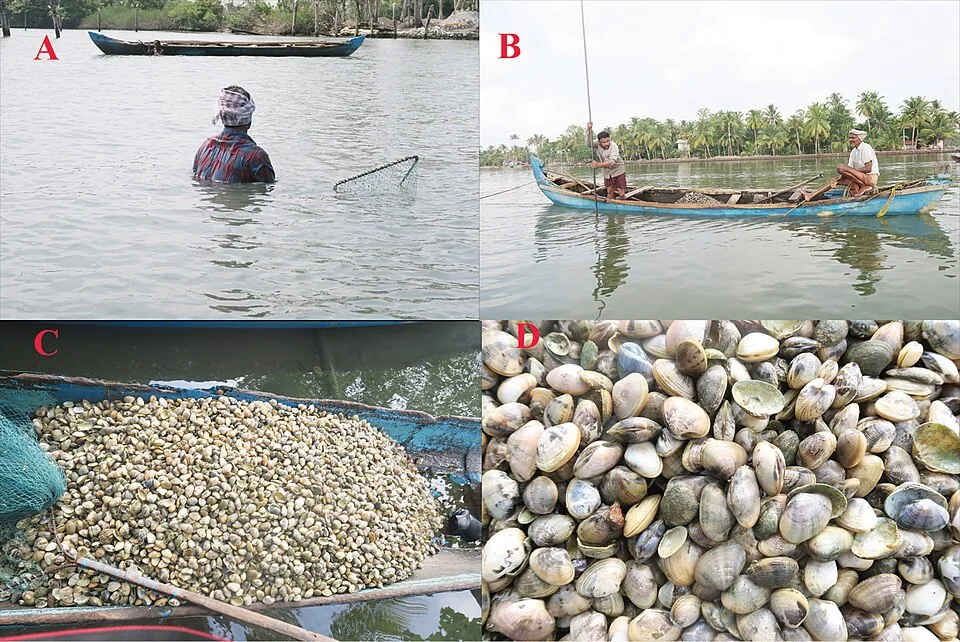
The best image of this fishery anywhere is Figure 2 of that same paper, published under a free licence: a man standing chest-deep in the lake in a checked shirt and headcloth with his rake beside him; two men in a blue canoe heaped with clams, one poling, palms on the far bank; the catch filling the boat; and the shells in close-up, pale and yellow-footed. The people who established that the certificate named the wrong animal are also the people who took the best photograph of the right one.
Frequently asked questions
What species is the Ashtamudi clam?
Marcia recens, according to a 2018 study in ZooKeys based on comparative shell morphology. It had been identified everywhere, including on the MSC certificate, as Paphia malabarica.
Was Paphia malabarica simply an old name for the same clam?
No, and that is the point. Paphia malabarica was already invalid and properly referred to Protapes gallus — a species the authors say is not found in Ashtamudi Lake at all, but in the shallow coastal waters offshore.
Is the correction accepted?
The re-identification is not seriously disputed; the nomenclature is. A CMFRI-linked molecular study argued from a 28.9 per cent genetic distance that the older name should be retained. Nobody argued that the clam on the certificate was the clam being fished.
Did the MSC respond?
We found no statement from the Marine Stewardship Council on the paper, and we are not going to imply one either way. The certificate was suspended in February 2020 and is now listed as withdrawn, for unrelated reasons.