Read the opening paragraph of almost any description of this lake, ours included, and you will meet a list of eight names: Thevally, Kureepuzha, Kandachira, Thekkumbhagam, Perumon, Kanjirottu, Kallada, Kumbalathu. They are offered as scenery, a pleasing roll-call of the villages the water touches.
The fifth of them is where a hundred and five people died.
8 July 1988
At about twenty past twelve in the afternoon, the Bangalore–Kanniyakumari Island Express derailed on the Peruman bridge across Ashtamudi, near Munrothuruthu, and went into the water. One hundred and five people were killed and two hundred and one injured.
The detail that anyone who lives here will tell you first is who arrived. Local fishermen reached the submerged carriages in country boats before any emergency service did. Some bodies were recovered five days later.
The number of coaches that entered the lake is genuinely uncertain — one account says ten of thirteen, another nine of fifteen — and we are not going to average two figures that cannot both be right. Most of the train went in. The death toll of 105 is consistent across sources.
The tornado
The inquiry by the Commissioner of Railway Safety attributed the derailment to a tornado striking the train on the bridge.
That finding was widely disbelieved at the time and has never been accepted locally. Explanations advanced since include the alignment of the track, defective wheels, and a delayed train making up time at speed across a bridge of a hundred and twenty-five metres. Kerala newspapers still run the anniversary under the word “mystery.”
It is not our business to call an official finding a lie, and we will not. It is worth being precise about the position instead: a tornado is what the inquiry concluded, no independent corroboration of a tornado over Ashtamudi that afternoon has been produced in thirty-eight years, and the people who live along this water have never believed it. All three of those statements are true at once, and the discomfort between them is the story.
Why it belongs to the lake and not to a list of accidents
Because Perumon is not near Ashtamudi. Perumon is Ashtamudi — one of the eight arms in the lake’s own opening sentence, on this page and every other.
Trains still cross that bridge. If you take the Munroe Island canoe cruise, which is the single most recommended thing to do on this lake and appears in every itinerary including ours, your boatman poles you underneath the line. Visitors glide through the accident site without knowing they are in it, photographing the reflections.
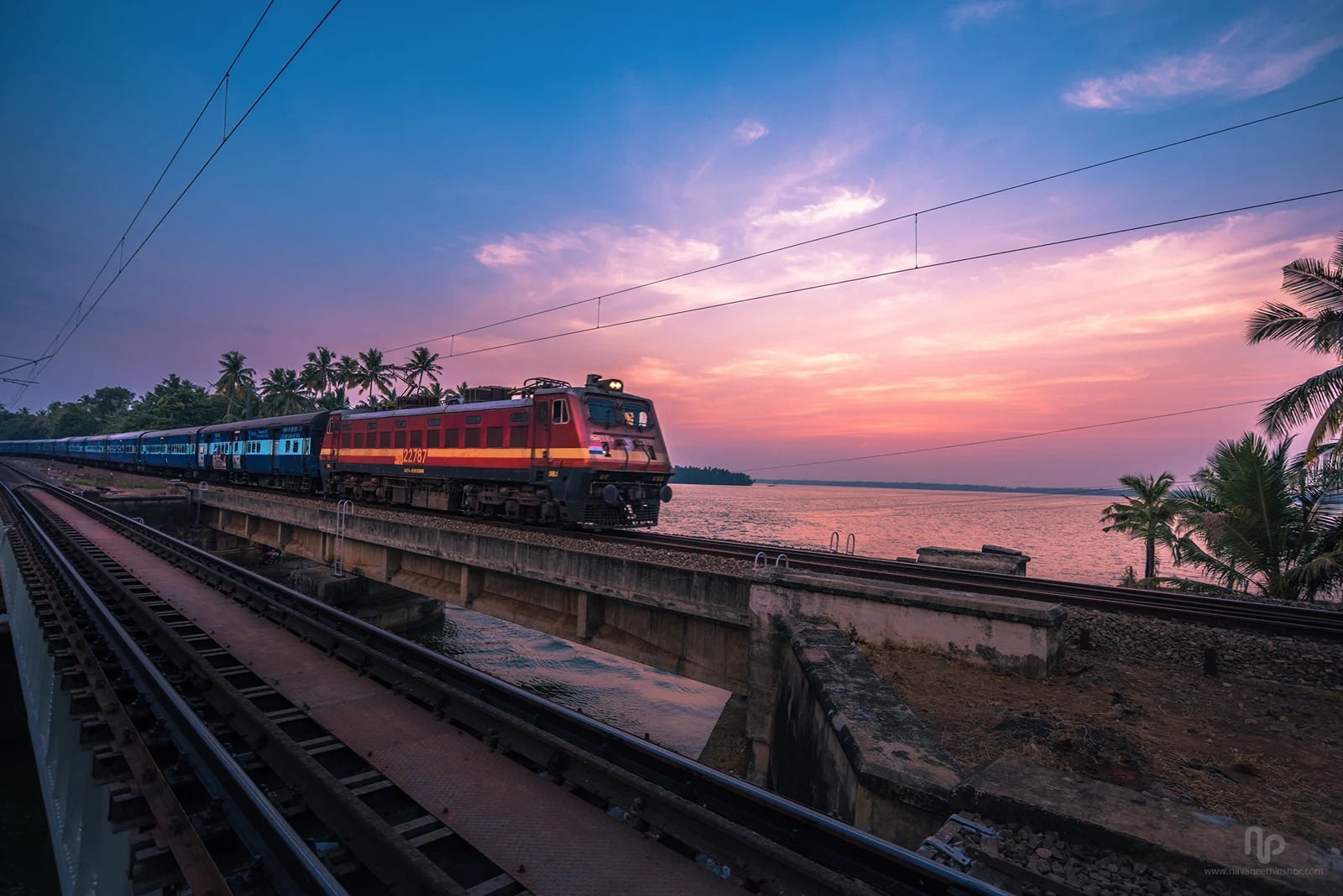
There is a handsome photograph on Wikimedia Commons of an electric locomotive hauling a train over the Peruman bridge at sunset. It is filed, quite correctly, under Ashtamudi Lake. Nothing about it says what happened there.
How to hold it
Not as a ghoulish detour — there is no memorial to visit, no viewing point, nothing to see. Simply as the thing you now know about a name you were going to read past. The eight arms are usually offered as poetry. One of them is a place where fishermen dived for strangers’ children in the middle of a July afternoon, and where the official explanation is a wind that no one has ever been able to confirm.
Frequently asked questions
What was the Peruman rail disaster?
On 8 July 1988 at about 12:20 pm, the Bangalore–Kanniyakumari Island Express derailed on the Peruman bridge over Ashtamudi Lake near Munrothuruthu and went into the water. 105 people died and 201 were injured.
What caused it?
The Commissioner of Railway Safety’s inquiry attributed it to a tornado striking the train on the bridge. The finding was widely disbelieved and has never been accepted locally; track alignment, defective wheels and excessive speed have all been advanced since. It remains contested.
Can you see the site?
There is nothing to see and no memorial. The railway still crosses the bridge, and the Munroe Island canoe cruise passes beneath the line — which is how most visitors encounter the place without knowing it.
How many coaches went into the lake?
Sources conflict — ten of thirteen in one account, nine of fifteen in another. Most of the train entered the water. The death toll of 105 is consistent.