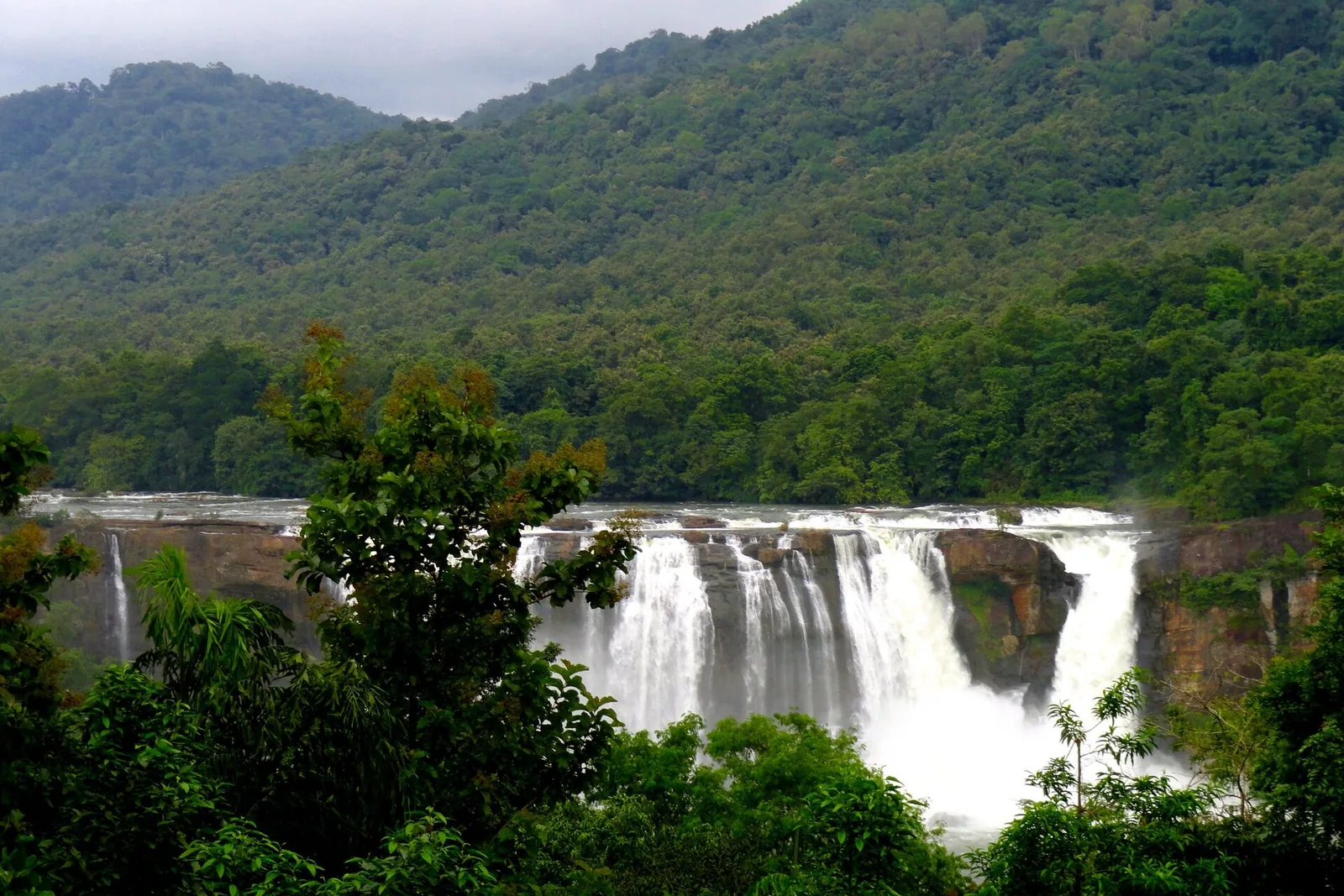
Two things get said about Athirappilly Falls before anybody has seen it. The first is that it is the Niagara of India. The second, more recent and much more damaging to first impressions, is that it is the waterfall from Baahubali. Neither survives contact with the place, and the disappointment they set up is entirely avoidable.
The film waterfall
Sequences for the Baahubali films were shot in this landscape, and that is true and worth knowing. What is not true is that the towering cliff the hero climbs — the impossible, several-hundred-metre wall of water that the story is built around — is a photograph of Athirappilly. That waterfall is a construction: computer-generated, assembled and scaled far beyond anything on the Chalakudy river.
So visitors who come looking for it experience a specific, silly kind of let-down. They stand in front of one of the finest waterfalls in southern India and feel short-changed by a piece of visual effects. It is worth defusing that before you arrive.
Athirappilly’s genuine film history is long and does not need the exaggeration. Punjabi House, Guru, Raavan and Raavanan and a shelf of Malayalam and Tamil productions have used this river. If the place feels familiar before you have ever stood in it, that is why — and it is also why the upper viewpoint is crowded on a holiday weekend.
The Niagara line
The other borrowed comparison is older and lazier. Athirappilly drops around 24 metres — about 80 feet — in a single broad curtain, and spreads to something like 100 metres wide when the monsoon is behind it. Niagara is vastly wider and carries an incomparably greater volume of water. The comparison is a tour-brochure reflex, and every time it is repeated it invites a visitor to measure Kerala’s biggest waterfall against something it was never going to match.
- Athirappilly is the largest waterfall in Kerala — roughly 24 m high, and up to about 100 m wide in full flow.
- It sits at around 180 m above sea level on the Chalakudy river, which runs about 145 km from the Ghats to the sea.
- The Baahubali waterfall is a visual effect. Sequences were shot in this landscape; the giant cliff was not.
- Athirappilly and Vazhachal, 5 km upstream, are normally sold on one ticket for the same day.
- People drown here. The rock above the lip is smooth and the level can rise when rain falls upstream out of sight.
The thing that is genuinely rare, and it is not the drop
Here is the swap worth making. Stop thinking about height and start looking at the forest. Athirappilly sits at about 180 metres above sea level, and low-elevation riverine rainforest at that height has been almost entirely cleared across the Western Ghats for plantation and settlement. What runs along this stretch of the Chalakudy is a remnant of it — the last substantial piece in Kerala.
Which is why this belt is one of the very few places where all four of peninsular India’s hornbill species still occur together: the Great Hornbill, the Malabar Pied, the Malabar Grey and the Indian Grey. The Great Hornbill needs big old trees with cavities large enough for a female to seal herself inside for a nesting season, and big old trees at low elevation are exactly what the rest of the Ghats has lost.
That is a genuinely rare thing, and unlike the height it is not a matter of opinion. There are bigger waterfalls in India. There is almost nowhere else in Kerala with this forest.
What to do with the visit
Do the upper viewpoint, then take the stepped path down to the base — ten to fifteen minutes each way, steep, slippery after rain, and the part most visitors skip. Then drive the five kilometres up to Vazhachal, which is flatter, quieter and the better place to actually look at the river and listen for hornbills. Treat the whole thing as one visit, because the ticket already does.
Frequently asked questions
Is the Baahubali waterfall Athirappilly?
No. Sequences for the films were shot in this landscape, but the enormous cliff-face waterfall central to the story is a computer-generated construction, scaled far beyond anything on the Chalakudy river. Arriving expecting it guarantees disappointment at a genuinely excellent waterfall.
How high is Athirappilly Falls?
Around 24 metres — about 80 feet — dropping in a single broad curtain that spreads to roughly 100 metres wide in full monsoon flow. That makes it the largest waterfall in Kerala.
Is Athirappilly really the Niagara of India?
It is a tour-brochure line rather than a useful description. Niagara is vastly wider and carries far more water. The comparison sets visitors up to measure Athirappilly against something it never resembled, when what makes it rare is the forest it sits in, not the drop.
Which films were shot at Athirappilly?
Punjabi House, Guru, Raavan and Raavanan and a long list of Malayalam and Tamil productions have used this river and these falls, along with sequences for the Baahubali films. It is a large part of why the place feels familiar and why the upper viewpoint gets busy.
What is actually rare about Athirappilly?
The forest. At around 180 metres above sea level, this is the last substantial stretch of low-elevation riverine rainforest in Kerala — a habitat almost entirely cleared elsewhere in the Western Ghats — and one of the very few places where all four peninsular Indian hornbill species occur together.
Should I visit Vazhachal on the same trip?
Yes, and the ticket normally assumes you will — one ticket typically covers both on the same day. Vazhachal is five kilometres upstream, flatter and much quieter, and it is the better of the two for actually watching the river and looking for hornbills.