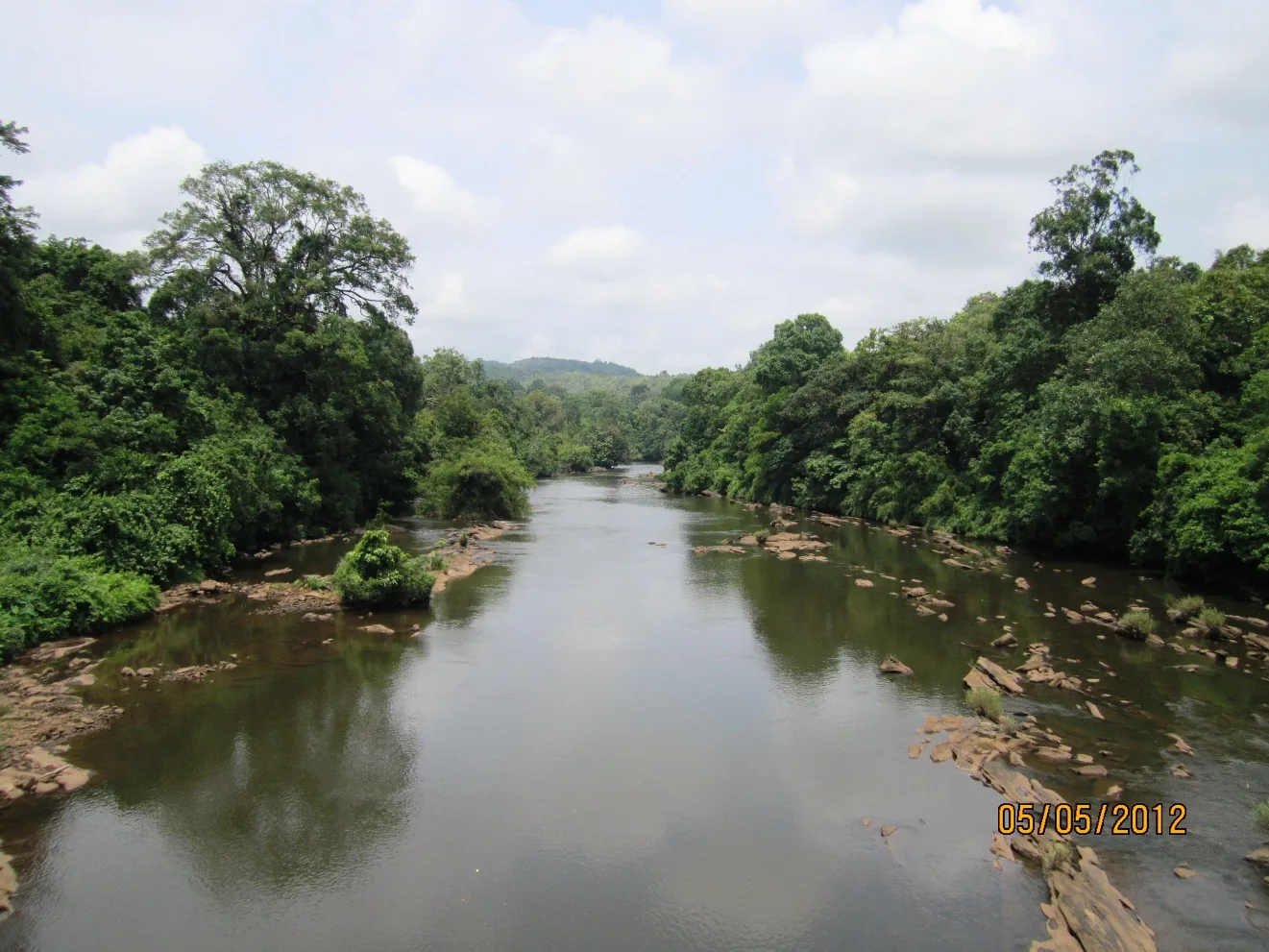
Almost everyone who visits Athirappilly hears some version of the sentence “they wanted to build a dam here and it was stopped”. It is true, it is usually where the story ends, and the interesting part is entirely inside the bit that gets skipped: who stopped it, and with what.
Thirty years, two formal rejections
The Kerala State Electricity Board’s 163-megawatt hydroelectric scheme on the Chalakudy river is usually dated to 1994, which is the year English Wikipedia gives, and that is the figure most reporting repeats. It is worth knowing that it is not the only date on offer: the Malayalam Wikipedia article devoted to the project says the board has been seeking central environmental clearance for a scheme here since 1970, Mongabay-India and Down To Earth date the proposal to 1979, and The News Minute gives 1996. They are probably steps in one long process rather than four rival answers, but no source we have found says so. What is not in dispute is the shape of the thing: it would have been the seventh dam on a river that already carries six, a barrage of 23 metres by 311 metres sitting five kilometres above the Athirappilly fall and four hundred metres above Vazhachal — meaning the fall itself would run at whatever the release schedule allowed.
Environmental clearance was granted in 2005. The Kerala High Court quashed that clearance in 2006 and ordered a fresh public hearing. In 2011 the Union Environment Minister rejected the project outright on environmental grounds. It came back in 2020, and was abandoned again after sustained opposition from environmental and tribal organisations.
Three decades, two formal rejections, at least three revivals. That is why nobody who has actually fought this describes it as settled.
What changed in 2014
Objections to a project can be argued away. A statutory right cannot, and in 2014 this forest acquired one.
Eight years after the Scheduled Tribes and Other Traditional Forest Dwellers (Recognition of Forest Rights) Act came into force, nine tribal settlements in and around the Vazhachal forest division became the first community in Kerala to receive Community Forest Resource rights — over an area on the order of 400 square kilometres. The community is dominated by the Kadar, who are classified as a Particularly Vulnerable Tribal Group.
The practical effect is narrow and enormous. A CFR title vests the gramasabha — the village assembly — with authority over the management and use of that forest area. When the assemblies of those settlements pass a resolution saying, as they did, that such projects are not welcome and that they reject their implementation in their CFR area now or in the future, that resolution is not a petition. It is a body with legal standing declining to consent inside its own jurisdiction.
Which is why proposals in this valley — the Athirappilly scheme and the separate Anakkayam proposal — now have to reckon with a village meeting rather than only with a public hearing.
Geetha Vazhachal
Rights of this kind do not arrive; they are claimed, filed, mapped, argued and defended, usually by somebody in particular. At Vazhachal that person is Geetha Vazhachal, the first woman to become moopathi — chieftain — of the Kadar community there.
She is an anganwadi teacher who started teaching at seventeen and set up a library for the settlement’s children. She led her community through the process of securing its forest rights and through the opposition to the dam, working with environmentalists and through legal and governmental channels. She received the P.V. Thampy Memorial Endowment Award in 2016 for that work.
It is worth holding the two scales together. One of the most photographed landscapes in South India, in front of which several million people a year take the same picture; and a small settlement whose assembly holds the paperwork that decides whether the river above it stays a river.
Why the forest matters more than the fall
The ecological argument that carried is not really about the waterfall, which is the part visitors find surprising. Athirappilly sits low — the elevation is variously given between about 120 and 180 metres — and low-elevation riverine rainforest is the scarcest forest type in the Western Ghats, because it occupies precisely the flat, well-watered ground that gets cleared first for plantation and settlement.
This stretch of the Chalakudy holds the last substantial remnant of it in Kerala, and it is one of very few places where all four hornbill species of peninsular India occur together: Great, Malabar Pied, Malabar Grey and Indian Grey. Great Hornbills need very large old trees with cavities big enough to seal a female inside for a nesting season. Old trees at low elevation are exactly what the rest of the Ghats has already lost.
A dam above the falls would not have removed the fall. It would have regulated it, and it would have cut through the riparian forest either side of it — which is the part that cannot be rebuilt when a release schedule changes.
What to do with this at the viewpoint
Nothing, except look at the forest as well as the water. The steep path down to the base is the best fifteen minutes at the site and it takes you through the thing that was actually being argued about. If you carry on five kilometres upstream to Vazhachal — normally the same ticket, same day — the river opens out and the forest is easier to watch, and that is where the hornbills are more often seen.
And treat the phrase “they wanted to build a dam here” as the beginning of the story rather than the end of it. The reason there is still a waterfall to photograph is a specific sequence of court orders, ministerial decisions, village assembly resolutions and one chieftain’s decade of work. That is a better souvenir than the postcard.
Frequently asked questions
Was a dam really going to be built above Athirappilly?
Yes. The Kerala State Electricity Board’s 163-MW hydroelectric project on the Chalakudy would have sat immediately upstream of the falls and been the seventh dam on that river. It is usually dated to 1994, though the Malayalam Wikipedia article on the project traces the board’s pursuit of clearance to 1970, and other sources give 1979 and 1996. A first clearance came in 1998 and was suspended in 2001; a second in 2005 was quashed by the Kerala High Court; a third followed in 2007; the Union Environment Minister opposed it in 2010; the Gadgil panel called it undesirable in 2012; the Expert Appraisal Committee approved it anyway in 2015; the state issued a no-objection certificate in June 2020; and it was abandoned again by October 2021.
What are Community Forest Resource rights?
A category of right under the Forest Rights Act 2006 that vests a village assembly — the gramasabha — with authority over the management and use of a defined forest area. It converts community objections from representations into decisions taken by a body with legal standing inside its own jurisdiction.
When did the Vazhachal community get its title?
2014, eight years after the Act. Nine tribal settlements in and around the Vazhachal forest division received Community Rights and Community Forest Resource rights over an area on the order of 400 sq km — the first such title in Kerala.
Who are the Kadar?
The indigenous community of the Vazhachal–Athirappilly forests, classified as a Particularly Vulnerable Tribal Group. Malaya, Mala Malasar and Mannan communities also live in the affected area. Their gramasabhas passed resolutions rejecting hydropower projects inside their CFR area.
Who is Geetha Vazhachal?
The first woman to become moopathi, or chieftain, of the Kadar community at Vazhachal. An anganwadi teacher who began teaching at seventeen and started a library for the settlement’s children, she led the community through securing its forest rights and through the opposition to the Athirappilly dam. She received the P.V. Thampy Memorial Endowment Award in 2016.
Is the project finished for good?
It has been shelved, not closed. Cleared in 1998 and suspended in 2001, cleared again in 2005 and quashed, cleared a third time in 2007, opposed by the Union minister in 2010, called undesirable by the Gadgil panel in 2012, approved by the Expert Appraisal Committee in 2015, given a state no-objection certificate in June 2020 and abandoned again by October 2021. People who have followed it since the 1970s describe the current position as a reprieve.
Why is the forest here considered so important?
It is the last substantial stretch of low-elevation riverine rainforest in Kerala — the scarcest forest type in the Western Ghats, because that flat, well-watered ground is what gets cleared first. It is also one of very few places where all four peninsular Indian hornbill species occur together, and Great Hornbills depend on very large old low-elevation trees for nest cavities.