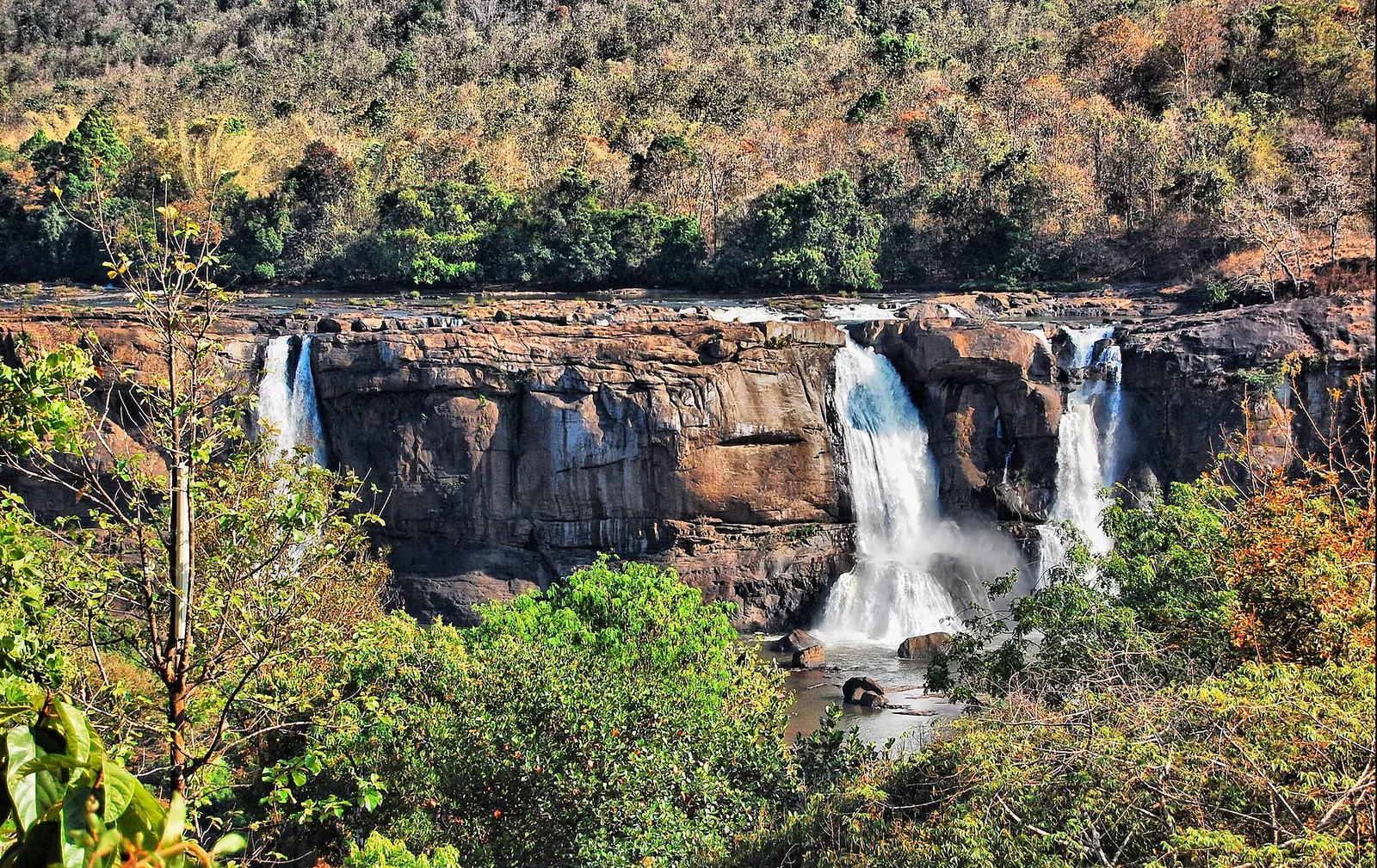
There are two Athirappillys, and the difference between them is about fifteen minutes of steps.
The first is the upper viewpoint, a short walk from the car park, where you stand at the lip and watch the Chalakudy river gather itself and go over the edge. It is loud, it is wide, and you are looking along the fall rather than at it. This is the Athirappilly that appears in most photographs and it is where the large majority of visitors stop, take their pictures and leave.
The second is at the bottom.
The path
A stepped track drops from the upper area down through wet rock, tree roots and dense green to the pool at the base. Ten to fifteen minutes down, rather longer coming back up. It is steep, it is uneven, and after rain the stone is genuinely slippery. There is no shortcut and there is no lift.
What it buys you is the whole face of the fall standing over you, the noise arriving as pressure rather than sound, and a permanent haze of spray that will soak a camera in about a minute. From below, the twenty-four metres reads as far more than twenty-four metres, because you are underneath it rather than beside it.
- Shoes with grip. Not sandals, not new white trainers — wet rock, roots and steps.
- Budget 40 minutes for the round trip with time at the bottom, and more if you are photographing.
- The climb back is the harder half. If you have knee or heart trouble, take that seriously.
- In peak monsoon the descent is sometimes closed on safety grounds. That decision is not negotiable at the gate.
- Assume everything you carry will get wet. A dry bag or a plastic sleeve for a phone is not excessive.
The part that has killed people
Athirappilly is beautiful and it is dangerous, and the two facts sit on the same rock. The stone above the lip is smooth and polished by the river, the current runs faster than it looks from the bank, and — this is the one that catches visitors — the level can rise quickly when rain falls in the catchment upstream, well out of sight of anyone standing at the falls.
That combination has drowned people. The barriers are where they are for a reason, and the guards who whistle at you are not being officious. Do not climb out onto the rocks above the fall for a photograph, do not swim, and do not assume that a calm-looking pool is a safe one.
Then go upstream
When you have come back up — and you will be warmer and wetter than you expected — drive the five kilometres to Vazhachal. The same ticket normally covers it on the same day. There the Chalakudy spreads across a wide shelf of black rock and races rather than drops, the crowds thin out, and you can sit near the water and watch the forest for a while.
Done in that order, the day has a shape: the drama first, from above and then from below, and the wide quiet river afterwards.
Frequently asked questions
Can you walk down to the bottom of Athirappilly Falls?
Yes. A stepped path descends from the upper area to the pool at the base, taking about 10 to 15 minutes down and longer back up. It is the best part of the visit and the part most people skip.
How difficult is the walk down?
Steep and uneven, on stone steps, tree roots and rock that is slippery in and after rain. The climb back up is the harder half. It is not a technical path, but it is a poor idea in sandals or with significant knee or heart trouble.
What should I wear and carry?
Shoes with grip, and the assumption that everything will get wet from spray. A dry bag or plastic sleeve for a phone or camera is worth having. Allow around 40 minutes for the round trip with time at the bottom.
Is the path to the base ever closed?
Yes. In peak monsoon the descent is sometimes closed on safety grounds when the river is high. That call is made at the site and is not negotiable.
Is it safe to swim or climb the rocks at Athirappilly?
No. People have drowned here. The rock above the lip is smooth and polished, the current is faster than it appears, and the water level can rise quickly when rain falls upstream out of sight. Stay behind the barriers and take the guards seriously.
What should I do after the falls?
Drive five kilometres upstream to Vazhachal, which the same ticket normally covers on the same day. It is flatter, far quieter, and the better place to sit by the Chalakudy and watch the forest — a good counterweight to the crowds at the main viewpoint.