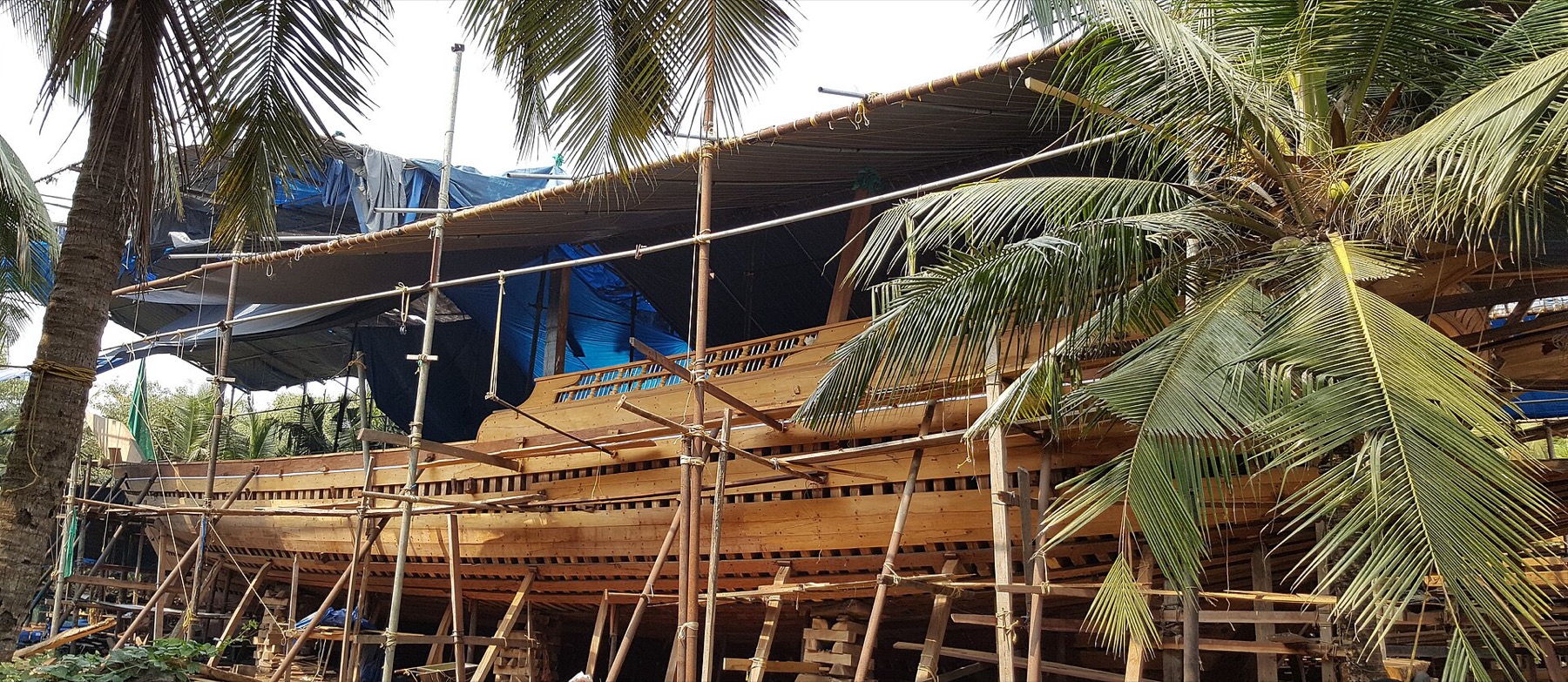
Everything written about Beypore is about the carpenters. That is fair — shaping a 150-foot hull by eye is the harder thing to explain and the more photogenic thing to watch. But there is a second trade in these yards, and on the one day the public reliably turns up to see something happen, it is the only trade working. The Khalasis do not build the ship. They move it.
Who they are
Khalasi is both an occupation and a set of families. The word is Arabic — khalasi, a dockyard worker, a sailor, the lascar of British shipping registers — and the community is overwhelmingly Mappila Muslim, concentrated in Beypore and across the river at Chaliyam. A local etymology reads the name as marking descent from Arab fathers and Malayali mothers, which is the sort of derivation that is impossible to prove and entirely plausible on this coast.
They are one part of a division of labour that the district tourism authority still names in its own terms. The Odayis are the maistries, the master carpenters. The Baramys are described as having migrated from Yemen. The Koyas were the agents, handling the building and the trade. The Khalasis are the muscle and the mechanics — and it is worth saying plainly that muscle is the wrong word for what is essentially an unwritten engineering discipline.
The technology, such as it is
There are no cranes at a Beypore launch and no hydraulics. The toolkit is a wooden lever called the dabber — daver in some spellings — along with the slenky, coir and hemp ropes, wooden pulleys, timber rails, rollers, and a stout pole rigged as a windlass with hawsers wound round it. Everything else is bodies, geometry and timing.
That last word is the whole art. A hull of several hundred tonnes on rollers does not respond to a hundred people pulling hard; it responds to a hundred people pulling at the same instant, repeatedly, for days. Get the beat wrong and the load stalls, the rope surges, and the danger is immediate. This is why the songs exist.
The songs are not decoration
The Khalasi repertoire has names: Vinchipattukal, Ambapattukal, Elayya pattukal. Kerala’s district tourism records them as intangible heritage, and they have started to attract academic attention — P. K. Nasreena published a study of the Vinchi pattukal as a cultural representation of the Mappila Khalasis in the journal ISHAL PAITHRKAM in 2023.
It is easy to file a work song under folklore and move on. In this case the song is the control system. It is a metronome that synchronises a large crew who cannot all see each other, distributed along ropes around a hull, and it carries information — when to take up, when to hold, when to heave. A visitor hearing it for the first time reasonably takes it for atmosphere. It is closer to a signalling protocol.
A week to put a ship in the river
The launch is the only part of uru-building the public reliably sees, and it is not an afternoon’s event. Easing a completed 150-foot hull from a riverbank yard down into the Chaliyar on rollers and rails takes roughly a week of continuous work. Crowds come. So does the press. If you are timing a visit to Beypore around one thing, this is the thing — though you will need local information to know when, because it is governed by the tide and the state of the vessel rather than a calendar.
The second career
Here is what turns a craft story into something stranger. Khalasi gangs are hired far beyond the shipyards, because there is a category of problem — very heavy, very awkward, in a place a crane cannot reach or cannot be trusted — for which rope and men remain the better answer. They worked on the Idukki Dam. They worked on the Feroke Bridge, the Vadakkumbadu Bridge and the Mahanadi Bridge.
And on 8 July 1988, when the Island Express went off the rails at Peruman near Perinad in Kollam and its carriages went into Ashtamudi Lake, the Khalasis were called. They lifted bogies out of the water and helped recover the dead. Kerala’s dhow-launchers, summoned across the state as its disaster-recovery crew — that is a sentence about a traditional craft community that no heritage brochure quite manages to say.
The near-collapse, and the Gulf on both sides of it
Uru-building fell apart in the 1970s for simple lack of demand, and the 1980s made it worse with labour disputes and a shortage of hands. There was a stretch — put at ten to fifteen years — when the yards effectively stopped. The district tourism authority is unusually candid about why the workers went: a noticeable reluctance among the younger generation, who preferred jobs in Gulf countries and migrated.
Read that alongside the order book and it has a bitter symmetry. The Gulf economies that now commission the urus — Qatar has been the anchor market since 2011 — are the same economies that drew away the men who launch them.
The recovery numbers come from an advocacy document and should be read as such: Kozhikode DTPC’s submission to the Green Destinations Top 100 Stories for 2025 reports active craftsmen rising from fewer than fifty in 2010 to more than two hundred by 2024, with over 150 coming through formal training; annual revenue up from around ₹2 crore to more than ₹15 crore; masters earning ₹50,000 to ₹1,00,000 a month; five hundred families supported directly and a thousand indirectly. Whatever discount you apply to a case made by the people making it, the direction is not in doubt — walk the yards and there are hulls on the bank again.
Frequently asked questions
Who are the Khalasis?
A hereditary occupational community of riggers and haulers, overwhelmingly Mappila Muslims of Beypore and Chaliyam, who move extremely heavy loads using rope, wooden levers, rollers and coordinated manpower rather than machinery. The name is Arabic, meaning a dockyard worker or sailor.
Can I watch an uru being launched?
If your timing is lucky. A launch takes about a week of continuous work and draws crowds, but it is not scheduled for visitors. Ask locally or at the yards; there is no published calendar.
Do the Khalasis only work on ships?
No, and that is the most interesting thing about them. Gangs have worked on the Idukki Dam and on the Feroke, Vadakkumbadu and Mahanadi bridges, and were called to the Peruman rail disaster of 8 July 1988 to lift carriages out of Ashtamudi Lake and recover bodies.
Is the tradition still alive?
Yes, though it came close to ending. Uru-building collapsed in the 1970s and stopped for a stretch of ten to fifteen years, largely because younger workers left for the Gulf. Kozhikode DTPC reports active craftsmen rising from under fifty in 2010 to over two hundred in 2024 — a figure from an advocacy submission, so treat the precision with care.