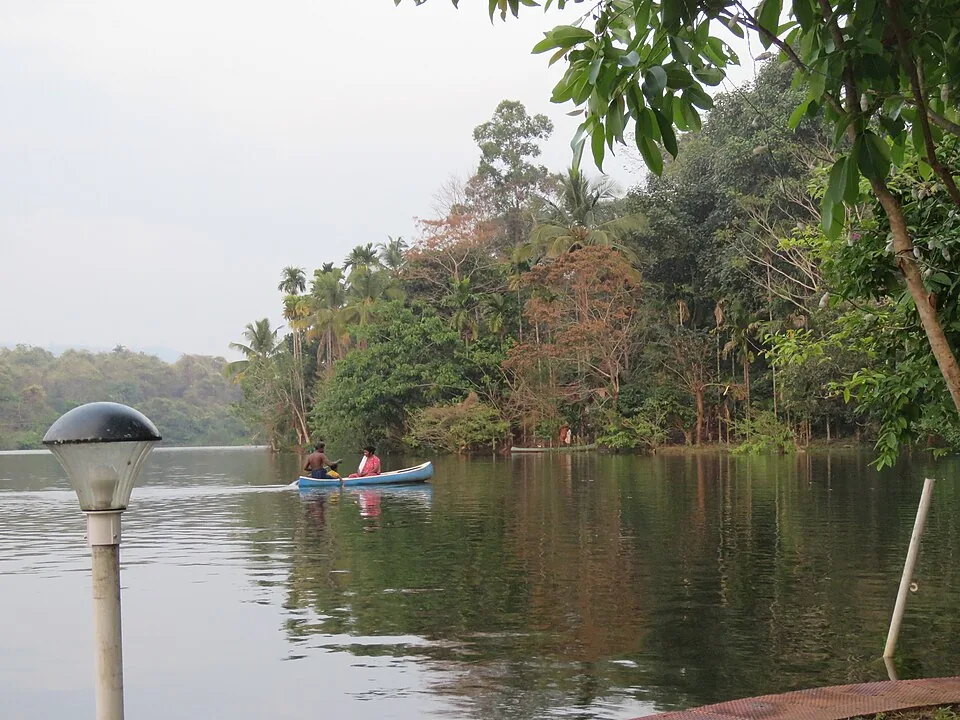
Take the boat out from the jetty at Bhoothathankettu and one detail is visible within a minute, though almost nobody reads it. The water does not have a bank. It runs flat up to a wall of trees, with no beach, no mud shelf, no shallow margin — the reservoir simply ends where the forest starts.
That is what a drowned riverbank looks like. The trees you are looking at are not the edge of the forest. They are what is left of the middle of it.
What was here in 1933
In 1933 the ornithologist Salim Ali surveyed the birds of Travancore and Cochin. On this stretch of the Periyar he found something he did not find anywhere else in the peninsula, and he said so in terms that have been quoted on every signboard in the district since: the richest bird habitat in peninsular India, comparable only with the eastern Himalayas.
The specific thing he was describing has a name. It is low-elevation riverine forest — tall, wet, closed-canopy woodland growing directly along the water at almost sea level. It is the scarcest forest type in Kerala, because it occupies exactly the flat, well-watered ground that people want for everything else. Where it survives, the bird lists are extraordinary; it is the same habitat type that makes the Athirappilly and Vazhachal stretch downstream so bitterly argued over.
He recommended the Thattekkad forest be protected. Nothing happened for fifty years.
What happened in 1964
In 1964 the barrage was completed here as the headworks of the Periyar Valley Irrigation Project: a little over 210 metres of gated structure outside Pindimana, built to divert the river into a left-bank canal system. Its output is not trivial and it is not disputed. It irrigates on the order of 32,800 hectares across six taluks, it supplies drinking and industrial water to greater Kochi, and it helps hold back the tidal salt that pushes up the lower Periyar.
The pool it created is the water you are boating on. It is called the Bhoothathankettu reservoir, and also — in older usage that has largely fallen out of the tourist material — the Thattekad reservoir.
What impounding it did to the bank upstream is recorded, and the record is not from campaigners. It is in the Kerala Forest Department’s own description of the sanctuary: the riverbank was submerged by something in the order of six to ten metres by the water body created by this irrigation project, and this destroyed almost all of the luxuriant riverine forest that had existed along the banks.
Almost all of it. The exact forest Salim Ali had singled out thirty-one years earlier, and the exact reason he had singled it out.
And then, nineteen years later, a sanctuary
The Salim Ali Bird Sanctuary at Thattekkad was notified in 1983, covering 25.16 square kilometres on the northern bank. It was Kerala’s first bird sanctuary and it carries his name.
Held in order, the three dates say something that no plaque at either site says. Surveyed 1933. Drowned 1964. Protected 1983. What the notification protected was the inland remnant — the forest that had been standing far enough back from the river to survive the reservoir. That is why the sanctuary today reads as a patchwork of partly disturbed evergreen, semi-evergreen and moist deciduous woodland with stands of eeta reed and old plantation ground, rather than as one continuous block running down to the water.
And it is why the reputation is more impressive than it first appears, not less. A fragment that lost its best ground still turns in a list of over 270 bird species on official counts, past 300 on birders’ cumulative tallies, and remains one of the last strongholds of the Sri Lanka Frogmouth. Whatever was here in 1933 must have been remarkable beyond the ability of a sentence to carry.
The part that recovered
There is a genuinely good ending to attach to this, and it is also documented. The reed growing through the sanctuary’s understorey is eeta, Ochlandra travancorica, and it was cut commercially for decades, along with bamboo. R. Sugathan surveyed frogmouth populations across the Western Ghats in 1979 and reported the bird as rare.
After 1984, once the notified area came properly under the Wildlife Protection Act, reed and bamboo cutting stopped. The dense low undergrowth grew back — and the frogmouth, which roosts precisely in that layer, increased. The bird that now brings visitors here from other continents is not a relic of the forest the barrage drowned. It is a recovery, and it took about forty years of simply leaving the understorey alone.
How to hold both things at once
None of this is an argument against the barrage, and it should not be read as one. Thirty-two thousand hectares of irrigated land and a city’s drinking water are not a footnote, and the people who built it were not choosing between a reservoir and a nature reserve — the sanctuary did not exist and would not exist for another nineteen years.
It is an argument for knowing what you are looking at. Bhoothathankettu is generally presented as a pleasant half-day: a boat, a barrage, a children’s park and a legend about demons who tried to dam the river overnight and fled when a rooster crowed. All of that is true and all of it is worth the trip. But the most consequential thing that ever happened at this spot is not the legend, and it is not even the engineering. It is the forest that went under in 1964 — and the plainest evidence for it is the treeline your boat is drifting towards, standing in water, with no bank in front of it.
Frequently asked questions
Did the Bhoothathankettu reservoir destroy forest?
Yes, and it is documented by the Kerala Forest Department itself. Its description of the Thattekkad sanctuary states that the riverbank was submerged by roughly six to ten metres by the water body created by this irrigation project, destroying almost all of the luxuriant riverine forest that had existed along the banks. The barrage was completed in 1964.
Is this the forest Salim Ali called the richest bird habitat in peninsular India?
It is what remains of it. He surveyed this stretch of the Periyar in 1933 and recommended protection. The reservoir went in in 1964; the sanctuary was notified in 1983 over the surviving inland forest. Read the three dates in order and the sanctuary reads as a remnant rather than as an intact habitat.
Why is the reservoir sometimes called the Thattekad reservoir?
Because the water body created by the barrage extends up along the boundary of what is now the Thattekkad sanctuary. Both names refer to the same pool; the Thattekad usage is older and has largely dropped out of tourist material.
What is riverine forest and why does it matter?
Low-elevation, wet, closed-canopy woodland growing directly along a river at near sea level. It is the scarcest forest type in Kerala because it sits on exactly the flat, well-watered ground people want for farming and settlement, and it carries exceptional bird diversity. The same habitat type is what makes the Athirappilly–Vazhachal stretch downstream so contested.
Did the frogmouth recover?
Yes. R. Sugathan reported the Sri Lanka Frogmouth as rare in a 1979 Western Ghats survey. After 1984, when the sanctuary area came properly under the Wildlife Protection Act and commercial cutting of eeta reed (Ochlandra travancorica) and bamboo stopped, the dense low undergrowth it roosts in re-established and numbers rose. It is now the species most visitors come to Thattekkad hoping to see.
Does this change how I should visit Bhoothathankettu?
Not the logistics — it is still a boat trip, a barrage, forest walks and a park, best done early in the day. What it changes is what you are looking at. The treeline standing in water with no bank in front of it is the clearest visible evidence of what the reservoir did, and it is a two-minute boat ride from the jetty.