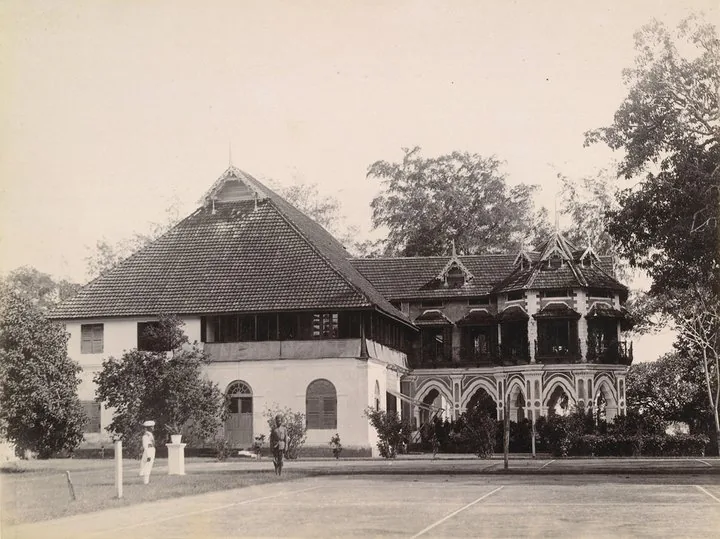
The standard summary of Bolgatty Palace fits in a sentence, and every board, brochure and listing uses more or less the same one: built by the Dutch in 1744, became the seat of the British Resident of Cochin, is now a heritage hotel. We used it too.
It has a hole in it roughly the size of a century.
The dates do not touch
Dutch power on this coast did not last until the British moved in. The British conquest of Malabar came in 1795, and the Netherlands formally ceded Cochin under the Anglo-Dutch Treaty of 1814. That is when the Dutch stop being a factor here.
The British lease of this palace is dated 1909.
Between those two facts sits something in the order of ninety-five years, and the accounts that bother to name the parties to the 1909 lease say who filled it: the King of Kochi. The palace was not seized with the coast in 1795 and it was not inherited. It was leased, more than a lifetime later, by an Indian ruler to the empire that had recognised his kingdom.
- 1744 — built by the Dutch East India Company as the residence of the commander of Dutch Malabar.
- 1795 — British conquest of Malabar ends Dutch power on the coast.
- 1814 — Anglo-Dutch Treaty formally cedes Cochin to Britain.
- 1795–1909 — the least documented stretch: the property of the Cochin royal house.
- 1909 — leased by the King of Kochi to the British; becomes the seat of the Resident of Cochin.
- 1976 — opened by KTDC as a heritage hotel, among India’s earliest palace conversions.
Why the gap gets erased
Not from any conspiracy. Colonial-period buildings in India are catalogued by which European power built them, and the label sticks: this is a Dutch palace, so its story is told as a Dutch story with a British postscript. The decades when it was neither are simply not what the category is for.
The loss is not trivial, though. For most of the nineteenth century this was an Indian-owned building on an Indian-owned island in an Indian kingdom, and what happened in and around it during that time — who lived there, what it was used for, whether it was maintained or left to the damp — is the part nobody has written down. A palace with a documented 1744 and a documented 1909 has almost nothing in between, in a period from which Cochin has a great deal of surviving record.
If you want one thing to take from a visit, make it that. The building is not a Dutch relic that the British later borrowed. It is a Kerala building that had a Dutch beginning, a long Indian middle nobody has bothered to reconstruct, and a short British episode that gets top billing because it produced photographs and paperwork.
And a correction about the golf
While we are on things repeated without checking: the nine-hole course wrapped around the lawns is constantly described as one of the oldest golf courses in India. That claim was on four separate fields of our own page on this place until we sat down with it, and it is wrong.
Kerala Tourism dates the course to 1923, with 1925 appearing in some sources. The Royal Calcutta Golf Club was founded in 1829 — the first golf club anywhere outside Great Britain. Bangalore Golf Club followed in 1876, and its course is generally reckoned the oldest in continuous use outside the British Isles. By 1923 golf in India was nearly a hundred years old and thoroughly established.
What Bolgatty has is a nine-hole course on a small island in the middle of a working harbour, built for a colonial Residency, with container ships passing behind the greens. That is a genuinely strange and good thing. It does not need to be the oldest anything.
What the old photograph shows
The period image at the top of this page is worth a minute. On the left is the low tiled block with the deep hipped roof — the Dutch building, doing what Dutch building in Kerala did, which is borrow the local roof and keep the European plan. On the right is a wholly different thing: a two-storey verandah wing in fretted ironwork and pointed gables, the sort of confection the British put on colonial residences, grafted onto the older house.
And in the foreground, marked out on the grass with a net post standing, is a tennis court. The Residency was playing tennis on this lawn before anybody laid out a fairway on it. The sporting history of the island is older than the golf course that gets all the attention — which is, in miniature, the same problem as the missing ninety-five years.
Seeing it
Bolgatty is a working KTDC hotel, so the interiors and the course are mainly for residents; day visitors can generally cross by ferry from the High Court jetty, walk parts of the grounds and eat at the restaurant. Confirm before building a day around it. What the day-visitor guide covers in practical terms, this piece is only trying to give you something to think about while you are on the lawn.
Frequently asked questions
Who owned Bolgatty Palace between the Dutch and the British?
The Cochin royal family, on the accounts that name the parties to the 1909 lease — the King of Kochi leased it to the British. Since Dutch power on the coast ended with the conquest of Malabar in 1795 and the cession of Cochin in 1814, that leaves roughly ninety-five years of Indian ownership in the middle of the palace’s life, and it is the least documented part of its history.
When did the Dutch actually lose Cochin?
Effectively in 1795, with the British conquest of Malabar, and formally in 1814 under the Anglo-Dutch Treaty. Neither date is when the British took this palace, which is the point — that happened in 1909.
Is Bolgatty’s golf course one of the oldest in India?
No. It dates from 1923, with 1925 given in some sources. Royal Calcutta was founded in 1829 and Bangalore in 1876, the latter holding the oldest course in continuous use outside the British Isles. The claim circulates widely and is simply not correct.
Is Bolgatty Palace really one of the oldest Dutch palaces outside the Netherlands?
That claim, unlike the golf one, appears to hold — but notice how carefully it is worded. Dutch, palace, outside the Netherlands. It is not a claim to be the oldest European building in India, and it should not be read as one.
Can I go inside?
It is a working heritage hotel run by KTDC, so the palace interiors and the golf course are primarily for resident guests. Day visitors can usually reach the island by ferry from the High Court jetty in under ten minutes, walk parts of the grounds and dine at the restaurant, subject to how busy the property is. Confirm locally.
Why is it called Bolgatty?
The usual derivation has Arab traders knowing the island as Gol-jetty, the round island, with Bolgatty being what that became in Dutch mouths. Malayalam speakers mostly call the island Mulavukad. If the derivation holds, the name is an Arabic description of a shape, filtered through Dutch, printed in English, on an island with a perfectly good local name.