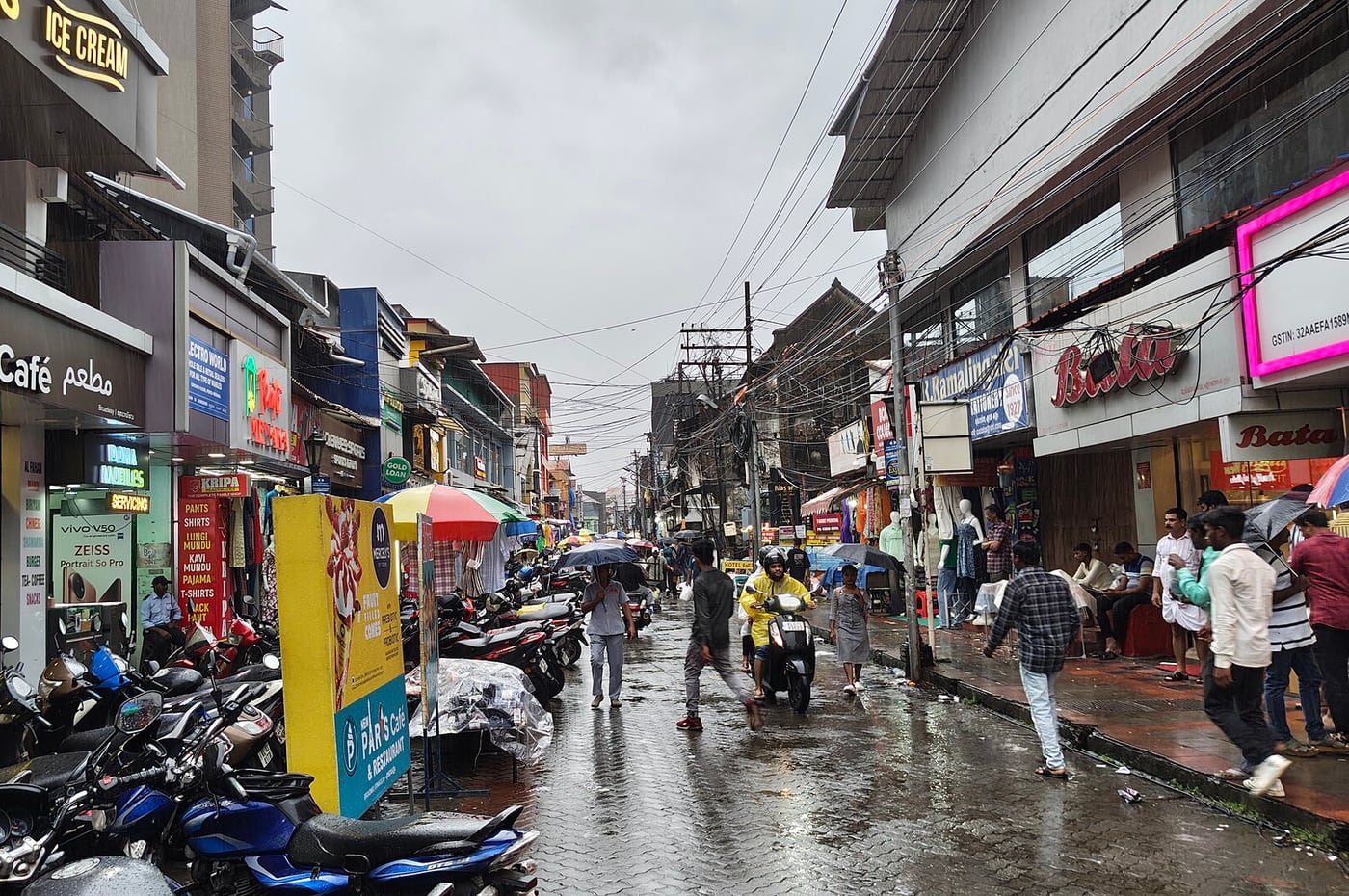
Nearly every visitor to Kochi crosses the harbour to Fort Kochi and never walks the street where the city itself shops. Broadway runs a few minutes inland from Marine Drive — pedestrianised, about a century old, and carrying something in the order of a thousand shops. It is also, despite the name, narrow. That contradiction is the right way into its history.
The market moved across the water
Broadway is not the origin of shopping in Kochi and should not be described as such. The market this street descends from was at Mattancherry, across the harbour, and it is centuries older. What happened here was a relocation: as the commercial centre of gravity shifted to the Ernakulam mainland under the British, a new retail street formed and eventually took over.
The dating of that shift is looser than most accounts admit. It is usually attributed to the British takeover of Cochin from the Dutch in the closing years of the eighteenth century. But every Broadway business whose founding is actually documented belongs to the turn of the twentieth, and one account periodises the street as formally established between about 1919 and 1935 and at its retail peak from roughly 1935 to 1978. As a street of shops, Broadway looks about a hundred and twenty years old rather than two hundred and thirty.
The shops with dates on them
What makes the street readable is that several of its founding businesses are documented by name. Valavi and Company opened here in 1899, dealing in paper, tyres and liquor imported from Europe — a combination that tells you a good deal about who was buying in Ernakulam at the time.
From around 1900 came the tailors, and Broadway’s were famous. J. Newfield and Company made what were reckoned the best three-piece suits in the city. Koya Hassan traded alongside them. The Bharatha Tailoring Company held the work for the State chauffeurs’ uniforms, which in a princely state was a serious contract. In the 1920s the White Hall Silk Palace was set up by a Muslim trader from Palakkad and made the street a textile destination — a character it has never lost, and which still accounts for one of its longest continuous stretches.
- Textiles — bolt after bolt, and shopkeepers who will unroll fifteen things you did not ask for.
- Provisions and spices — sacks open at the mouth, tea and coffee sold by weight.
- Gold — a serious local trade rather than a tourist one.
- Household goods and hardware. The zoning is not designed; it accreted.
A wholesale street that also sells retail
The thing that explains Broadway’s prices is that most of Kochi’s wholesale dealers are based in or around it. Retailers from across the district buy here, the spice market at one end is a wholesale market, and Ernakulam Market adjoins it on the northern side with more of the same. You are shopping inside the supply chain rather than at the end of it. The old market canal still cuts through Broadway and Market Road, a reminder that this trade arrived by water long before it arrived by lorry.
The scale figures come from the Broadway Shop Owners Association and should be read with care. Around a thousand shops trade within a two-kilometre radius; sales in 2016 were put at an average of about ₹5 crore a month. Footfall is quoted as a minimum of 5,000 on holidays rising to 20,000 on working days — which is the reverse of what anyone who has stood here on an Onam weekend would expect, and most likely reflects trade counts on a wholesale street rather than shoppers.
The conservation plan that never happened
Broadway is sometimes written up as a conserved heritage street. It is not. In 2009 the Centre for Heritage, Environment and Development, working with the Kerala Sustainable Urban Development Project, submitted a ₹30-crore conservation scheme for the street under JNNURM. It failed to proceed — attributed to cost escalation and defects in the detailed project report — and a revised report of roughly ₹25 crore followed in 2013.
Neither was carried out. What you walk down today is an unconserved working street, which is arguably the better outcome: it is still doing its job rather than performing its past. But it should not be called restored, and the pedestrianisation that makes it pleasant is a traffic decision rather than a heritage one.
How to use it
Walk the whole length; it is the only sensible way to see it. Come in the morning if you actually want to buy something and have a shopkeeper talk to you, and in the evening from about six if you want the street at full volume. Many shops close on Sunday. Fixed-price shops and bargaining shops sit side by side with nothing to signpost which is which, so ask before you assume. Then walk west to Marine Drive for the sunset, which is a few minutes away.
Frequently asked questions
Why is Broadway in Kochi called Broadway when it is narrow?
Nobody can settle it. The usual explanation is that it was the broadest road in the young town, when most of central Ernakulam including MG Road was open ground. The competing reading is simply that Broadway is a name the British applied to shopping streets across the empire. The street is narrow enough that it was eventually closed to cars, and no source resolves the question.
How old is Broadway market in Ernakulam?
As a street of shops, roughly a hundred and twenty years. Valavi and Company opened in 1899, the celebrated tailoring houses from around 1900, and the White Hall Silk Palace in the 1920s. The older claim — that it dates to the British takeover of Cochin in the 1790s — does not match any documented founding on the street.
Is Broadway older than the Mattancherry market?
No. Mattancherry’s market is centuries older and is the market Broadway descends from. Broadway is the mainland successor that took over when the commercial centre of gravity crossed the harbour. Calling it the oldest shopping area in Kochi is only true of the Ernakulam side.
What should I buy on Broadway?
Spices, tea and coffee are markedly better value here than at any visitor-facing counter in Fort Kochi, because this is a wholesale street and it is where the city buys them. Textiles are the other strength, and gold is a serious local trade. Check whether a shop is fixed-price or expects bargaining — both kinds sit side by side.
When is Broadway open, and when is it busiest?
Shops generally open around ten in the morning and trade until eight or nine at night, with many closed on Sunday. Evening is busiest and liveliest; morning is better for actually shopping. The weeks before Vishu, Onam and Christmas are the peak of the year.
Has Broadway been restored as a heritage street?
No. A ₹30-crore conservation scheme was submitted in 2009 under JNNURM and failed on cost escalation and problems with the project report; a revised ₹25-crore version followed in 2013. Neither was implemented, so the street remains substantially unconserved.