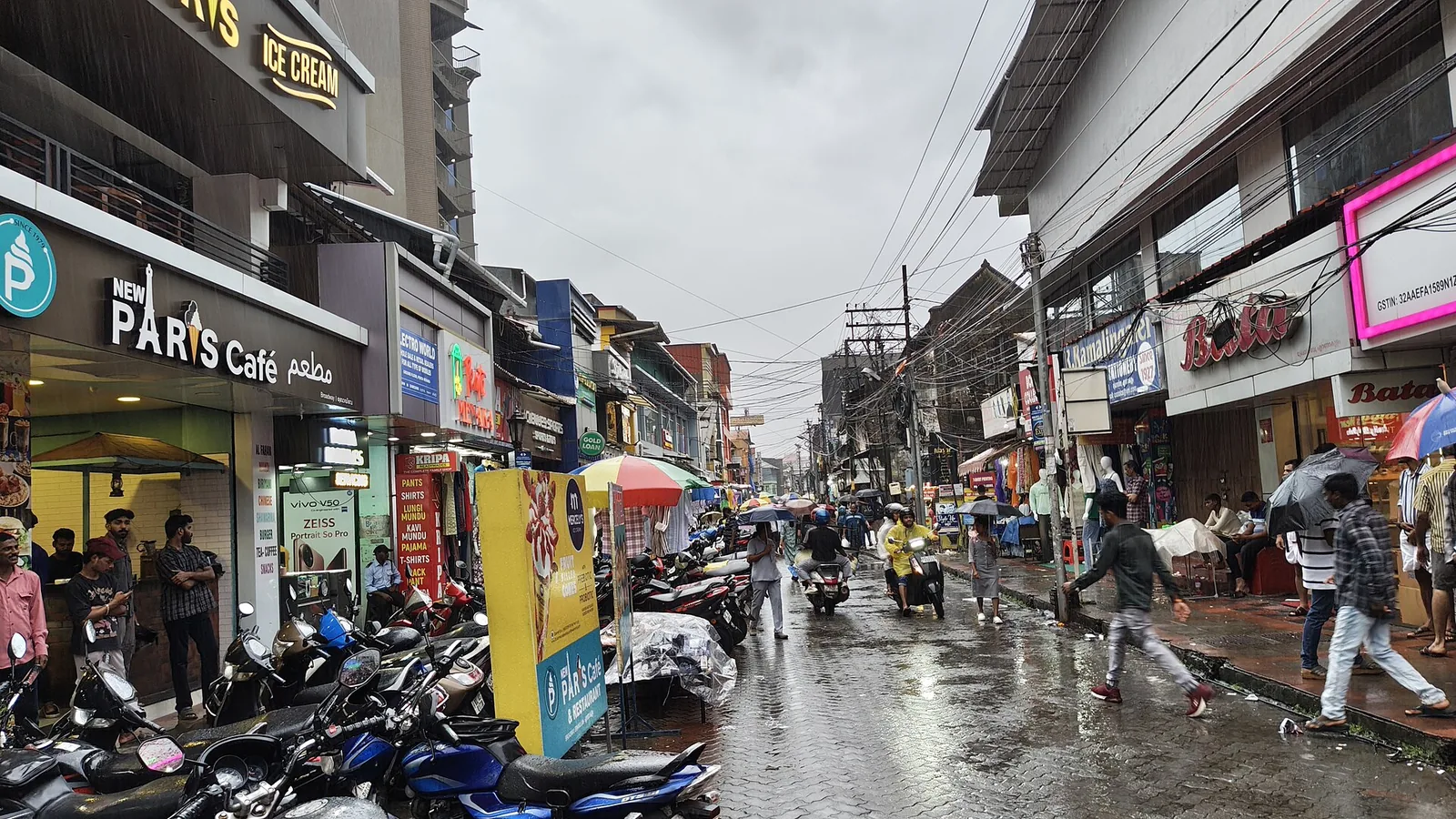
From about 1900, Broadway in Ernakulam was known for tailoring. Not for cheap tailoring — for the best in the city, and specifically for a garment almost comically unsuited to the climate: the woollen three-piece suit.
That combination is the interesting thing. A hot, wet port on the Malabar coast supporting a bespoke trade in European formalwear tells you something quite precise about who was living here and what they were trying to look like.
The names
J. Newfield and Company is the one remembered for the suits — by repute the finest three-piece suits in Kochi at a time when that was a competitive claim. Koya Hassan traded alongside them. The Bharatha Tailoring Company held what was, in a princely state, a serious piece of business: the uniforms for the State chauffeurs.
In the 1920s the White Hall Silk Palace was established by a Muslim trader from Palakkad, and it made Broadway a textile destination rather than only a tailoring one. That distinction still holds: the longest continuous stretch of the street today is textiles, bolt after bolt, and it descends directly from that period.
For context on the street’s commercial age, Valavi and Company had opened on Broadway in 1899 dealing in paper, tyres and liquor imported from Europe. Put those businesses side by side — European liquor, imported tyres, bespoke suits, silk — and the customer becomes visible.
Who wore the suits
Three overlapping groups, and none of them were the majority of the city.
The market for formal tailoring in early-20th-century Kochi
| Customer | What they needed |
|---|---|
| Cochin state officials and the court | Formal dress for durbar, ceremony and administration |
| Lawyers, doctors, professors, merchants | The uniform of the English-educated professional class |
| European traders and officials | What they wore at home, made locally and far cheaper |
| State chauffeurs and staff | Livery — issued, not chosen, and a contract worth holding |
The chauffeurs are the detail worth pausing on. A tailoring firm making uniforms for a princely state’s drivers was not doing fashion; it was doing supply, to specification, repeatably. That is a different and steadier business from bespoke, and it is the sort of contract that keeps a shop open for decades.
Wool in the tropics
It is fair to ask why anyone in Kochi wanted a three-piece suit. The answer is that formal dress in colonial and princely India was rarely about comfort. It was a claim — to office, to education, to standing in an administration that read clothing as evidence. The wool was the point, precisely because it was unreasonable.
Kerala’s own dress traditions ran in parallel and mostly won on the street: mundu and shirt, and for women the set-mundu, all cotton, all suited to the weather. The suit belonged to specific rooms — the court, the office, the courtroom — rather than to the day. Broadway’s tailors were making clothes for those rooms.
What is left of it
Bespoke tailoring on Broadway has contracted the way it has everywhere, squeezed by ready-made clothing and by the collapse of the formal dress code that created the demand. The textile trade, by contrast, survived and is thriving — the street still sells cloth by the metre in enormous quantity, and the tailoring that remains is largely stitching what customers buy across the road.
That is not a decline story so much as an inversion. The high-status end of the trade, the suits, went first. The part that served ordinary households — cloth, blouses, school uniforms, festival clothes for Onam and Vishu — is the part that is still there, and it is the reason Broadway is busy at all.
Walk the textile stretch and you can see both. The shopfronts have changed hands and names, and the shape of the business is a century old.
Frequently asked questions
Was Broadway in Kochi known for tailoring?
Yes, from around 1900. J. Newfield and Company was reputed for the best three-piece suits in the city, Koya Hassan traded alongside, and the Bharatha Tailoring Company made the uniforms for the Cochin State chauffeurs. The White Hall Silk Palace, founded in the 1920s, made the street a textile destination too.
What is the White Hall Silk Palace?
A textile business set up on Broadway in the 1920s by a Muslim trader from Palakkad. It established the street’s reputation for cloth, and textiles remain the longest continuous stretch of Broadway today.
Why would anyone wear a three-piece suit in Kochi?
Because formal dress in colonial and princely India was a claim to office, education and standing rather than a response to the weather. The suit belonged to specific rooms — the court, the office, the courtroom — while Kerala’s own cotton mundu and set-mundu ran in parallel for everyday wear.
Can you still get clothes tailored on Broadway?
Yes, though the trade has shifted. Bespoke suit-making has contracted with the rise of ready-made clothing, while the cloth trade is thriving — the street sells textiles by the metre in large volume, and much of the tailoring that remains stitches what customers buy nearby.
How old are the businesses on Broadway?
Several documented foundings sit at the turn of the twentieth century: Valavi and Company in 1899, the main tailoring houses from around 1900, and the White Hall Silk Palace in the 1920s. That makes Broadway as a street of shops roughly a hundred and twenty years old.
When is the best time to shop for cloth on Broadway?
Mornings, if you want a shopkeeper with time to talk and cloth pulled out for you. Evenings from about six are the busiest and liveliest but the worst for actually buying. Many shops close on Sunday, and the weeks before Vishu, Onam and Christmas are the peak of the year.