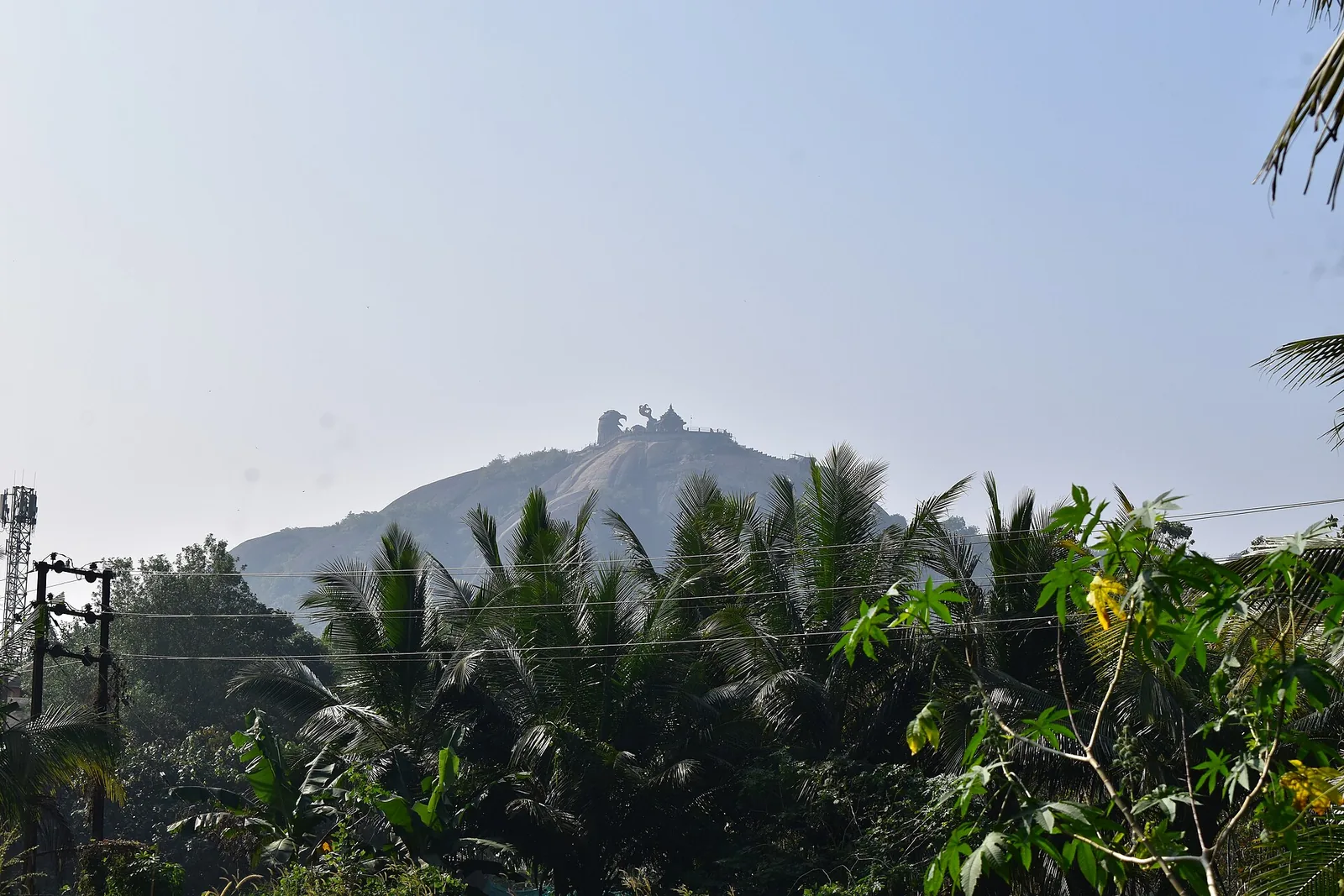
Kerala's midland belt is described, correctly and constantly, as laterite country. The soil is red, the road cuttings are red, the older buildings are cut from red blocks that hardened in the air after quarrying.
They are not, and the difference is the most interesting fact available about this landscape.
What laterite is
Laterite is not a rock that was formed and then exposed. It is a weathering crust — the residue left when heavy tropical rainfall leaches silica and bases out of an underlying rock over a very long time, concentrating iron and aluminium oxides in what remains. That is where the red comes from.
It is a skin, in other words, and it forms on top of something. In Kerala that something is the crystalline basement.
What the domes are
Jatayupara is an inselberg — literally an island-mountain, the term for a resistant mass left standing while softer material around it erodes away.
The rock it is made of belongs to the Kerala Khondalite Belt, part of the Precambrian Southern Granulite Terrain: charnockite and khondalite, high-grade metamorphic rocks formed deep in the crust under enormous heat and pressure, and now at the surface because everything that was above them has gone.
These are the oldest things in the district by an order of magnitude that is genuinely hard to hold in the head. The sculpture on top is eight years old. The Ramayana tradition attached to the rock may be a thousand or two. The rock is Precambrian — on the order of a billion years and more.
Why the domes are bare
Because the laterite has been stripped off them, and cannot re-establish.
A weathering crust needs the water to sit and soak. On a steep convex dome the monsoon runs straight off, taking loose material with it, and nothing accumulates long enough to weather in place or to hold a soil. So the gentler ground between the outcrops carries deep red laterite and coconut gardens, and the domes stay bare grey rock with a few streaks of algae and a fringe of vegetation only where a crack holds water.
You can see the whole argument in a single photograph taken from the road: dense green coconut and plantain country, and rising out of it an unvegetated grey dome. Two different surfaces, one landscape, and the boundary between them is exactly where the slope steepens.
The same rock, four kilometres away
This is not an isolated curiosity. The whole family of bare rounded outcrops along this inland belt is the same basement: the domes around Anchal and Kadakkal, and — four kilometres from here — the boulder at Ittiva that somebody in the eighth or ninth century chose to cut a temple into.
That choice was not arbitrary. You cannot excavate a rock-cut shrine in laterite; it is too soft, too irregular, and it crumbles. You need a large, homogeneous, hard mass of crystalline rock, and this belt is where Kerala has them. The reason the state has only a handful of rock-cut temples while the Tamil country across the Ghats has hundreds is partly about patrons and traditions — and partly about which rock was lying around, bare and exposed, for somebody to work.
So the geology and the archaeology are the same story told twice. The domes stand out of the country because they are hard. Being hard is why one of them has a cave temple carved into it and another has a sixty-one-metre bird bolted onto it.
Frequently asked questions
Is Jatayupara made of laterite?
No. The bare dome is crystalline basement rock — charnockite and khondalite of the Kerala Khondalite Belt, part of the Precambrian Southern Granulite Terrain. Laterite is the red weathering crust that mantles the gentler ground between such domes; on the rock itself it has been stripped away.
What is an inselberg?
Literally an "island mountain" — a resistant mass of hard rock left standing above a plain as the softer weathered material around it erodes away. Jatayupara is a textbook one.
Why are the domes bare when everything around them is green?
Because a weathering crust and a soil both need water to sit and soak in. On a steep convex dome the monsoon runs straight off, so nothing accumulates, and the rock stays bare except where a crack holds water.
How old is the rock?
Precambrian — on the order of a billion years and more. The sculpture on top of it dates from 2018.
Does the geology explain the Kottukal cave temple?
Partly, yes. You cannot excavate a rock-cut shrine in laterite — it is too soft and crumbles. It needs a large homogeneous mass of hard crystalline rock, and this belt is where Kerala has them. The cave temple at Ittiva, four kilometres away, is cut into the same basement rock that forms Jatayupara.