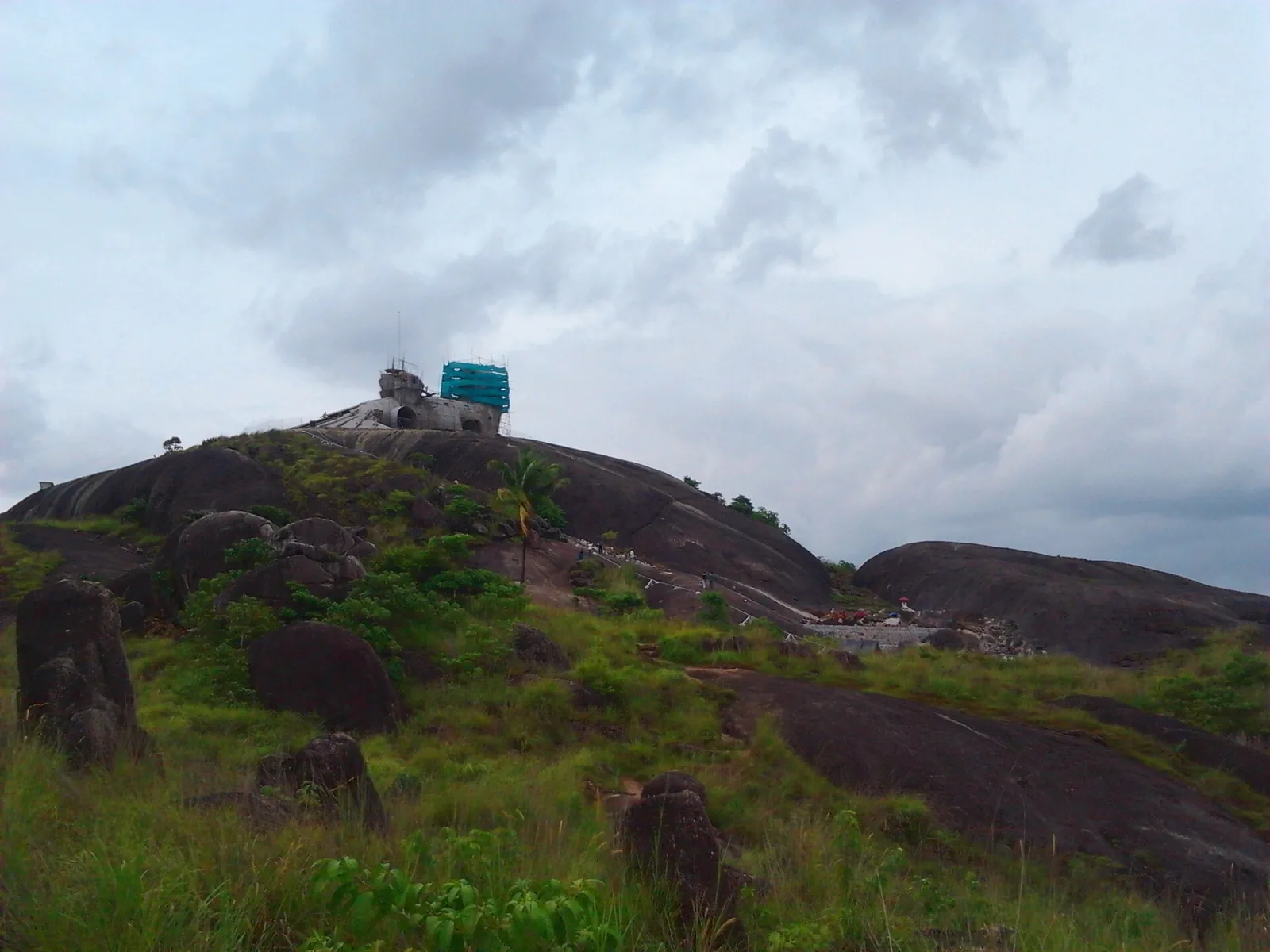
Kerala Tourism says it. Every travel site says it. The park's marketing says it. This site said it in five places. Chadayamangalam, the story goes, is named for the fall of Jatayu — Chatayan being a Malayalam form of the bird's name, so that the town itself is a memorial.
It is a lovely derivation and the historians do not support it.
What the name is made of
Take it apart. Chadayan plus mangalam.
The suffix is the easy half. -mangalam denotes a granted or settled village and is one of the standard settlement suffixes of the medieval Tamil–Malayalam world. It appears across dozens of Kerala place-names. There is nothing epic about it; it is administrative vocabulary.
Chadayan is the interesting half, and it is a ruler's name. It was borne by the Pandya king Jatila Parantaka Nedunjadaiyan — Varagunavarman I — who reigned from roughly 765 to 815 CE, whose conquest of the Ay kingdom and sack of the port of Vizhinjam are recorded in contemporary inscriptions. Ay and Vel rulers of the same name are also attested.
So the plainest reading of Chadayamangalam is a named ruler plus a settlement suffix: the village of Chadayan. It is an entirely ordinary eighth- or ninth-century toponym, and historians trace the town's origin to that period and to the Ay–Pandya conflict rather than to the Ramayana.
The corroboration is four kilometres away
And we already publish it, on a different page of this site.
The Kottukal rock-cut cave temple at Ittiva is dated by the Kerala State Department of Archaeology to the eighth or ninth century CE, and belongs to the Pandyan and Ay rock-cut idiom. Same window, same rulers, four kilometres away.
There is a nice symmetry in the errors, too. Wikipedia's article on that cave temple credits its construction to "Nedumchadayan, who ruled Chadayamangalam the nearby place" — turning a Pandya emperor ruling from Madurai into a local village chief, in order to explain a temple. Here the same name is being explained by a bird. The one solid thing in both cases is that a real ruler called Chadayan was operating in this region in exactly that century.
A third possibility
There is a separate strand deriving Chadayan from Shiva — from jata, the god's matted locks. That is independently plausible in a town whose principal village temple is a Mahadeva temple.
It is also the key to why this has become so tangled. Jata is likewise the root of Jatayu's own name. The bird and the god and the king are all reachable from the same syllable, which is exactly why the etymologies collapse into one another the moment anyone retells them.
What we are actually saying
Not that the legend is false. The identification of this rock with Jatayu's fall is a real, living, locally held tradition, and it is what the place means to the people who live beside it. Traditions do not need an inscription to be worth respecting, and we are not in the business of telling a town that its own story about itself is a mistake.
The correction is narrower and more interesting than a debunk: the direction of derivation has most likely been reversed. A settlement named for a ruler — or for Shiva — acquired, over centuries, a Ramayanic reading of its own name. The rock got its story from the name at least as much as the name got its story from the rock.
And then, in 2018, that reading was cast in concrete on top of the hill at a cost of around a hundred crore rupees. Which is, whatever else you think of it, a remarkable thing for an etymology to achieve.
Frequently asked questions
Does Chadayamangalam mean "where Jatayu fell"?
Probably not, though it is universally printed that way. The name parses as Chadayan (a ruler's name) plus -mangalam (a standard medieval suffix for a granted or settled village). Historians trace the town to the 8th–9th century and the Ay–Pandya conflict rather than to the epic.
Who was Chadayan?
The name was borne by the Pandya king Jatila Parantaka Nedunjadaiyan, also known as Varagunavarman I, who reigned about 765–815 CE and whose conquest of the Ay kingdom is recorded in inscriptions. Ay and Vel rulers of the same name are also attested.
Is there other evidence for that period here?
Yes, four kilometres away: the Kottukal rock-cut cave temple at Ittiva, dated by the Kerala Department of Archaeology to the 8th–9th century CE and built in the Pandyan and Ay rock-cut idiom.
Could the name come from Shiva instead?
It is a real third possibility — Chadayan from jata, Shiva's matted locks — and the town's principal village temple is a Mahadeva temple. Note that jata is also the root of Jatayu's own name, which is why these etymologies keep collapsing into each other.
So is the Jatayu tradition wrong?
No. It is a genuine living local tradition and it is what the place means to the people who live there. What is likely wrong is the direction: the settlement was probably named for a ruler and later acquired an epic reading of that name, rather than the other way round.