For most of the year Chalakkudy Forane Church is a busy parish on a side road off the highway. For about a fortnight in late January and early February it is the reason the town is loud at night.
What the name means
Ambu is the Malayalam word for arrow, and ambu perunnal — or ambu thirunal — is the arrow feast. The arrow belongs to St Sebastian, the Roman officer of the third century who was, in the story, tied to a post and shot full of arrows by his own soldiers, survived, and was clubbed to death afterwards. Europe made him a plague saint, on the logic that arrows falling from the sky were how the ancients pictured epidemic, and Kerala took the arrow with the saint. That is why arrow feasts cluster across central Kerala in the weeks after Christmas rather than in one common week — at Thazhekkad near Kallettumkara on 2, 3 and 4 May, at the Rosary church at Karoor on 25 and 26 January, at the Perpetual Help church in West Chalakkudy on the last weekend of January, and at the forane church itself.
The obvious question is why a church dedicated to the Nativity of Our Lady keeps a Sebastian feast at all, and the answer is the ordinary Kerala one: the titular feast and the popular feast need not be the same. The Nativity of Our Lady on 8 September is the parish’s dedication, marked with a Eucharistic procession through the first eight days of September. The ambu perunnal is what the town turns out for.
It is not on St Sebastian’s day
This is the detail most sources get wrong by assumption. St Sebastian’s day is 20 January, and the parish keeps it there — the January 2026 bulletin lists him at the 20th in its month’s calendar of saints, with no special ceremony attached. The perunnal is held separately and later.
The 2026 dates are published by the parish and are worth having as a specimen year. A nine-day novena opened at five in the evening on Monday 26 January, with Mass, novena and the ladeenj — the litany — each evening. The feast itself ran across four days: 6, 7, 8 and 9 February. Alongside it the parish ran a charity drive under the name Koodorukkan Koodeyundu. The vicar’s letter introducing all of this does not describe it as a parish feast. It calls the ambu thirunal the deshiyotsavam of Chalakkudy — the town’s own festival — which is a striking word for a parish priest to use about his own church’s celebration, and it is the most accurate thing anyone has written about it.
What actually happens
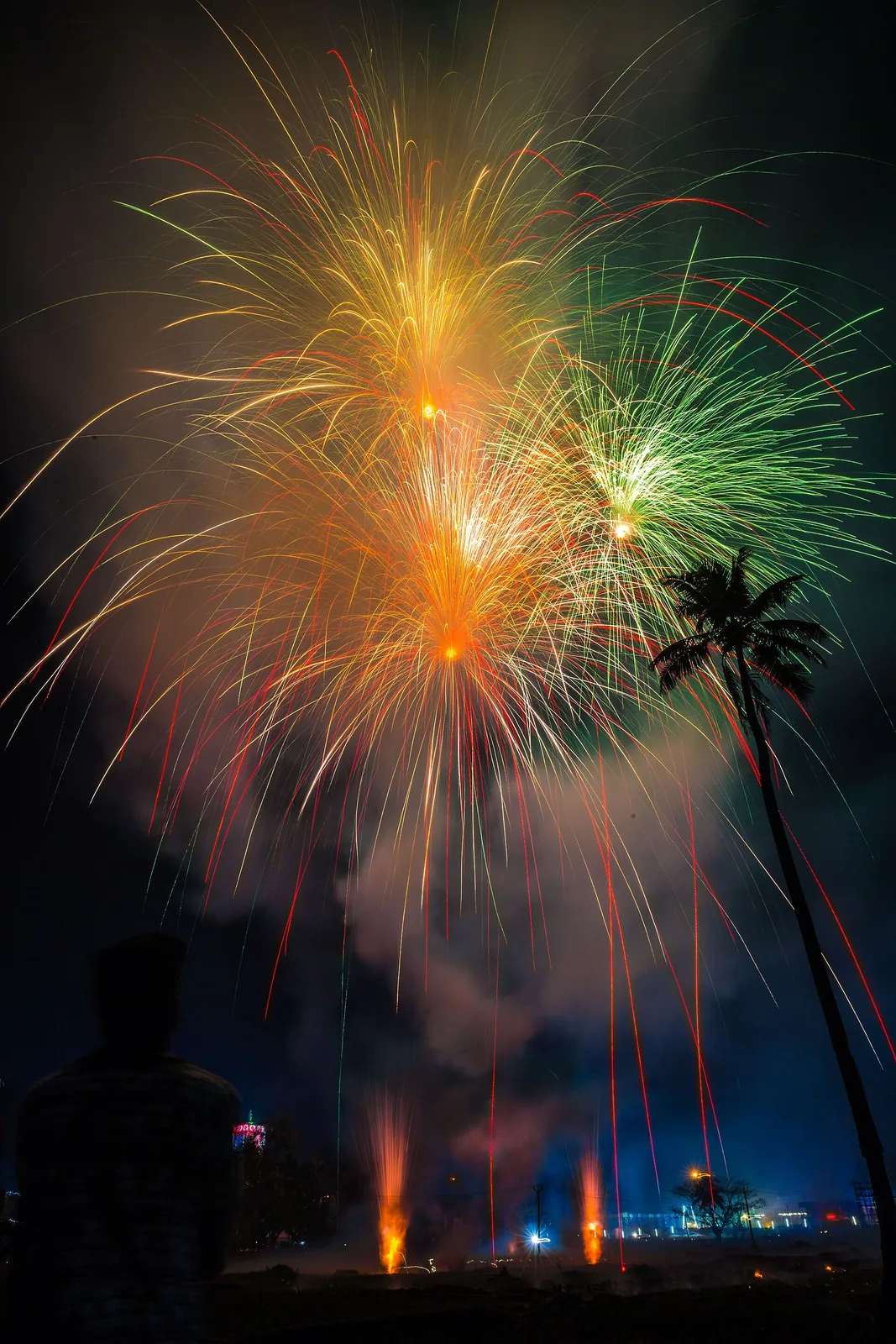
Two photographs on Wikimedia Commons show the two halves of it better than description does. In one, taken on 9 February 2014 and captioned by its photographer to St Sebastian’s feast at this church, the entire church front — the zigzag gable, the flanking piers, the Marian niche, the cross at the top — has disappeared under illuminated panelling: concentric wheels in red and green, rosettes, chevrons, a lit cross above the apex, and an arcade of decorated frontage running away to the right. The forecourt below is solid with people. In the other, taken on the night of 31 January 2016, fireworks are going up over the coconut palms in three colours at once, with a single silhouetted figure watching from the bottom of the frame.
That is the shape of it: nine evenings of quiet devotion, then four days in which the church is turned into a lit object and the fireworks bring people who have no other business with the parish. A third Commons photograph, taken on 5 February 2012, shows a church procession moving along the divided highway through Chalakkudy behind ceremonial umbrellas and a processional cross — early February again, the same window.
Kept across the lines
Malayalam Wikipedia records that the ambu thirunal at St Mary’s is celebrated without regard to caste or creed, and says the same of the arrow feasts at Karoor and West Chalakkudy and of the chandanakkudam at the Kombadinjamakkal mosque. Our Chalakkudy town page already sets that in the context of the town’s wider festival calendar, and there is no need to make the point twice.
What can be added here is that the parish behaves consistently with it. Its own notices record an interfaith and ecumenical gathering held in the church before Christmas and inaugurated by the municipal chairman, and a mega carol procession that starts at the North bus stand and walks into the church. A parish that opens its Christmas with the town council and closes January with a fireworks display the whole town watches is not simply tolerated by its neighbours; it is one of the institutions the town uses to assemble itself.
The nine quiet evenings first
The fireworks are what outsiders remember, but the structure of the feast is the other way round: nine evenings of devotion, then the noise. Each novena evening in 2026 opened at five o’clock with Mass, the novena prayers and the ladeenj — the litany, from the Portuguese ladainha, one of the words the Latin missionaries left behind in Malayalam church usage. Nine days is the standard novena, and running it into the feast rather than around it is what turns a saint’s day into a fortnight.
Attached to the 2026 feast was a charity drive the parish called Koodorukkan Koodeyundu — roughly, we are with you to build the nest. The vicar’s letter asks for help with the feast and with the charity in the same sentence, which is how these things are run here: the illumination contract and the relief fund are the same fortnight’s business. It is also why the feast is moveable. It is scheduled around the parish’s working year, not pinned to a calendar date, and that is precisely why the dates need checking each year rather than assuming.
If you want to see it
Check the dates. The feast is moveable within a window that has run from the last days of January into the second week of February in the years we can document, and it is not tied to 20 January. Ring the parish office rather than trusting a date you read anywhere, including here. Come in the evening — the illumination and the fireworks are the point, and both are after dark. Expect the forecourt to be full and the side roads to be parked out; the railway station is about 1.5 km away and walking in is easier than driving in.
Frequently asked questions
What does ambu perunnal mean?
Arrow feast. Ambu is Malayalam for arrow and it points to St Sebastian, who in the story was shot with arrows, and who was invoked across Europe and later Kerala against plague.
When is the ambu perunnal at Chalakkudy?
Late January into early February. In 2026 the novena began on 26 January and the feast ran on 6, 7, 8 and 9 February. It is not held on St Sebastian’s liturgical day, 20 January.
Is the church’s main feast the ambu perunnal?
Not liturgically. The dedication is the Nativity of Our Lady, kept on 8 September with a procession over the first eight days of the month. The ambu perunnal is the popular feast and much the larger event.
Are non-Christians welcome?
Yes, and the parish’s own literature and Malayalam Wikipedia both describe the feast as kept by people of all communities.