The thing that brings coach parties to Chalakkudy Forane Church is not the church. It is a walled enclosure in the grounds with a pink crenellated gateway, the words HOLY LAND in raised letters across the parapet, and a life-size angel above them holding a sash that says WELCOME. Malayalam sources call it the bible gramam, the Bible village. It is worth describing accurately, because it is neither the ancient site some visitors expect nor the tat that the word replica suggests.
What is inside
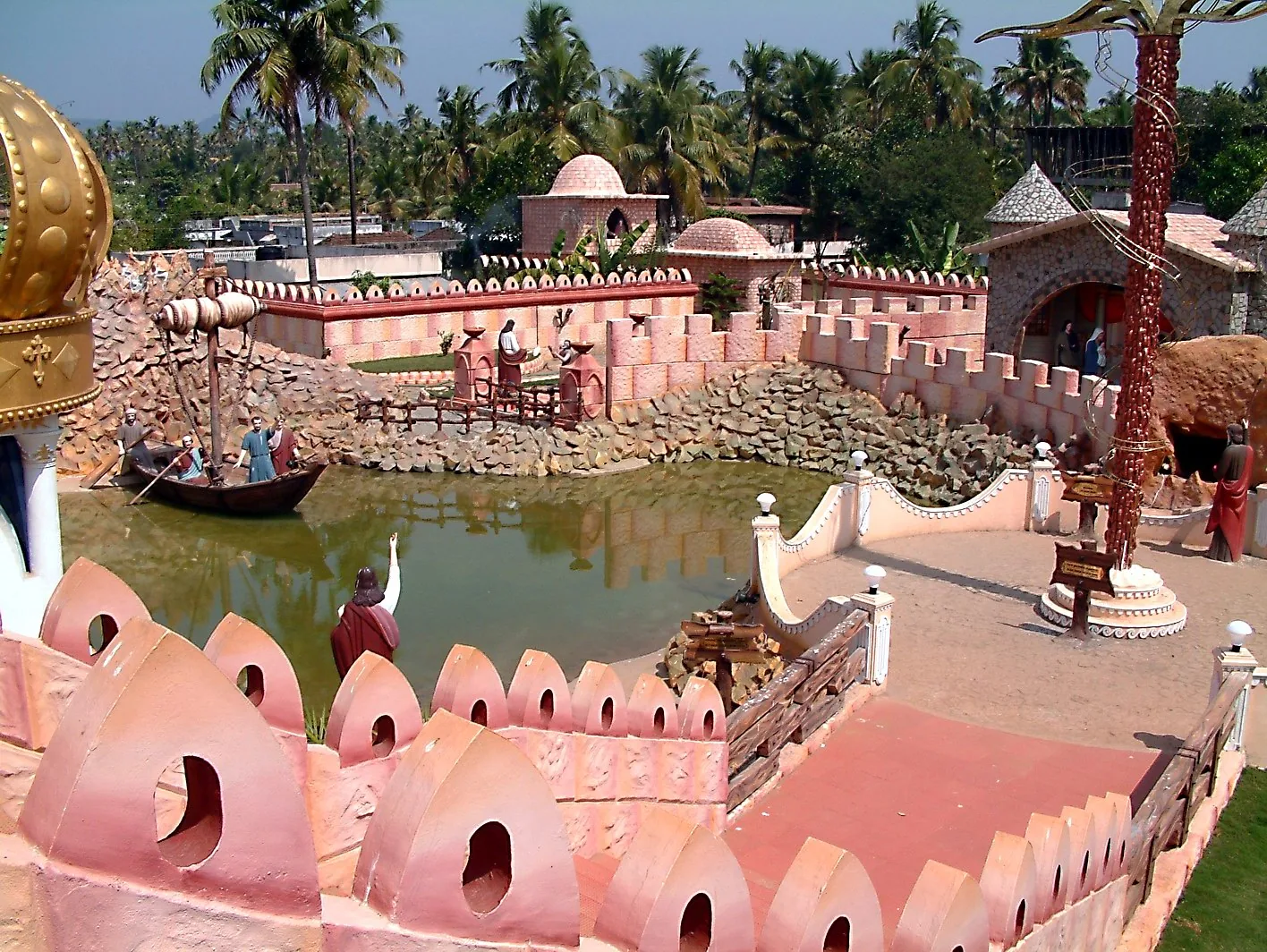
You go up a ramp and down into an enclosed landscape of about the size of a large garden. The centrepiece is an artificial pond standing in for the Sea of Galilee, green and still, with a wooden fishing boat drawn up in it and life-size painted figures aboard — Christ and his fishermen, arranged mid-scene. Around it: rockwork, a bridge, mock city walls in pink crenellations, small domed buildings suggesting a Jerusalem skyline, a stone-built house, a stretch of sand for the desert, and a moulded palm trunk carrying a device at the top. Painted figures stand in twos and threes along the paths with small wooden signboards naming the episodes.
The sequence is deliberate and runs the length of scripture. It opens with an Old Testament scene — Moses raising the bronze serpent in the wilderness, chosen because Christian reading has always taken it as a figure of the crucifixion. Then the nativity, the public ministry, the passion, the crucifixion, the resurrection and the ascension, closing with the crowning of the Virgin as Queen of Heaven. There is a museum on the site holding relics and other objects. The whole thing is open through the day, and the parish says it is best in the evening once the lights come on.
When it was built, and by whom
It took three years to build. Cardinal Varkey Vithayathil blessed it on 8 September 2006 — the church’s own titular feast, the Nativity of Our Lady — and Kodiyeri Balakrishnan, then Kerala’s Home and Tourism Minister in the government formed that May, inaugurated it. Malayalam Wikipedia says it was built at a cost of crores of rupees, without giving a figure; we have not found a costed account and do not repeat a number we cannot source.
The date can be checked independently, which is unusual for this kind of thing. A Malayalam Wikipedia contributor photographed the gateway and the interior on 13 March 2007, six months after the blessing, and released both images into the public domain. The 2007 photographs and a second set taken in December 2013 show the same structures, the same angel, the same pond — so the Holy Land has stood essentially unchanged for twenty years, and anybody describing it as brand new is working from a description written in 2007 and never updated.
It is not heritage, and nobody says it is
This matters because the parish around it does make a claim to great antiquity — it dates its own foundation to AD 600 — and it would be easy for a visitor to slide the two together and come away thinking the Bible village is somehow old. It is not. It is a piece of purpose-built devotional theming from the mid-2000s, in painted concrete and plaster, and the parish has never presented it as anything else. Its own page calls it the latest addition and says it attracts a great number of tourists. That is a straightforward description of a straightforward thing.
Nor is it unusual in Kerala, though few examples are this large. Building a walk-through scriptural landscape is a recognisable devotional genre here — the Rosary church at Karoor, two kilometres away, has its own konthagramam, a rosary village, built in the same period. What distinguishes Chalakkudy is scale, the pond, and the fact that the sequence is theologically ordered from Moses to the coronation rather than assembled as a set of tableaux.
The detail that changes how you read it
A visitor could reasonably assume the Holy Land exists to bring in outsiders, and it does do that. But the parish uses it for its own worship, and the timetable proves it. In Lent, the Way of the Cross is prayed inside the church at 5.30 and 6.50 in the morning — and out in the Holy Land at seven in the evening, on every day of the fast except Friday. Six weeks a year, after dark, the pond and the walls and the painted figures are the stations of a real devotion for the people who live around them.
That is the fairest thing that can be said about it. It is a constructed landscape, recently made, popular, and slightly startling to a first-time visitor. It is also a working part of a parish that has 2,068 families on its rolls and organises them in sixty units, and it was blessed on the feast of the church’s own dedication rather than on a convenient Sunday. Judge it as devotion rather than as archaeology and it makes complete sense.
It was the third of three
The Holy Land did not appear out of nowhere. It was the last and largest of three additions made to this compound in seven years, and the sequence tells you what the parish was doing. October 2000: a grotto to the Virgin on the Lourdes model, built under Rev. Fr Thomas Panjikaran, which the parish describes as the largest in the diocese and around which a Saturday litany and novena and a seven o’clock rosary have since formed. October 2001: the Perpetual Adoration Centre, opened as a memorial of the silver jubilee of the Diocese of Irinjalakuda and of the consecration of its first bishop, Mar James Pazhayattil. September 2006: the Holy Land.
Read together, those are the moves of a parish converting a Marian Pilgrim Centre designation — conferred by Cardinal Simon Lourdusamy at the consecration of the rebuilt church in 1987 — into somewhere with enough to do that a pilgrim will actually stop. A grotto to pray at, a chapel to sit in at any hour, and a landscape to walk. The museum inside the Holy Land, holding relics and other objects the parish describes as of religious and historical importance, is the fourth element of the same idea. We have not seen a catalogue of it and make no claim about what it contains.
Practical
Free to enter, open through the day, no ticket. Half an hour is enough to walk it; longer if the museum is open. Go in the evening if you can — the lighting is the parish’s own recommendation and the pond looks better for it. Combine it with the belfry and the grotto and you have an hour at the site, which fits comfortably into a Kochi–Thrissur drive or into the run out to Athirappilly.
Frequently asked questions
Is the Holy Land free?
Yes. There is no ticket for the Holy Land, the grotto or the church, and the parish says the Holy Land is open to the public through the day.
When was it built?
Three years of construction, blessed by Cardinal Varkey Vithayathil on 8 September 2006 and inaugurated by the then Home and Tourism Minister of Kerala, Kodiyeri Balakrishnan. Photographs from March 2007 confirm it standing.
What is actually in it?
An artificial pond standing for the Sea of Galilee with a boat and life-size figures, mock city walls, domed buildings, rockwork, a desert stretch and a museum of relics — with scenes running from Moses and the bronze serpent through to the crowning of the Virgin.
How long does it take to walk round?
About half an hour at a normal pace, or an hour if you take in the church, the belfry and the grotto as well.