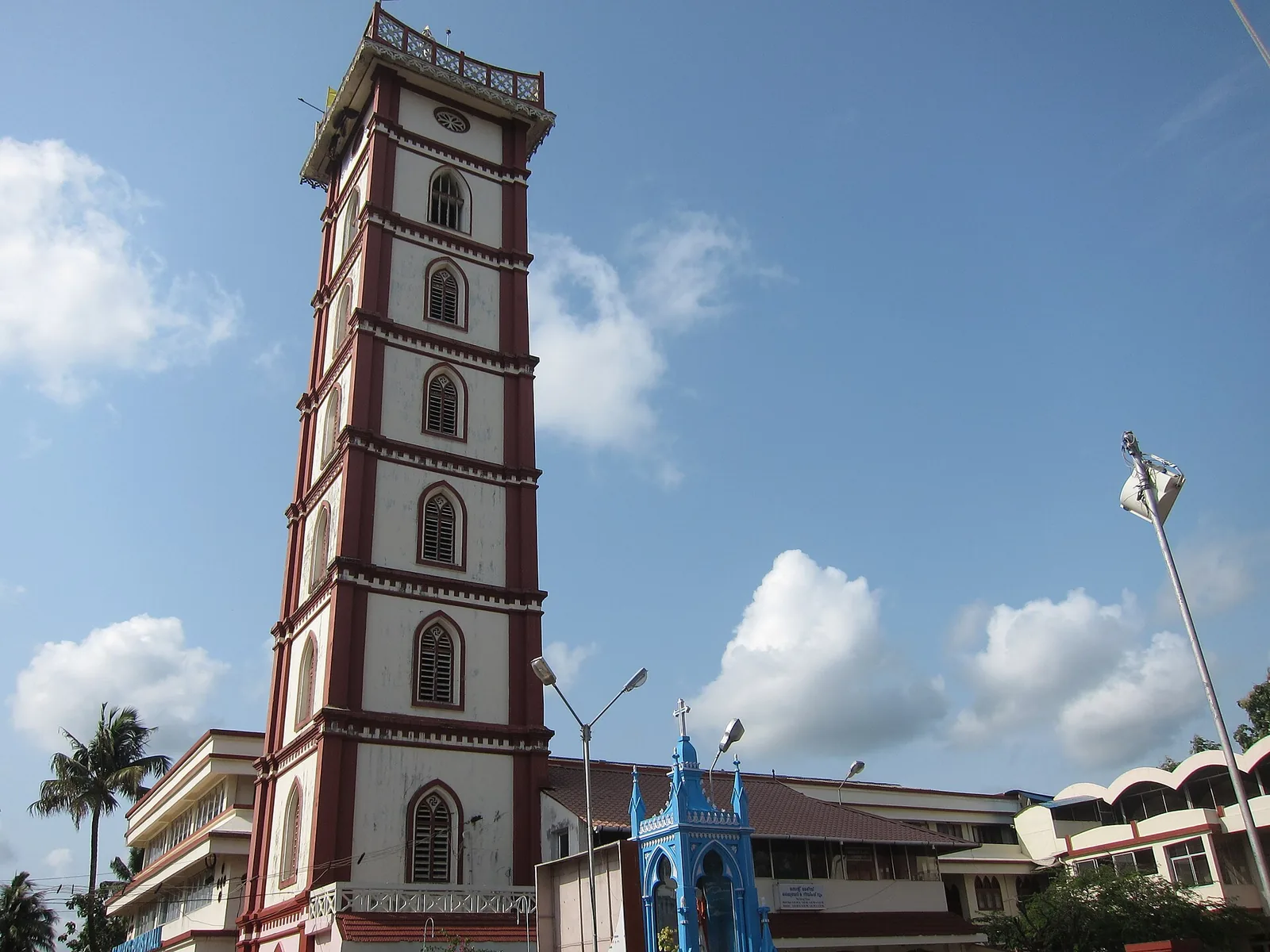
Most visitors to Chalakkudy Forane Church register it as a big parish church with a Bible village attached. That undersells what it is. The word in its name — forane — is a piece of church administration, and it is the reason this particular building has a school, a cemetery, a bulletin, a website and a phone number that other people’s parish councils ring.
A forane is a deanery
In the Syro-Malabar Church, a forane is a cluster of parishes grouped under one senior parish. The vicar of that senior parish is the forane vicar, and he has a defined coordinating role over the others: pastoral meetings, the forane pastoral council, the shared calendar. It is the same idea as a deanery in the Latin church, and the word itself is a survival from the Portuguese and Latin-rite reorganisation of Kerala Christianity — foraneus, the outlying one, the priest set over an area away from the cathedral.
St Mary’s at Chalakkudy is one of ten foranes in the Diocese of Irinjalakuda. The diocese itself is recent: it was created on 22 June 1978 by Pope Paul VI, by the bull Trichurensis Eparchiae, out of territory split off from the then Diocese of Trichur. Mar James Pazhayattil was its first bishop and held the see until 18 January 2010; Mar Pauly Kannookadan has held it since. Trichur has been raised to an archdiocese, with Irinjalakuda a suffragan eparchy under it.
The seventeen
The parish publishes its own table of the churches under it, and reading it is the quickest geography lesson available for this stretch of Thrissur district. St Antony’s at Perambra. St Joseph’s at Aloor and Our Lady of Grace at Aloor West. The Little Flower church at Potta. Our Lady of the Rosary at Karoor. Our Lady of Fatima at Vellanchira. Our Lady of Grace at Thuruthiparambu. Our Lady of Perpetual Help in West Chalakkudy. St Sebastian’s at Thachudaparambu. St Joseph’s in North Chalakkudy. St Antony’s at Kottatt. Our Lady of Perpetual Help at Koodapuzha. Our Lady of Lourdes at Elinjipra and St Francis Assisi at Bethlehem-Elinjipra. St Joseph’s at Mettipadam. St George at Pariyaram. St Mary’s at Thessery.
Lay those names on a map and the pattern is obvious. The cluster is dense in the town itself — north, west, Thachudaparambu — and then it thins eastward, up the road that eventually becomes State Highway 21 and runs to Athirappilly and Malakkappara. Elinjipra and Pariyaram are out that way. This is a Christian population that moved inland with the timber and rubber economy in the twentieth century, and the churches were built behind it as it went.
The count nobody agrees on
Three sources give three numbers, and it is worth printing rather than smoothing over. The parish’s own table lists seventeen daughter churches. The parish’s own About page, on the same website, says sixteen. Malayalam Wikipedia says seventeen including the forane church itself, and its list differs in detail — it names a Kalvarikkunnu church that the parish table does not, and it has no Thessery. Nothing turns on it, but it is a reminder that even an institution counting its own parts can produce two answers in one week.
What the daughters prove about the mother
Here is where the forane structure earns its keep as evidence. The parish claims a foundation in AD 600 and cites nothing. Its daughters, on the other hand, kept records, and those records mention the mother.
The best case is Aloor. The people of Aloor, who until then belonged to the Chalakkudy church, secured land for a building in 1858 and put up a prayer house. In 1868 the Vicariate Apostolic of Verapoly raised it to a church. In 1872 it became a parish in its own right. That is three dated steps in fourteen years, and every one of them presupposes a Chalakkudy parish already big enough to be shedding a village.
West Chalakkudy — the Munjeli church, dedicated to Our Lady of Perpetual Help — was built in 1966 for people on the forane’s rolls who lived on that side of the town. At Elinjipra the Capuchins founded the Bethlehem friary in 1962, a cross-chapel followed in 1963, and the parish was erected on 24 August 1998, with a minor seminary attached to it. Read in order — 1858, 1868, 1872, 1962, 1963, 1966, 1998 — those dates give you a century and a half of a town parish subdividing outward, which is a more useful history than any undated founding legend.
And what it does not prove
It does not get you to 600. The parish’s account — that the first church went up in AD 600 on Palace Road and moved to the present site around 1300 — is tradition, and the diocese has copied the figure into the Established Year field of its parish register, which gives it the look of a record without giving it the substance of one. The honest summary is that the parish is old, that it thinks of itself as very old, and that the earliest date anyone can actually stand on is 1858.
The parish as a machine
The diocese lists 2,068 families here. The parish organises them into roughly sixty numbered units grouped in ten zones, and those units are not decorative: they take turns leading the Sunday Mass and cleaning the church, they run the annual retreat in their own zones over three evenings each, and they are the unit through which the bulletin, the family-unit meetings and the charity drives operate. The parish bulletin, Snehadeepam, prints an advertising rate card and a bank account number for donations. Its January 2026 issue carried a devotional story in which a Muslim neighbour tells a family that dialysis kits come from the Chalakkudy church — the parish’s own account of itself, and a fair indication of what a forane church of this size does with its money.
What the forane owns
A forane church usually holds the things a small daughter parish cannot afford to hold alone, and at Chalakkudy that is visible on the ground. There is a cemetery, entered between pink piers each carrying a large angel with a staff, with a mortuary chapel at the end of the path under a Risen Christ. There is the school. There is the bulletin, printed monthly with an editorial board, a chief editor, sub-editors, a treasurer, a circulation manager and an advertising manager — a masthead longer than many small magazines carry. There is the forane pastoral council, which meets across the parishes rather than within one. And since 2001 there has been a Perpetual Adoration Centre, opened as a memorial of the diocese’s silver jubilee and of Mar James Pazhayattil’s consecration, which is the kind of round-the-clock commitment only a parish with a couple of thousand families can staff.
None of that is unique to Chalakkudy. All of it is what the word forane is describing when it appears on a signboard, and it is why the same word is worth reading rather than skipping.
Frequently asked questions
What is a forane vicar?
The vicar of the senior parish in a forane, who coordinates the parishes grouped under it. At Chalakkudy the post is currently held by V. Rev. Fr Varghese Pathadan, listed by the diocese as the parish’s vicar.
How many parishes does the Diocese of Irinjalakuda have?
Roughly 134 parishes and 20 missions as of 2015, in ten foranes, serving about 270,000 Catholics. The diocese was created on 22 June 1978.
Is the Chalakkudy forane the biggest in the diocese?
We could not establish that. It has seventeen churches under it by its own count and 2,068 families in the mother parish, but we found no published comparison across the ten foranes.
Which is the oldest church in the forane?
By claim, the forane church itself. By evidence, the sequence starts with Aloor’s documented dates of 1858, 1868 and 1872 — and those dates only make sense if Chalakkudy was already established well before them.