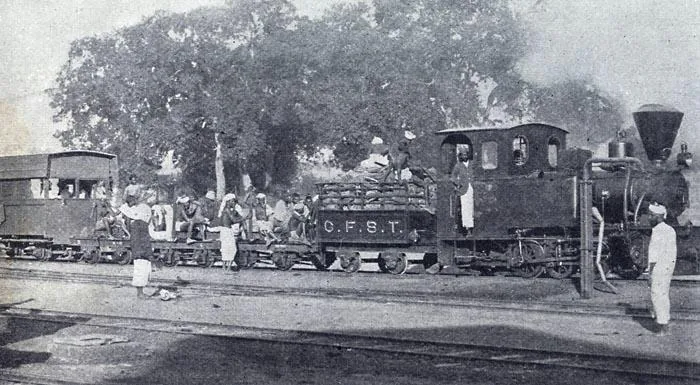
By the time the Cochin State Forest Tramway started operating in 1907, the railway at Chalakkudy was already five years old. That order of events explains the town. The tramway did not come down from the hills and happen to find a railway waiting; it was extended, at considerable expense, precisely because the railway was here.
Why the tramway had to reach this town
The problem the Cochin forest department was trying to solve at the turn of the twentieth century was blunt. Around 50,000 hectares of forest were reckoned to be valuable and effectively inaccessible, and a great deal of it lay in the Chalakkudy hills. The idea of a tramway was first put forward by J. C. Kolhoff, the first Conservator of Forests for Cochin, who as early as 1894 recommended a 20 km wooden tramway; that recommendation went nowhere. In 1900 the conservator V. Alwar Chetty had the alternative studied — floating the timber down the Chalakudy river on rafts — and a special officer was appointed to report on it. Rafting was abandoned as too expensive, and with the additional and decisive drawback that it worked for only about four months of the year, while a tramway would work all twelve.
British officers named in the sources as Haldwell and Floukes carried out the initial survey and route. R. E. Haffield is recorded as the first tramway engineer, who cleared the forest and laid the lines. The design went through repeated revision. The first scheme had three sections beginning in the Parambikulam valley with a 500-metre self-acting incline, then seven kilometres including a 2,100-metre timber slide, then seven kilometres ending on the bank of the Kurumali river, from where timber would be rafted to Thrissur in the monsoon and carted to Chalakkudy by bullock the rest of the year.
That plan failed twice over. Getting the Parambikulam timber to the head of the line by river proved impossible, so about 20 km were added at the top. Then the combination of river and road out of Kurumali proved unworkable too, so the third section was lengthened by a further 24 km and taken all the way to Chalakkudy. The tramway, in other words, ended up here by elimination — because every alternative way of getting the timber to a railhead had been tried on paper and discarded.
What was actually built
The finished system ran to three sections and 49.5 miles, about 79.5 km. English-language sources give them as Chalakudy to Anapantham, 21 miles; Kavalai to Pothupara, six miles; and Komalapara to Chinnar, 22.5 miles. It was metre gauge, 1,000 mm, the same gauge the main line ran on until 1935 — a coincidence of standards that made the transfer here a good deal easier than it might have been.
The equipment was bought abroad. The locomotives, rolling stock and machinery came from Orenstein & Koppel of Germany; the surviving builder’s photographs show 0-6-0 tank engines catalogued under works numbers 1498 of 1904, a 50-horsepower machine named Rajahgopal, and 2604 of 1907, a 150-horsepower machine listed in the firm’s records simply as Waldbahn Cochin, Indien. The bridges and culverts came from P&W MacLennan of the United Kingdom. Two locomotives worked the trucks and saloons. The system had double lines and worked on rollers and cables: empty wagons were rolled up while loaded wagons ran down on the other rails, so that the weight of the timber did the work of hauling the empties back.
On 26 June 1907 the Maharaja of Cochin passed the Cochin Forest Tramway Act, providing for the protection and management of the line. K. R. Menon is recorded as the last tramway engineer.
The transfer itself
Chalakkudy housed the tramway workshop and the timber yard. This is where the two systems met, and it is the reason a station at this point on the line was worth more than its town warranted. Timber came off the tram, was held and worked here, and left by rail for the coast on a section whose name — Shoranur to Cochin Harbour — is a plain statement of destination. Everything downstream of that depended on this transfer working.
There is nothing at the station to show you any of it. The tram alignment survives about a kilometre and a quarter away as Tramway Road, still carrying that name, classed as a major district road, with its rails long since tarred over; the station forecourt is a plain apron off Mala Road with no visible connection to it. The two systems met at the scale of the town rather than at a single platform edge, and any account that offers you a photogenic junction is inventing one.
What the transfer paid for
The money that came through here did not stay here. English-language sources are explicit that tramway earnings built ports, bridges, roads, colleges and schools — and specifically that Cochin Port, now one of the major ports on the Arabian Sea route, was constructed out of tramway revenues, and that Willingdon Island, the artificial island created during the port works, was bankrolled the same way. The timber that passed across this transfer point helped pay for the harbour at the far end of the same railway line.
The ending, and a date that does not fit
The tramway was under review for most of its later life. A special finance committee recommended abolition as early as 1926 and was overruled by the government in 1928. Another committee, chaired by the Chief Conservator of Forests, recommended discontinuation in 1950. A commission appointed in 1953 reported that the tramway should be revived at any cost. Finally, English sources say, it was abolished in 1963 after fifty-six years, on the strength of a special finance committee report, and the staff were absorbed into various government departments.
The disagreement between the English and Malayalam accounts of the tramway’s beginning is set out on our Chalakkudy town record and is not re-argued here. One thing does need adding, because it is a third date rather than a restatement of the two: Malayalam Wikipedia’s dedicated article on the tramway gives the decommissioning as 24 April 1951, while the Malayalam article on the town says only that the line existed until the 1960s, and English sources say 1963. Three sources, three endings. We print all three and pick none.
Frequently asked questions
Why did the tramway end at Chalakkudy?
Because the railway was there. The original plan ended the line on the Kurumali river, but river and road transport from that point proved unworkable, so the last section was lengthened by about 24 km and taken all the way to Chalakkudy, where timber could be transferred to the mainline.
How long was the Cochin State Forest Tramway?
English-language sources give three sections totalling 49.5 miles, about 79.5 km: Chalakudy to Anapantham, 21 miles; Kavalai to Pothupara, six miles; and Komalapara to Chinnar, 22.5 miles.
Who built the equipment?
The locomotives, rolling stock and machinery came from Orenstein & Koppel of Germany, and the bridges and culverts from P&W MacLennan of the United Kingdom. Surviving builder’s photographs show works numbers 1498 of 1904 and 2604 of 1907.
When did the tramway close?
The sources disagree. English-language sources say it was abolished in 1963 after fifty-six years. The Malayalam article on the town says it lasted until the 1960s. The dedicated Malayalam article on the tramway gives 24 April 1951. We print all three.
Is anything left to see at the station?
No. The tram alignment survives about 1.25 km away as Tramway Road, still carrying the name, with the rails tarred over. There is no visible junction at the station itself.