Everything Chaliyam is famous for was demolished. The Portuguese fort of 1532 was levelled in 1571. The railway terminus of 1861 was pulled down in 1888. Both were carted to Kozhikode and built into something else.
What has actually continued here, without interruption and without a monument, is an Islamic scholarly and maritime settlement older than either of them.
The mosque, and the name of the place
By tradition the mosque at Chaliyam is one of ten built in Malabar by Malik ibn Habib, deputy of Malik Dinar, on Malik Dinar’s instruction, with Jafar ibn Sulaiman appointed as Chaliyam’s qazi — a detail recorded in the Rihalathul Mulook. The waqf boundaries are given in the old measure of kol: fifty east, seventy west as far as the house of Faqih Ahmad ibn Umad Zaithoosi, forty south, and north as far as the Karuvanthuruthi river. Malik ibn Habib is said to have stayed five months.
This is tradition rather than archaeology, and it should be read that way — the standing building is later Kerala-Islamic work, not a seventh-century structure. What is documented independently is that two fourteenth-century Islamic tombstones are recorded at Chaliyam, and that Ibn Battuta came here around 1342.
You will see Ibn Battuta quoted calling it a fine city known for its weaving. We could not trace that sentence to any translation of the Rihla, so we will say only that he visited.
The weaving is real, though, and it is in the name. Chaliyam is named from the Chaliyar or Chaliyanmar, the weavers — and so, therefore, is the river.
Puzhakkara Palli
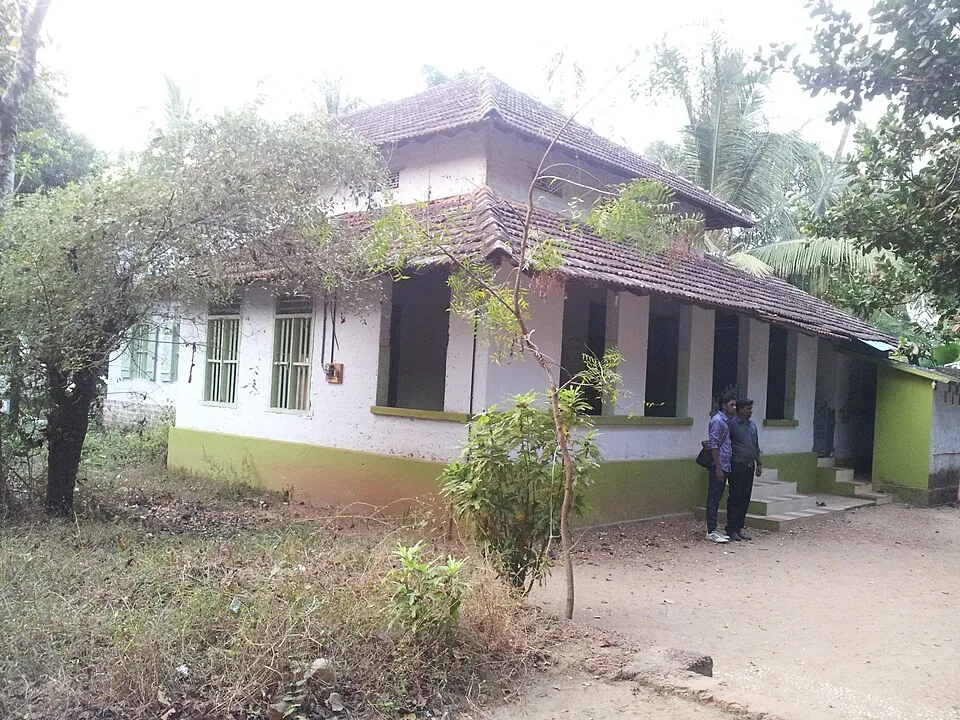
The survivor on the ground is Puzhakkara Palli, and it is not what a visitor expecting a monument will imagine. It is low and whitewashed with a green-painted plinth, under a two-tiered hipped roof of clay tile, with wooden pillars along an open verandah and thick greenery pressing in on a red-earth lane. It is a working mosque.
Malayalam Wikipedia records the local belief that Malik Dinar prayed here. In its courtyard there is a sundial.
This is also, by every account, the mosque whose stones and timber the Portuguese took in 1532 to build their fort — along with the stones of its burial ground. That is not a general claim about Chaliyam; it is the specific transaction that put the fort on the beach.
The scholars
Shaykh Nooruddin, a descendant of Uthman al-Madani of Oman, was educated under the Ponnani Makhdum, settled at Chaliyam and died there in 1041 AH. His grave is visited by people of all communities.
Shihabuddin Ahmad Koya Shaliyathi was born at Chaliyam on 22 Jumada al-Akhira 1302 AH and died on 27 Muharram 1374 AH. He became court scholar to the Nizam of Hyderabad, who paid him a salary until his death, and fatwas were sought from him from across India. He is buried beside the mosque.
The dates here are given as the Malayalam sources give them, in the Hijri calendar. We have not converted them, and neither should anyone quoting this page without checking.
The kuthub khana
Shihabuddin’s birth-house at Putharambath holds a large reference library — a kuthub khana — and this is the detail that turns a list of names into a living thing.
Researchers may stay two days free of charge to consult the books.
The present custodians have become watchful, because visitors had been tearing pages out of the rare volumes. Which is both a sad sentence and a reassuring one: the collection is used enough to be damaged, and guarded enough to survive.
The schoolmaster who came back rich
One more, because it completes the shape. P. B. Umbichi Haji was born at Chaliyam and left it in extreme poverty. He made a fortune in trade in Ceylon and was made a Justice of the Peace by the Ceylon government. Then he came home and founded a school — Al Manar Muslim High School, now Umbichi Haji Higher Secondary School.
It is still standing, and it is on the map. Which is more than can be said for the fort or the terminus.
That is the honest reckoning of this village. The two structures that got into the history books were both taken to pieces. The mosque, the graves, the library and the school are what is still here.
Frequently asked questions
How old is the mosque at Chaliyam?
By tradition it is one of ten built in Malabar by Malik ibn Habib, deputy of Malik Dinar — which would put its foundation very early indeed. That is tradition, not archaeology, and the standing building is later Kerala-Islamic work. What is independently recorded is two fourteenth-century Islamic tombstones at Chaliyam and Ibn Battuta’s visit around 1342.
Can I visit the reference library?
The kuthub khana is in Shihabuddin Ahmad Koya Shaliyathi’s birth-house at Putharambath, and researchers may stay two days free of charge to consult the books. The custodians have become watchful because visitors had been tearing pages from rare volumes, so approach it as a working scholarly collection rather than an attraction.
What does the name Chaliyam mean?
It comes from the Chaliyar or Chaliyanmar, the weavers — the trade the settlement was known for. The river Chaliyar takes its name from the same source.
Is Puzhakkara Palli the mosque the Portuguese demolished?
It stands on the site of the mosque whose stones and timber, along with the stones of its graveyard, the Portuguese used to build their fort in 1532. Local sources are consistent on that. The present building is a later structure — low, whitewashed, under a two-tiered clay-tiled roof, with a sundial in the courtyard — and it is in daily use.