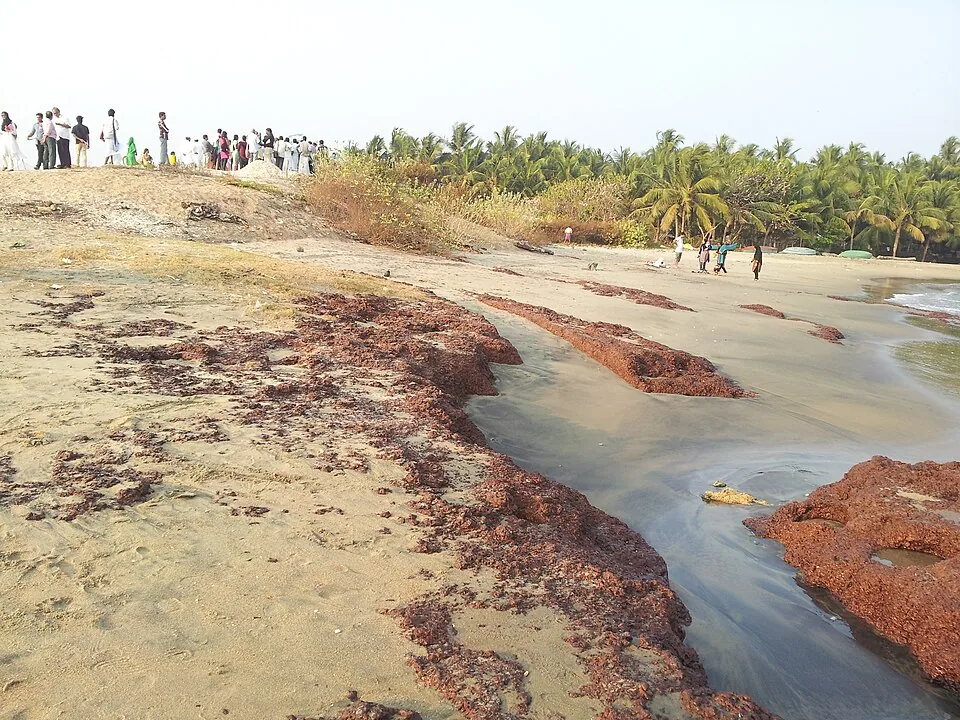
Walk south along the sand from the Chaliyar mouth and you will come to two long, low, straight courses of dark red laterite rising out of the beach and running toward the surf, forming a channel between them, with at least one clean right-angle return.
This is what people mean when they tell you that you can see the Portuguese fort at Chaliyam. It is worth being clear about what you are looking at, because the guidebook phrasing oversells it and the truth is more interesting.
What can and cannot be said
In favour: the lines are straight, parallel and rectilinear, they return at right angles, and they sit exactly where every source places the fort. Photographs support the reading, and they show footings rather than walls — which is precisely what you would expect of a structure demolished to the ground and then buried and re-exposed by a moving beach.
Against: laterite outcrops naturally along this coast. There has been no archaeological survey here that we could find. There is no Archaeological Survey of India protection, no INTACH documentation, and Chaliyam does not appear on the list of monuments of national importance in Kerala.
The most careful Malayalam source phrases it with real precision: the place where the Franks’ fort stood can still be seen at Chaliyam today. The place. Not the fort.
That is how we would put it to a visitor. Go and look, because it is genuinely striking. Do not expect a site, an interpretation board or anyone to have dug there.
Why there is nothing left
Because the demolition was the point. The fort completed in 1532 was, in a contemporary phrase, a pistol held against the throat of the Zamorin, commanding the southern approach to Calicut. When the Zamorin’s forces finally took it in November 1571 — after a siege from 14 July under Mangattachan, forty guns, trenches dug all round, the supply route closed at the river mouth and the garrison starved to the point of eating dogs — it was levelled.
The phrase that survives in the chronicles is that they left not one stone upon another. The Portuguese commander, Dom Jorge de Castro, was executed at Goa for surrendering.
When a Portuguese force came back in 1572 there was nothing to retake. Because the fort had been utterly demolished, one account records, they overran Chaliyam, wrought destruction with sword and fire, and went back.
Oceanus
On the evening of 19 December 2024 the Kerala Tourism Minister P. A. Mohamed Riyas inaugurated Oceanus Chaliyam, a model beach tourism centre, on this strip of sand.
What was built: a one-kilometre embankment walkway, a beach yard with decorative lighting, granite seating and food cafés, fourteen bamboo kiosks, a bamboo restaurant, toilet blocks, twenty-six beach umbrellas, ten bamboo chairs and a watch tower. Rs 10 crore was allocated across a two-phase plan to develop Chaliyam as a water-sports destination.
A caution on this, since tidy claims circulate: assertions that the project was "completed in 2025" trace to a source we could not read at all — it returned an error on every page. The 19 December 2024 inauguration is separately sourced and is the date to use.
Both things at once
So the practical, unglamorous truth to carry with you is this. The remains of one of the most consequential fortifications on the Malabar coast are courses of laterite on a public beach that now has granite benches and a promenade running along it, a fishing harbour at one end and a red-and-white lighthouse behind the palms.
Nobody charges you. Nobody explains it. Families sit on the benches and people bathe off the sand a few metres from the stones.
Every listing still describes Chaliyam Beach as quiet, uncrowded and a working fishing village, and that is still accurate — the promenade is barely a year old and the tourist coaches all go across the river to Beypore. Go now, while both halves of that sentence are still true.
Frequently asked questions
Are the laterite lines on Chaliyam beach really the Portuguese fort?
That is the local attribution and photographs support it — the courses are straight, parallel and return at right angles, exactly where the sources place the fort. But laterite outcrops naturally on this coast, no archaeological survey has been done, and the site has no ASI or INTACH protection. The most careful local phrasing is that the place where the fort stood can be seen, which is a different claim from seeing the fort.
When was the fort destroyed?
November 1571, after a siege that began on 14 July under Calicut’s commander Mangattachan. The Portuguese commander Dom Jorge de Castro surrendered and was executed at Goa. The fort was levelled so completely that the phrase in the chronicles is that not one stone was left upon another — and when a Portuguese force returned in 1572 there was nothing to retake.
What is Oceanus Chaliyam?
A model beach tourism centre inaugurated on the evening of 19 December 2024 by the Kerala Tourism Minister P. A. Mohamed Riyas: a one-kilometre embankment walkway with decorative lighting, granite seating, cafés, fourteen bamboo kiosks, a bamboo restaurant, toilets, beach umbrellas and a watch tower, with Rs 10 crore allocated across two phases toward a water-sports destination.
Is Chaliyam beach crowded?
Not yet. It reads in every listing as quiet and uncrowded, a working fishing village rather than a resort beach, and that remains accurate — the promenade opened only in December 2024 and the tour coaches go to Beypore across the river.