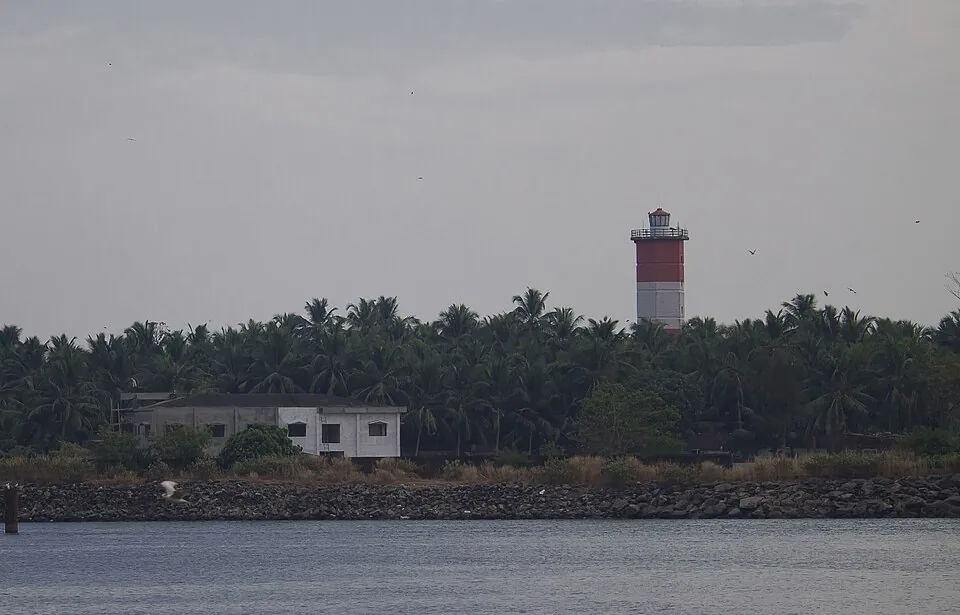
From the Beypore breakwater you can see Chaliyam clearly. The palms, the rubble revetment, the red-and-white lighthouse standing above the trees. It is about nine hundred metres away. By road it is sixteen kilometres, round through Feroke, and takes the better part of forty minutes.
That gap is not a curiosity. It is the single fact that has determined everything about this village for a hundred and sixty-five years.
Why the railway stopped
When the Madras Railway brought the first line in what is now Kerala down to the coast, it terminated on 12 March 1861 at Chaliyam — and named the station Beypore, after the place on the other side that it could not reach.
The reason was the water. The Chaliyar at its mouth is wide and deep, and there was no bridge. Freight and passengers finished the journey by boat across to Beypore and went on by bullock cart.
Chaliyam had been chosen on engineering grounds rather than commercial ones: safer anchorage, a natural reef that worked as a breakwater, and above all a river navigable inland toward the Nilambur and Wayanad timber country. The line existed to move teak. It just could not move it the last nine hundred metres.
When the railway did finally bridge the Chaliyar, in 1888, it did so upstream at Feroke — and Chaliyam was left off the line entirely. Sources give the old Feroke bridge as 1883 or 1888 and we are not going to pick one. Its granite piers still stand in the river beside the replacement that came in with track doubling in the early 2000s.
The jankar
What crosses today is the jankar — a vehicle ferry that takes cars and motorbikes between the two jetties, roughly nine hundred metres apart. It is the quickest way over, and from midwater it gives the best view there is of the uru yards on the Beypore bank.
It is also a direct descendant of the 1861 problem. You can pay a few rupees and cross the hole in the network yourself.
The frequently quoted twenty-to-thirty-minute frequency comes from a business directory rather than the operator, and no current timetable or fare is published. Arrive with time in hand and ask at the jetty.
The bridge that has been coming for five years
The Beypore Bridge across the Chaliyar, part of the Kerala Coastal Highway, is what ends this. It is a real project with a real paper trail, and the paper trail is the story.
The Kozhikode district administration has published a Rehabilitation and Resettlement Package dated 1 October 2021. A Social Impact Assessment report. A Section 4(1) land acquisition notification. Five years of documents. No bridge.
When it opens, two things go at once. Chaliyam stops being forty minutes from a place it can see. And the jankar — the last working piece of the 1861 gap — becomes unnecessary.
What the isolation has cost
It would be easy to write the ferry up as picturesque. The people who live here do not.
A Malayalam account of the village from 2017 puts it plainly: Chaliyam, which set an immortal mark on the pages of history, stands today carrying the sorrow of lost glory — while other places have gone far ahead in development, Chaliyam has achieved no progress worth mentioning.
The same writer inventories what is actually there: eight mosques, burial grounds spreading over acres, enormous trees, gravestones, a market and a few shops around it. That, he says, completes the thumbnail portrait of today’s Chaliyam. He hopes for the Karuvanthuruthi and Kadalundikkadavu bridges on the proposed coastal road, and asks who is left to raise a voice for them.
And one bridge a Chaliyam man did build
There is a coda worth having. The iron bridge at Feroke, built about a century ago by Beeran Kutty Moopan of Chaliyam, has survived time and stands today.
A village that has spent a century and a half waiting for a crossing produced a man who built one — five kilometres upstream, on the route that bypassed it.
Frequently asked questions
How do I get from Beypore to Chaliyam?
Use the jankar vehicle ferry for the roughly 900 m crossing between the two jetties; it carries cars and bikes and crosses in minutes. The road alternative is about 16 km through Feroke. The operator does not publish dependable timings or fares online, so check at the jetty before relying on a particular sailing.
Why did Kerala’s first railway stop at Chaliyam?
Because the Chaliyar at its mouth was too wide and deep to bridge. The terminus opened on 12 March 1861 and was named Beypore, but it stood at Chaliyam and no train ever reached Beypore itself. Passengers and freight crossed by boat and went on by bullock cart. Chaliyam was chosen for its anchorage, its natural reef and its river route inland to the Nilambur teak country.
Is a bridge being built?
The Beypore Bridge across the Chaliyar, part of the Kerala Coastal Highway, has been in process since at least 2021 — the Kozhikode district administration has published a rehabilitation and resettlement package dated 1 October 2021, a social impact assessment report and a Section 4(1) land acquisition notification. As far as we can establish it is not built.
Where did the railway cross the river instead?
Upstream at Feroke, when the line was extended to Kozhikode in 1888 — which is also when the Chaliyam terminus was abandoned. Sources date the old Feroke bridge to 1883 or 1888. Its granite piers still stand in the river beside the early-2000s replacement.