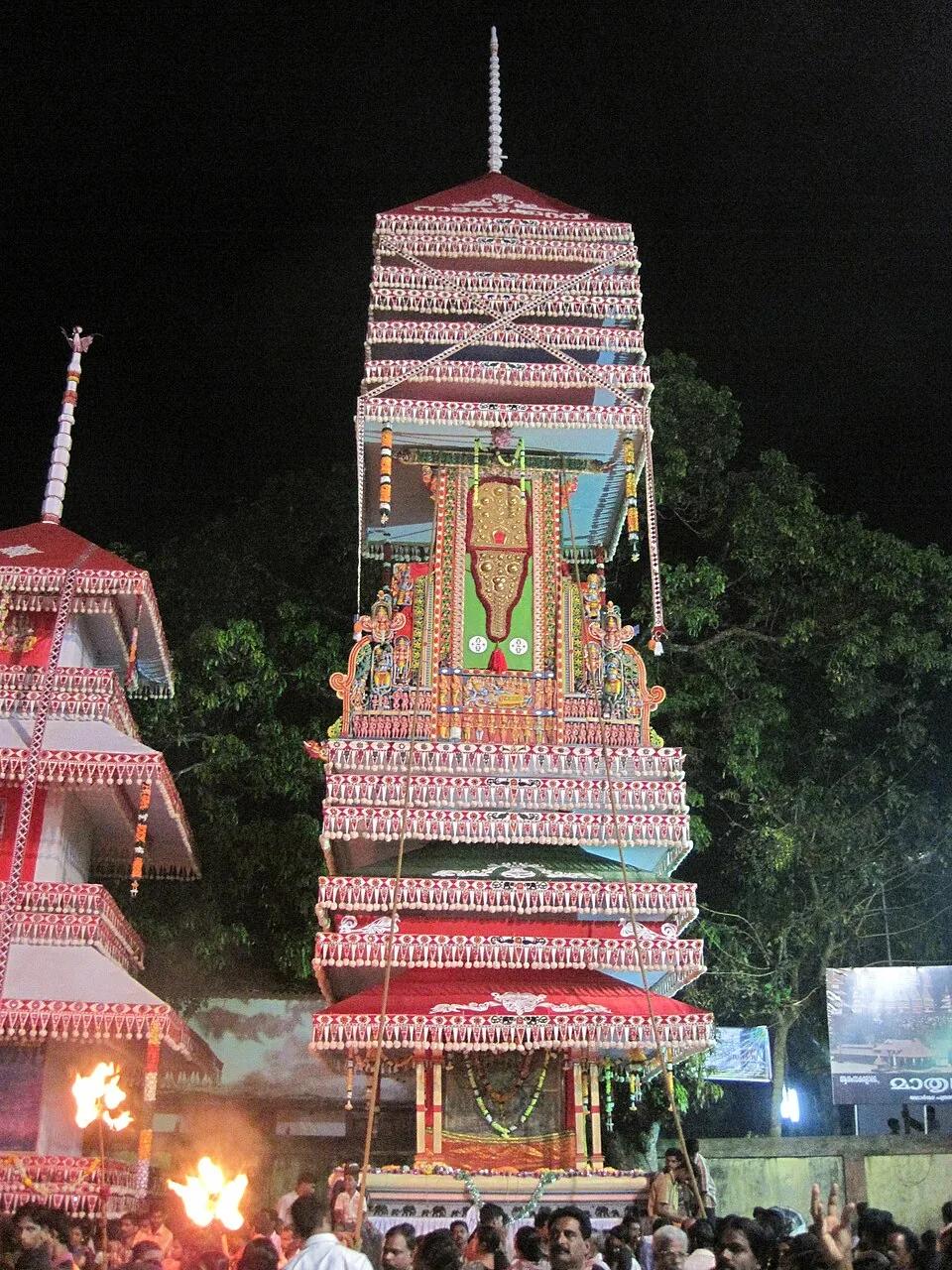
Stand in front of a finished Kuthira at night, torchlit, and it is hard to work out what you are looking at. The thing is a hundred feet of decoration with no obvious structure — tier upon tier of fringed cloth, tinsel, gilt panels, a painted centre with figures either side, and a long white spire on top like a mast.
Underneath all of that is a frame, and the frame is the craft.
What it is made of
A Kuthira is built from lashed timber and bamboo. There are no permanent joints in the sense a carpenter would mean; the structure is tied, which is what makes it both erectable and dismountable, and which is why the skill that matters most is not joinery but lashing. Kettukazhcha itself means, roughly, the tied-up spectacle — the name describes the method.
On to that frame go the courses of cloth and tinsel that give the tower its tiers, the painted central panel, the flanking painted figures, and the finial. There is a photograph on Commons of an undecorated Kuthira frame — a raw skeleton of poles and ties — and it is far more instructive than any of the finished shots. It shows a tapering lattice, wide at the base and narrowing hard towards the top, which is the only way an object of that height stays up in a field with no foundation.
Why the shape is the shape
Once you see the frame, the proportions make sense. The tower is narrow because it has to be light. It is tiered because each tier is a horizontal stiffening ring in a structure with no rigid core. The overhanging fringed edges that read as pure ornament also break up the wind on a very tall, very light object standing in the open. And the spire is a mast rather than a decoration.
This is folk engineering of a high order, arrived at by iteration over roughly two centuries by people building one of these a year and watching what their neighbours did.
Raising it
The assembly happens over weeks in the kara. The raising happens in an evening, and it is done by hand and by numbers — the reason a kara needs a village behind it rather than a committee. The edifices are then hauled to the temple field, where they stand in a line at dusk with the crowd moving between them.
If you go, the thing worth doing is not simply looking up. Walk between two of them and compare. The competition is in the detail of the panels, the quality of the tinsel work and the trueness of the tower, and the karas know exactly whose is best. You will not be able to tell on your first visit. Everyone around you can.
Frequently asked questions
What is a Kuthira made of?
Lashed timber and bamboo forming a tapering tiered frame, dressed with courses of cloth and tinsel, a painted central panel, flanking painted figures and a spire finial. Kettukazhcha means roughly “the tied-up spectacle” — the name refers to the lashed construction.
How tall are they?
Commonly given as roughly 70 to 105 feet, varying by kara and by year.
How long does one take to build?
The assembly runs over weeks within each kara; the raising is done in a single evening, by hand, which is why the work needs a whole village rather than a small crew.