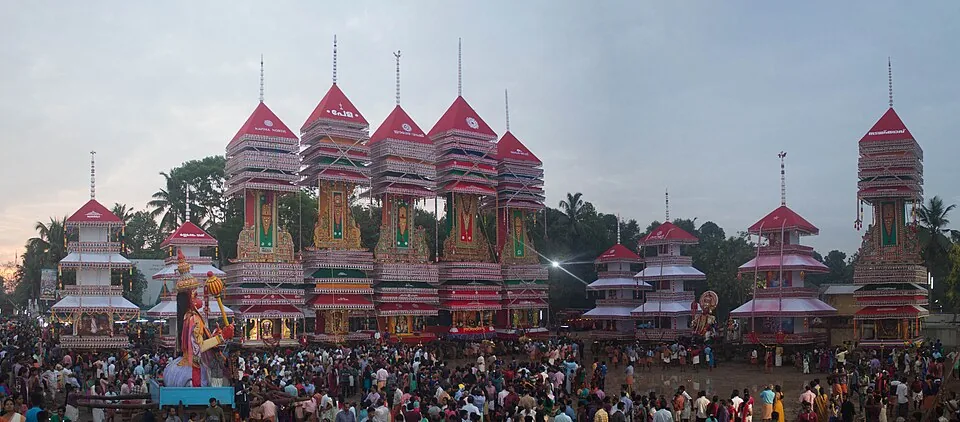
The usual way to describe Chettikulangara’s Kettukazhcha is as a spectacle: enormous decorated edifices, seventy to a hundred and five feet tall, raised in a field at dusk before a crowd of many thousands. That is accurate and it undersells the thing entirely, because it describes the output and not the machine.
The machine is thirteen villages.
Name them
The territorial units are called karas, and there are thirteen. The four innermost are Erezha South, Erezha North, Kaitha South and Kaitha North. The other nine are Kannamangalam South, Kannamangalam North, Pela, Kadavoor, Anjilipra, Mattam North, Mattam South, Menampally and Nadakkavu.
Between them they raise six Kuthiras and five Therus, plus colossal figures of Bhima and Hanuman. In the panoramas a giant painted standing figure looms at the left of the field, identified variously as Bhima or as Panchali.
Naming them is not pedantry. The moment you have a list of thirteen villages, the festival stops looking like a religious event that happens to be large and starts looking like what it is: a competition between neighbouring communities, held annually, with a fixed set of participants and a public result.
What a kara actually does
Each kara finances its own edifice, holds the craft knowledge to build it, assembles the frame over weeks, decorates it, and on the day supplies the muscle to raise the thing upright and haul it to the temple. That is a substantial annual undertaking for a village, repeated for generations.
There is a small piece of evidence for how seriously it is taken that is easy to miss. On Wikimedia Commons there is a separate photograph for each kara’s edifice — Erezha North, Kaitha South, Kannamangalam South, Kadavoor, Pela and the rest, each filed under its own name. Nobody photographs thirteen near-identical towers separately unless the identity of each one matters to somebody. They are not thirteen contributions to a single display. They are thirteen entries.
Why the competition is the point
Folk crafts usually decay for want of a reason to keep doing them well. What the kara system supplies is a reason: your neighbours are building one too, and everybody will see both. Bamboo-lashing, timber-framing, cloth-and-tinsel work and the painting of the central panels all survive here at a high standard because the work is judged annually by people who know what they are looking at.
It is worth being accurate about the timescale, though, because the temptation is to call this immemorial. The Kettukazhcha in its present form is reckoned to be not more than a hundred and eighty to two hundred years old. That is old, but it is within reach of records, and it means these villages did not simply inherit the tradition. Within a traceable period, they invented it.
And it is not a horse
One correction, which we make because we opened the photographs. The word Kuthira means horse, and a great many descriptions — including ours until August 2026 — call these “giant horse effigies”. They are nothing of the kind. A Kuthira is a tall, narrow, multi-tiered tower of cloth, tinsel and timber, with a painted central panel, flanking painted deity figures and a spire finial. A Theru is the shorter, broader tiered canopy form beside it. The names are traditional; the shapes are architectural. Our own page on the Kadakkal Kuthirayeduppu already makes the same point about the same word.
Frequently asked questions
What are the thirteen karas of Chettikulangara?
Erezha South, Erezha North, Kaitha South and Kaitha North are the four innermost; the others are Kannamangalam South, Kannamangalam North, Pela, Kadavoor, Anjilipra, Mattam North, Mattam South, Menampally and Nadakkavu.
How many edifices are built?
Six Kuthiras and five Therus, together with colossal figures of Bhima and Hanuman. Heights are commonly given as roughly 70 to 105 feet.
Is the Kuthira shaped like a horse?
No, despite the name. It is a tall, narrow, multi-tiered tower of cloth, tinsel and timber with a painted central panel and a spire finial. The Theru is the broader tiered canopy form. We checked this by opening photographs of both at full size.
How old is the Kettukazhcha?
In its present form it is reckoned at not more than 180 to 200 years — old, but not ancient, and roughly contemporary with the chuttambalam around the sanctum.