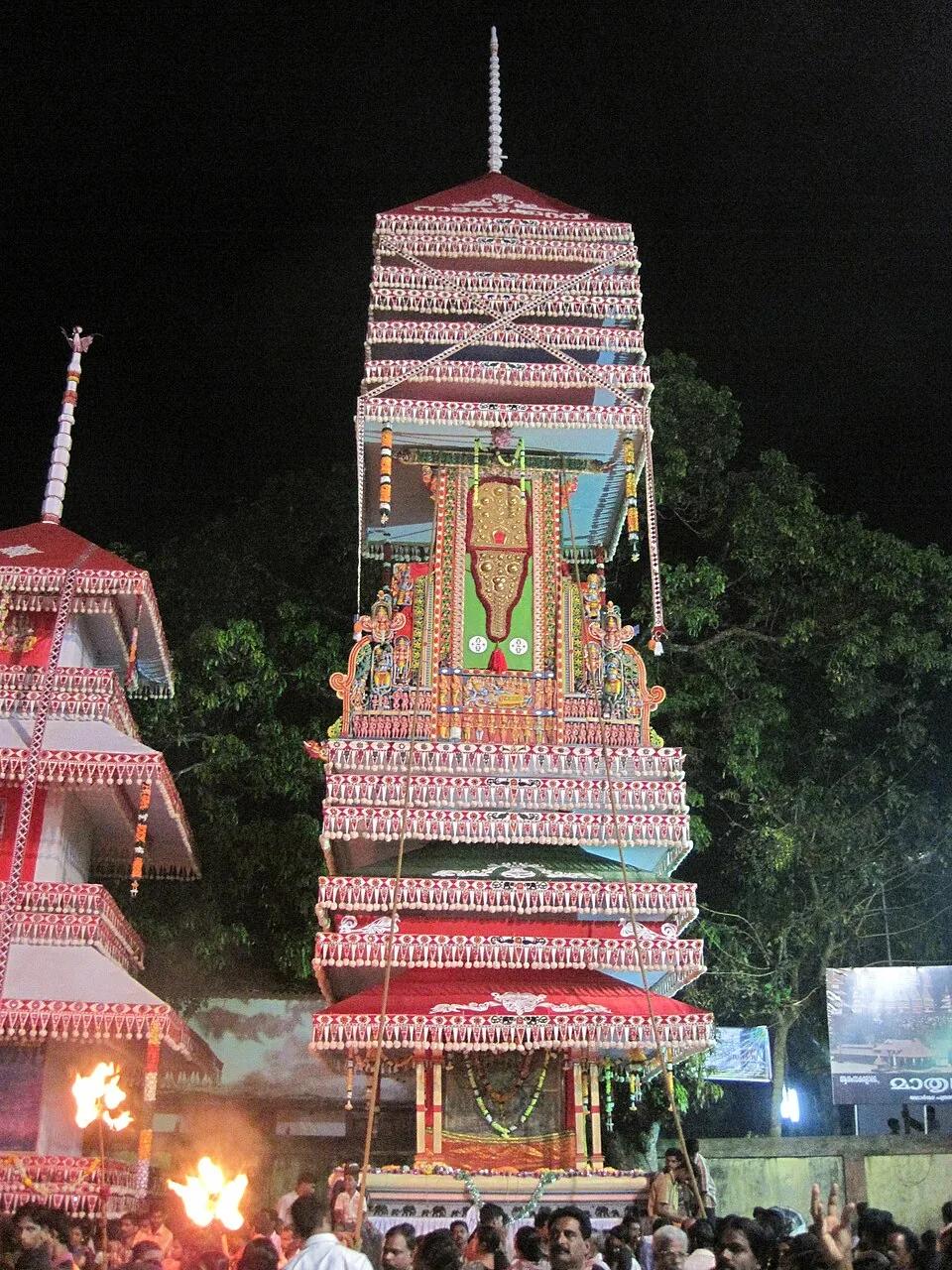
Chettikulangara is unusual among Kerala temples in having a founding date precise to the day. Tradition holds that the shrine was consecrated by Padmapadacharyar, a disciple of Adi Shankara, on the Uthrittathi day of the month of Makaram in the year 823 CE.
It is also unusual in that historians dispute it. We pass both halves of that on, because a date is not made more reliable by being repeated confidently.
What can be dated
Three things at Chettikulangara have firmer dates than the founding, and all three are more recent than most visitors assume.
The sreekovil — the sanctum — was substantially revamped in 1540 CE. The chuttambalam, the cloister that rings it, is reckoned at not more than about two centuries old. And the Kettukazhcha, the festival that brings tens of thousands of people here and is the reason most of them have heard of the place, is put in its present form at not more than a hundred and eighty to two hundred years.
Put those together and the picture is of a site of very long standing whose visible fabric and signature ceremony largely belong to the last five hundred years, with the most famous element belonging to the last two hundred.
Why we are being careful about the three faces
There is one further claim worth handling honestly, because this page was built on it. It is very widely said that the Devi here shows three forms through the day: Saraswati in the morning, Lakshmi at noon, Kali in the evening. It is a beautiful idea and it is genuinely part of how people speak about the Goddess at Chettikulangara.
We could not trace it to an institutional source. It is on devotional sites and travel sites in abundance and absent from the standard encyclopedic account of the temple. So we have kept it — a living belief held by the community around a shrine is a real thing, and worth reporting — but we no longer let it carry the whole description of the temple, which is what it was doing here before.
What is not in doubt
The Goddess is Bhadrakali, held to be an incarnation of Mahakali born from the third eye of Shiva, and addressed as creator, protector and destroyer at once. The temple is administered by the Travancore Devaswom Board. The thirteen karas are real, named, and photographed individually. The Kumbha Bharani falls on the Bharani star in the month of Kumbham, in February or March. And the edifices are between seventy and a hundred and five feet tall, which anyone can verify by standing under one.
That is a good deal to be going on with, and none of it needs the founding date to be true.
Frequently asked questions
When was Chettikulangara Devi Temple founded?
Tradition gives the consecration by Padmapadacharyar on the Uthrittathi day of Makaram in 823 CE, but historians dispute the date. What is better attested is that the sanctum was revamped in 1540 CE and the surrounding chuttambalam is not more than about two centuries old.
Does the Devi really appear in three forms during the day?
That belief — Saraswati in the morning, Lakshmi at noon, Kali in the evening — is very widely repeated and is part of local devotional life, but we could not trace it to an institutional source and it does not appear in the standard encyclopedic account. We report it as a living belief rather than as an established fact about the temple.
Who is the deity?
Bhadrakali, held to be an incarnation of Mahakali born from the third eye of Shiva, addressed as creator, protector and destroyer, and as nature, power and Kundalini Shakthi.