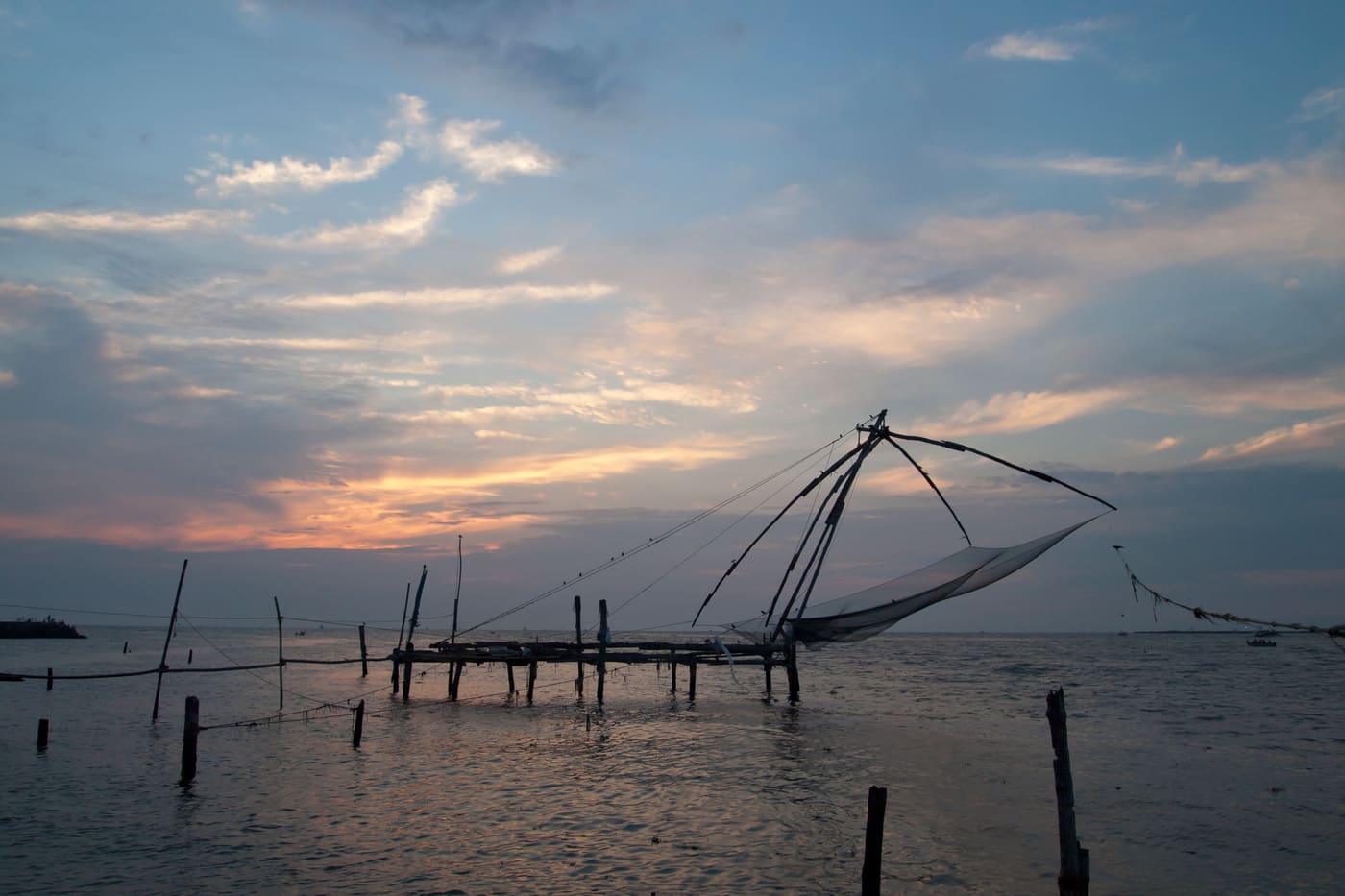
In the early evening the light over the harbour mouth turns gold. A man walks slowly along a wooden plank on the Fort Kochi shore, and as he moves, a huge net on a long arm sinks into the water. He has not pulled a rope or turned a wheel, because his own weight is enough. This is the quiet trick behind the Chinese fishing nets of Fort Kochi. Kerala Tourism calls them a hallmark of the town and one of the most photographed sights in the city.
What makes that walk possible is a machine built entirely on balance. Kerala Tourism describes each net as a fixed structure of teak wood and bamboo poles about 10 metres high, standing on the beach rather than riding on a boat. A long cantilever arm holds a net that spreads across about 20 metres. So the whole frame leans over the sea like a giant hammock waiting to drop.
That forward lean would tip the frame into the water if nothing held it back, which is why stones hang at the other end. Each stone is about 30 cm across and hangs from a rope of its own length. Together they act as counterweights against the arm and the net. The balance is set so finely that the man on the main plank becomes the last small weight in the system, and when he steps forward, the net goes down.
Lowering the net is the easy part, because bringing it back up takes a whole crew. More than four fishermen work each net. After the net has rested in the water for a short time, they haul on the ropes together. It rises slowly, with the catch gathered in the sagging middle. After dark, lights hang from the teak posts to draw the fish in, so the work goes on into the night.
All of this has a rhythm, and the rhythm decides when people come to watch. Fishing usually happens in the morning and in the early evening. Those are the hours when the walkway along Fort Kochi Beach fills with people waiting for the next lift. The favourite spot is Vasco da Gama Square, the narrow walkway beside the nets. Kerala Tourism says the view of the frames against the sunset is one of the most beautiful sights in Kochi.
People on that walkway often wonder why a net in Kerala carries the name of China, and the answer lives in tradition rather than in any single record. In Malayalam the frames are called cheenavala, which simply means Chinese net. Kerala Tourism records the belief that the explorer Zheng He brought them to Kochi "from the court of the Kubla Khan". It places their arrival on this shore between 1350 and 1450 AD, and it frames the account as a belief.
That belief fits easily into a port that already saw itself through China. Kochi was busy with traders from many lands long before Europeans arrived. Kerala Tourism records a separate legend that traders from the court of Kublai Khan gave the port city its name. One story is about the nets and the other is about the town. Together they show how firmly China sits in the way Fort Kochi tells its own past, and why the name cheenavala has lasted.
Long use has also worn the nets down, because a frame that stands in salt water all year needs constant care. Ropes fray, the netting tears and the wooden parts rot, so without fresh timber the structures slowly weaken. In November 2025 the local councillor told Onmanorama that around 20 nets once lined the shore and that only 11 remain. The long effort to rebuild those eleven, and the platform that gave way that same month, is told in our story of the restoration that never finished.
Since that collapse, the walk along the plank belongs to the fishermen alone. Fort Kochi police barred all operators from letting tourists onto the wooden platforms. So visitors now watch from the walkway and the sea wall, which is the better view anyway, because the whole frame can be seen tipping and rising at once. The base of each net tells a second story, since some frames stand on new teak and others still rest on iron pipe.
When the last lift of the evening is done, the nets make a natural starting point for a walk through the old town. A few minutes inland stands St Francis Church, where Vasco da Gama was first buried, a history told in our story of St Francis Church and Vasco da Gama. From there the lanes lead on to Santa Cruz Cathedral Basilica and the Dutch Cemetery near the beach. Further east are the spice shops of Mattancherry Jew Town, and the wider district waits in our Ernakulam guide.
Frequently asked questions
What are the Chinese fishing nets called locally?
They are called cheenavala in Malayalam, which means Chinese net. They are fixed lift nets that dip from the shore, not nets towed by a boat.
How does one man lower such a big net?
Stones about 30 cm across hang from ropes as counterweights. The balance is so fine that one man walking the main plank tips the net down.
Who brought the nets to Kochi?
Kerala Tourism records a tradition that the explorer Zheng He brought them between 1350 and 1450 AD.
When are the nets working?
Fishing usually happens in the morning and early evening, and the sunset view from Vasco da Gama Square is the most famous sight.