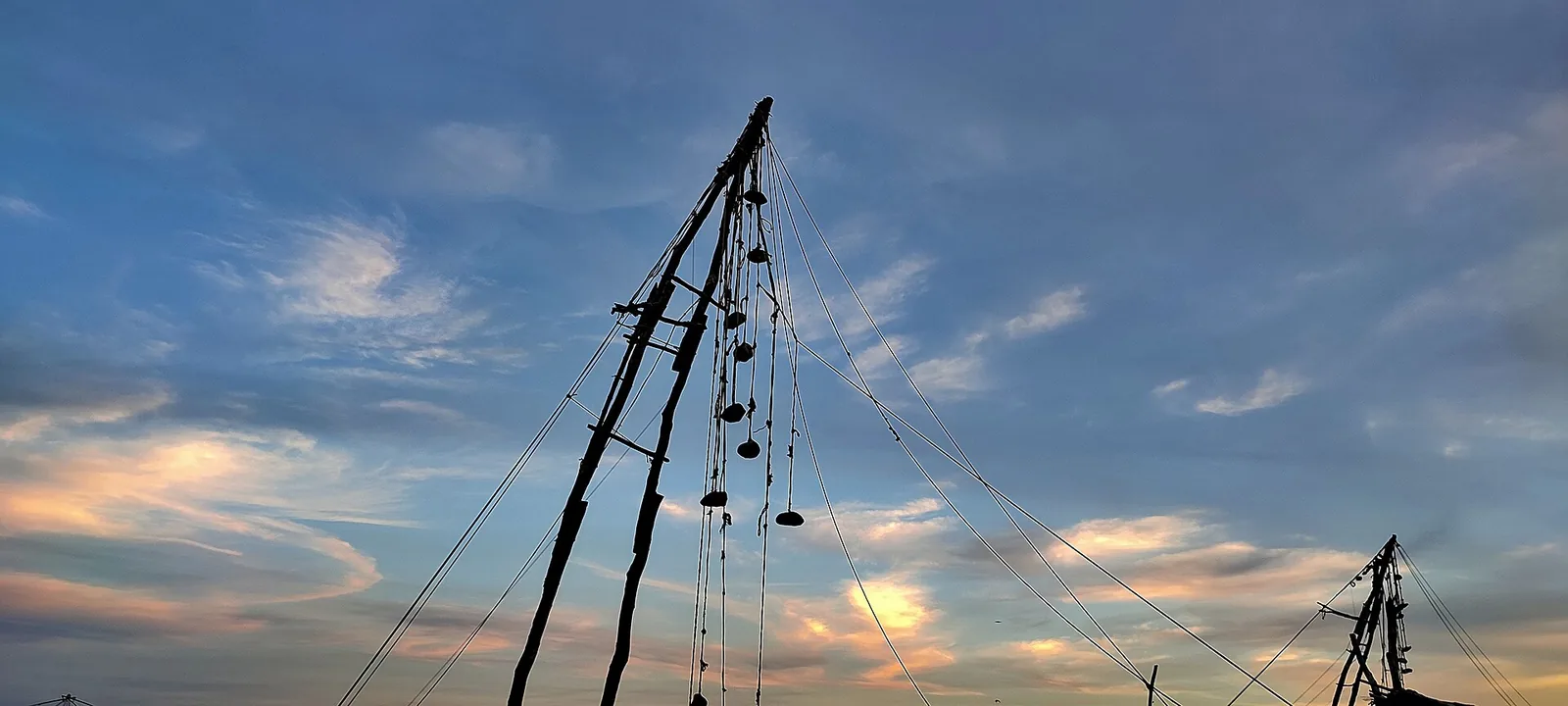
Everybody photographs the net. Almost nobody looks at what is holding it up. Stand under one of the Chinese nets at Kumbalangi and the thing above you is not really a net at all — it is a piece of heavy timber engineering, permanently planted in brackish water, and its whole future is a question about the price of wood.
What the structure actually is
A cheena vala is a shore-operated stationary lift net. A frame of teak and bamboo carries a cantilevered beam out over the water; a rectangular net roughly twenty metres across hangs from the end of it, and at the landward end a set of large stones — commonly around thirty centimetres across — is roped on as a counterweight. The whole assembly stands about ten metres high and needs a crew of four to six.
The balance is the clever part. A well-set net is trimmed so finely that a man simply walking out along the main beam is enough to tip it and drop the net flat into the creek. It sits under for a few minutes; then the crew runs back along the platform hauling hand over hand, and their weight plus the stones brings the spread up clear of the surface. Look at the apex and you will see the stones hung on individual ropes rather than as one block — that is so weight can be added or removed as the timber, the netting and the crew all change over the years.
Why the timber is the whole story
This machine lives in salt water and never comes out of it. The netting perishes and is replaced. The ropes chafe through. And the uprights and beams rot from the waterline down, so that every few years a net has to be partly rebuilt — sections cut out and new hardwood spliced in.
That is an expensive repair and it is getting harder, because good long teak is expensive and increasingly difficult to obtain. So you see the problem solved with whatever is at hand: coconut trunk, salvaged beams, and, more and more, lengths of steel pipe. Which is how a wooden structure celebrated as heritage gradually becomes a steel structure with a wooden reputation.
- Netting: perishes in brackish water, replaced regularly.
- Ropes: chafe through at every running point.
- Uprights and beams: rot from the waterline down, need splicing or replacing.
- Long hardwood: expensive and hard to source, which drives the substitutions.
- A crew: four to six people, every haul, whether the net comes up full or empty.
- Result: most idle platforms are idle because of the repair bill, not because the fish left.
The famous row is not the safe one
It is easy to assume that the nets with an audience are the protected ones. The record at Fort Kochi argues the opposite. Around 22 net structures stood on that seafront three decades ago; roughly a dozen remain. Crews there were hauling about a hundred times a day by 2014, down from something nearer two hundred and fifty.
The people working them have been blunt about it. AFP, reporting from Fort Kochi in 2014, quoted V R Simon, then 75 and one of the oldest operators on the beach: “We live like beggars.” Another, John Kalathil Barried, 62, put the arithmetic plainly — less fish, less money, and not enough of either to keep a family on.
A restoration that has taken nine years
The state did respond. Kerala Tourism put up ₹1.5 crore for refurbishment, which grew into a ₹2.40 crore scheme, implemented by the consultancy KITCO, to renovate eleven nets and build viewing platforms so visitors could see them worked at close range.
Nine years on it was still not finished. Around ₹1.20 crore of teak and kalasanti wood had been bought and left stacked since 2017. Some 220 teak logs were eventually supplied; four operators, tired of waiting, had gone out and bought twelve-metre coconut stumps themselves. Bills of several lakh for those stumps and the associated labour sat uncleared, snagged partly on a GST registration problem with the operators’ association. Meanwhile most crews had propped their nets on steel pipe, because the timber they were promised had not arrived.
It is a very ordinary bureaucratic failure and it has an unusual consequence: the nets that are being restored are, in the interim, less authentically built than the nets that nobody is restoring.
What that means at Kumbalangi
There are more than a hundred nets in the water around this village, spread along creeks rather than lined up on a promenade, and there is no scheme attached to any of them. Nobody is buying them teak. Nobody has built a viewing platform. Each one stands or falls on whether the household that owns it can justify the repair out of what the creek gives.
That cuts both ways, and it is worth being honest about it. These nets are the real thing in the sense that matters — they are fished because a family needs the fish, not because a crowd is expected at sunset. But an unsubsidised structure with a thinning catch behind it is not obviously the safer bet. The postcard row has money it cannot spend. Kumbalangi has no money and no queue.
The catch is falling for reasons no repair fixes
Underneath all of this is the water. Small motorised boats work their own nets in the same channels and take fish before it ever reaches a fixed platform. Industrial effluent and urban run-off have degraded the Kochi backwaters for decades. Crews here point to the 2004 tsunami as a break after which hauls never came back.
And the nursery has gone. Kerala’s mangroves — where the juveniles of most of what a lift net catches are reared — fell from something like 700 square kilometres in the 1980s to under 18 by 2020. A cheena vala is a passive machine: it takes a slice of whatever the tide brings past it, which makes it an unusually direct instrument for measuring what is no longer there.
How to look at one properly
Give it a full cycle rather than a photograph. Watch the drop, wait out the few minutes underwater, watch the haul, and see what comes up — which will very often be almost nothing, and which the crew will treat as unremarkable, because it is. Then look at the frame: find the waterline, look for where a beam has been spliced, and count how much of what you are looking at is steel.
That last check tells you more about the future of these nets than any signboard on the beach. A net repaired in hardwood is a household betting on another decade. A net repaired in pipe is a household getting through this season.
Frequently asked questions
How many Chinese nets are left at Fort Kochi?
Around a dozen, down from roughly 22 three decades ago. The Fort Kochi seafront is the famous row, but it is also the shrinking one — modern boats and trawlers took the commercial fishing, and the labour-intensive lift net stopped paying for itself.
What is the ₹2.40 crore renovation project?
A Kerala Tourism scheme, implemented by the consultancy KITCO, to renovate eleven Chinese fishing nets at Fort Kochi and build platforms so visitors can see them worked. It began with an allocation of ₹1.5 crore and grew. Nine years on it remained unfinished, with roughly ₹1.20 crore of teak and kalasanti wood bought and stacked since 2017, and operators’ bills uncleared.
Why are some nets held up by steel pipes?
Because the timber did not arrive. Long hardwood is expensive and hard to source, and the delay in procuring teak logs under the renovation scheme left most Fort Kochi operators propping their nets on steel pipe instead — at a real cost to both the look and the working feel of the structure.
Do the Kumbalangi nets get any government support?
No scheme comparable to the Fort Kochi one. There are more than a hundred nets in the water around this village and each is maintained by the household that owns it, out of what it earns. That is why an idle platform here is usually a repair bill nobody could justify rather than an abandoned fishery.
Why has the catch fallen so much?
Several causes at once: small motorised boats fishing the same channels, industrial effluent and run-off into the backwaters, a drop in catches that crews date to the 2004 tsunami, and above all habitat loss. Kerala’s mangroves, the nursery ground for most backwater species, went from roughly 700 sq km in the 1980s to under 18 sq km by 2020.
How long does a net last before it needs rebuilding?
There is no fixed figure, because it depends on the wood, the water and how hard the net is worked. What is constant is the pattern: netting and ropes go first and are replaced routinely; the uprights and beams rot from the waterline down and eventually have to be cut out and spliced. That splice is the expensive moment, and it is the one that decides whether a platform keeps working.