A canoe stops at a bank on Munroe Island. Bundles of coconut husk are staked out in the shallows. A woman fifty metres away is spinning yarn on a wheel. The implication is obvious and nobody has to state it: that husk becomes that yarn.
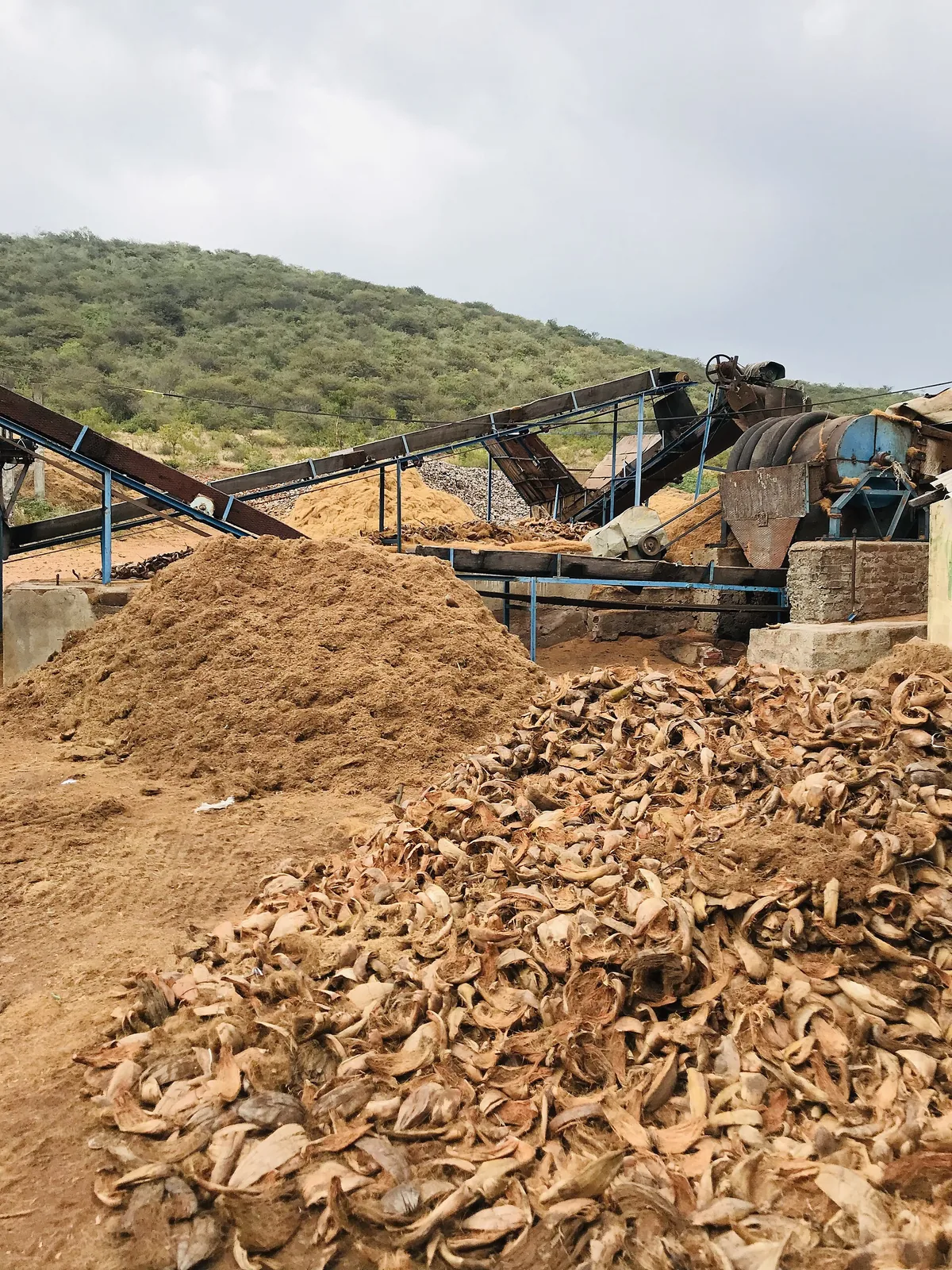
It very probably does not. The fibre on the wheel was most likely crushed out of dry husk by machine in Tamil Nadu, and never went near water at all.
The paragraph that explains it
The source for this is not a critic of the industry. It is the Kerala Institute of Labour and Employment, a Government of Kerala body, in its 2015 study of the state of the coir industry.
It records that when mechanical de-fibering machines were introduced, stiff opposition from local trade unions meant the companies were not allowed to set up such units in Kerala, but Tamil Nadu rapidly established several. And then: with retting and manual extraction becoming more and more difficult and costly, the yarn-spinning industry started to use more and more un-retted Tamil Nadu fibre. Initially it was 10% Tamil Nadu fibre mixed with 90% Kerala retted fibre, and this equation slowly shifted to 100% Tamil Nadu fibre for most qualities of yarn.
Its conclusion: the Kerala coir industry now is more or less dependent on Tamil Nadu for fibre, and with the gradual disappearance of the retting activity in Kerala due to ecological and social reasons, the scope of fibre production in the State is very minimal.
Un-retted is the word that matters
Retting is soaking. Bundled husk goes into shallow brackish water for months while bacteria rot away the pectin that binds the fibre to the pith. It is the slowest step by an enormous margin and it is the step the whole romance of Kerala coir rests on.
Tamil Nadu fibre is un-retted. Dry husk goes into a machine and is crushed. There is no soaking, no months, no water.
So the modern process does not merely do the traditional one faster. It deletes a stage. Which means the thing a visitor is brought to see is not the slow version of what happens — it is a stage that has mostly stopped happening, shown next to a stage that is still real.
Ten kilos against sixty
The economics are not close. Hand-spinning in Kerala yields about 10 kg per person per day, and the report notes that figure has not changed in decades. In mechanised Tamil Nadu it is about 60 kg, and rising every year, after four or five generations of automated spinning machines.
Cost to company for the same job: about ₹810 a day in Kerala, ₹368.21 in Tamil Nadu.
Kerala subsidises its spinners at roughly ₹150 a day per worker, and still, in the report’s words, they are not able to compete with the machine-spun yarn from Tamil Nadu both in quality and productivity and cost. It frames the state’s options bleakly: even more subsidy to support a lost cause, or adopting modern and efficient methods of production.
And the yarn is going the same way as the fibre
Coir’s biggest export product is the PVC-backed mat. The report tracks what happened to the yarn that feeds those lines: five years earlier, 100% of the yarn required for PVC backing lines in Kerala was produced in Kerala itself — even the few lines in Tamil Nadu took Kerala yarn. By 2015, all the Tamil Nadu lines and at least half the units in Kerala were using Tamil Nadu yarn, all machine-spun. The report expected it to reach 100% in Kerala within a couple of years.
First the fibre left. Then the spinning began to follow it.
A note on whose account this is
The section of the report explaining why mechanisation never happened in Kerala — the union opposition, machines destroyed in the 1970s, the piece-rate trap in which a more efficient machine simply doubles the wage bill without a productivity gain — was gathered from employers, at a meeting of the Federation of Indian Coir Exporters Association in August 2015. It is one side’s history and should be read as one.
The durable facts are not in dispute: 10 kg against 60, ₹810 against ₹368.21, and the yarn share moving state by state. Where the factories went is also a matter of record — Tuticorin, Pollachi, Tirupur.
What Kerala still has
It would be wrong to end on decline alone. Kerala remains dominant in finished coir products, and it is where the cooperative movement lives: about 76% of India’s coir societies, 93% of the members and 74% of the workforce are here.
Kerala is no longer the source of all the fibre its coir industry consumes. Secondary reporting places the Tamil Nadu share at around 90%, although the primary Coir Board material cited here does not publish that exact percentage. The broader shift towards imported fibre is well documented.
And there is a final twist in the research. Coirret, the bacterial treatment developed by the Coir Board’s own institute in Alappuzha, has been adapted for improving the quality of mechanically extracted un-retted green husk fibre. The state’s coir science is now working on making Tamil Nadu’s dry-crushed fibre soft — recovering by biology what the months in the water used to do for free.
Frequently asked questions
Is the coir spun on Munroe Island made from local husk?
Often not. The Kerala Institute of Labour and Employment’s 2015 report records the shift from a 10% Tamil Nadu / 90% Kerala-retted blend to "100% TN fiber for most qualities of yarn", and concludes that the scope of fibre production in Kerala is now very minimal.
What does "un-retted" mean?
That the husk was never soaked. Tamil Nadu fibre is crushed out of dry husk by machine, so the months-long retting stage is skipped entirely rather than shortened.
Why did mechanisation not happen in Kerala?
The report attributes it to opposition to mechanisation from the 1950s to the 1990s, including machines destroyed in the 1970s, and a piece-rate structure under which a more efficient machine raised the total wage bill without a productivity gain. That account was gathered from employers and should be read as their side of it. The factories went to Tuticorin, Pollachi and Tirupur.
How big is the productivity gap?
Hand-spinning in Kerala yields about 10 kg per person per day, unchanged in decades; mechanised Tamil Nadu is about 60 kg. Cost to company for the same job is around ₹810 a day in Kerala against ₹368.21 in Tamil Nadu, and Kerala subsidises spinners about ₹150 a day on top.