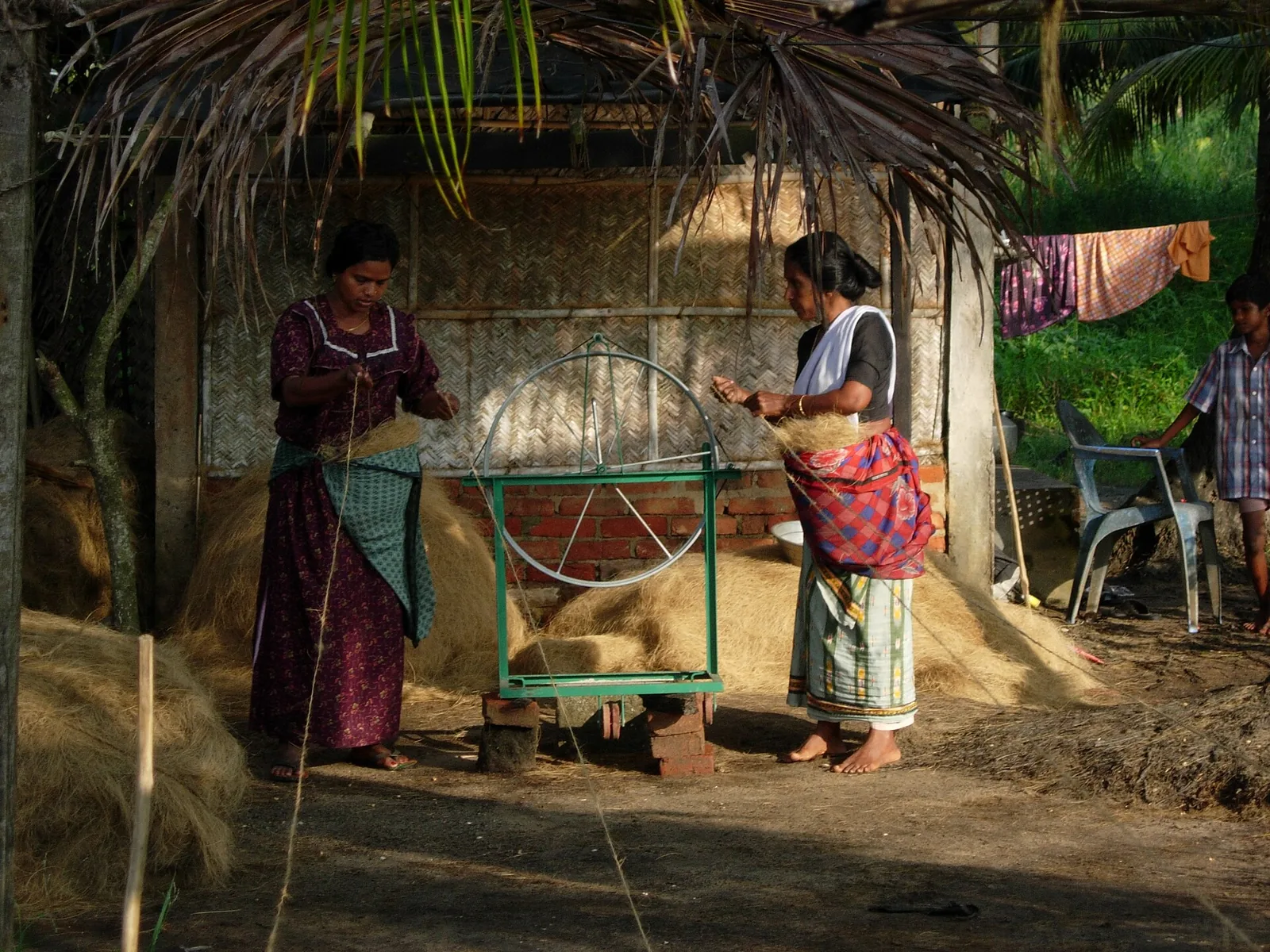
Every visitor to a retting yard notices the smell, and almost every visitor is told the same thing about it: that this is simply how the backwater smells.
It is not. It is hydrogen sulphide, and it is the sound of an argument nobody on the boat is having.
What retting does
Bundled coconut husk is submerged in shallow brackish water, often weighted with mud and palm fronds, for months. Bacteria and fungi break down the pectin that binds the fibre to the pith — that is the whole purpose, and it works.
In doing so they release pectin, fats, tannins and polyphenols into the water. The bacterial load consumes the dissolved oxygen. In the anoxic conditions that follow, sulphate-reducing bacteria generate hydrogen sulphide.
That is the rotten-egg smell. It is not the backwater. It is oxygen leaving the water.
In a wetland of international importance
A 2022 paper in the Indian Journal of Environmental Protection studied this on Ashtamudi specifically. Its finding, in its own words: the coir industry plays a major role among the anthropogenic pressures on the estuary and causes serious damage to the water environment; high values of BOD and polyphenols and low dissolved oxygen depict deterioration of the physico-chemical quality of water in retting areas; and the findings clearly indicate that coconut husk retting has increased the organic pollution load in the estuary. It also notes that traditional retting releases greenhouse gases.
We are deliberately not quoting concentrations. Figures for retting-zone oxygen and sulphide levels circulate in secondary summaries, and we could not tie them to a paper we had actually read. What is safely established is the mechanism and the direction.
And Ashtamudi is a Ramsar Wetland of International Importance, designated in 2002.
The government’s own position
This is not an argument being made by outsiders about a traditional livelihood. Kerala’s own labour institute puts it in a single short section: retting is to be discouraged since it strongly pollutes ponds, canals and lakes; also, affects the health of the workers engaged in retting, beating and willowing; the industry has to be taken forward in an eco-friendly manner.
Note the second clause, because it is the one that gets left out. This is a workers’ health issue as much as a lake issue, and the workers standing waist-deep in the retting shallows are overwhelmingly women.
The fix exists, forty kilometres away
The Coir Board’s Central Coir Research Institute at Kalavoor, near Alappuzha, developed Coirret — a Bacillus-based bacterial consortium that accelerates retting. The KILE report cites it as reducing the retting period to 78 hours, and says that if the process is made eco-friendly it should be promoted urgently.
Reported reductions vary a good deal by application — 78 hours in that citation, three months down from nine to twelve in other Coir Board material, and a separate 72-hour treatment used to soften finished yarn. We give the figure as the report gives it and flag the variation rather than picking one.
It has displaced neither the months-long soak nor the Tamil Nadu machines at scale. A solution developed by the industry’s own research institute, in the state that the industry is named for, sitting unused while the industry loses to a dry-crushing mill in another state.
Three pressures, one shore
So retting on this island is being squeezed from three directions at once, and only one of them is the one our pages used to talk about.
It is losing on cost to un-retted machine fibre from Pollachi and Tuticorin. It carries a formal recommendation from its own government that it be discouraged, for the lake and for the women who do it. And it needs a particular water — shallow, brackish, in a fixed place — on an island that has lost about 14% of its land area since the Kallada was dammed, where more than 500 households have already left and residents who once lived by agriculture, fish farms, coir retting and weaving are now largely daily-wage labourers.
The ending that does not resolve
Our own pages have been part of the problem here. We have sold clam-raking and coir-making side by side with the words "Ramsar site", as though they were all the same kind of good thing, and we have told readers that the retting smell is not pollution. One of those was a framing error and one was simply wrong.
The honest version has no comfortable shape. Ashtamudi is losing a heritage industry and gaining dissolved oxygen. Both of those are true, they are the same event, and there is no way to be straightforwardly glad about it.
None of which is a reason not to go, or not to buy. It is a reason to understand what you are looking at, which is a working shore in the middle of an argument rather than a craft preserved in amber.
Frequently asked questions
What is the smell at a retting yard?
Hydrogen sulphide. Husk releases pectin, fats and tannins as it decomposes; bacteria consume the dissolved oxygen, and sulphate-reducing bacteria then produce the rotten-egg smell. Visitors are frequently told it is just how the backwater smells, which is not correct.
Does retting damage Ashtamudi?
Yes. A 2022 study in the Indian Journal of Environmental Protection on this estuary found high BOD and polyphenol values and low dissolved oxygen at retting sites, and concluded that husk retting has increased the organic pollution load. Ashtamudi is a Ramsar wetland, designated 2002.
What does the Kerala government say about it?
Its labour institute states that the practice "is to be discouraged since it strongly pollutes ponds, canals and lakes" and that it affects the health of the workers engaged in retting, beating and willowing — who are mostly women.
Is there a cleaner alternative?
Coirret, a bacterial consortium developed at the Coir Board’s Central Coir Research Institute at Kalavoor near Alappuzha, is cited as cutting the retting period to as little as 78 hours; other material reports different reductions. It has never displaced the traditional soak or the Tamil Nadu machines at scale.
Should I avoid coir because of this?
No. Buying directly from the household that made it is the most useful thing a visitor can do — those units get no subsidy, keep no accounts and otherwise sell through middlemen. The pollution question is about the retting stage and about policy, not about whether to support the people doing the work.