David Hall is a modest Dutch bungalow on the Fort Kochi parade ground with two famous facts attached to it. Both are printed everywhere, including in official tourism material. Neither survives being checked.
Problem one: the arithmetic
The first claim is that this was the residence of Hendrik Adriaan van Rheede tot Drakenstein, the Dutch commander who compiled the Hortus Malabaricus.
Van Rheede governed Dutch Malabar from 1669 to 1676. He died at sea on 15 December 1691. The building is usually dated to about 1695. A man cannot live in a house raised four years after his death.
There is a way out of that, and it is not a comfortable one: the date of the building is itself unsettled, with 1665 also proposed. So either the date is wrong or the residence is. What cannot be true is the version everybody prints — the 1695 house that van Rheede lived in.
Where van Rheede actually is
He is at Surat, nine hundred kilometres north, under one of the more extravagant European tombs in India: a domed, columned, galleried mausoleum in the Dutch cemetery there, built on a scale meant to eclipse the tombs of his English rivals, the Oxendens, alongside it. A Dutch admiral who visited in 1775 recorded that it exceeded every other monument in that ground for size, elegance of architecture, magnificence of ornament and richness of material.
Which is worth setting against the Dutch Cemetery a few minutes from David Hall, where the graves are flat, heavy, unornamented slabs and many carry no cross at all. Same company, same century, two completely different ideas of how a Dutchman should be buried in India.
Problem two: the genealogy
The second claim is the name. You will read almost everywhere that the house is named after David Koder, a Jewish businessman who lived here.
The Koder family record does not contain a David Koder. Samuel Koder’s sons are named as Elias, Shabdai — the S. S. Koder of Koder House — and Cecil. The last Jewish owner of David Hall is given as Gladys Koder, wife of S. S. Koder. Her father was E. D. David, who died in 1958.
On that reading the David in David Hall comes from the David family, her father’s side, and not from a Koder called David at all. It is a small correction that quietly changes whose house this is remembered as.
- Does not hold: van Rheede lived in a house dated c. 1695. He died at sea on 15 December 1691.
- Does not hold: the house is named for David Koder. No David appears in the Koder family record.
- Holds: van Rheede was really here and really governed Dutch Malabar from Cochin, 1669–1676.
- Holds: the Hortus Malabaricus — 12 volumes, some 740 plants, ~25 collaborators, printed at Amsterdam 1678–1693.
- Better supported: the name comes from E. D. David, father of the last Jewish owner, Gladys Koder.
- Unresolved: we have seen no deed or contemporary document naming the house.
What is not in doubt
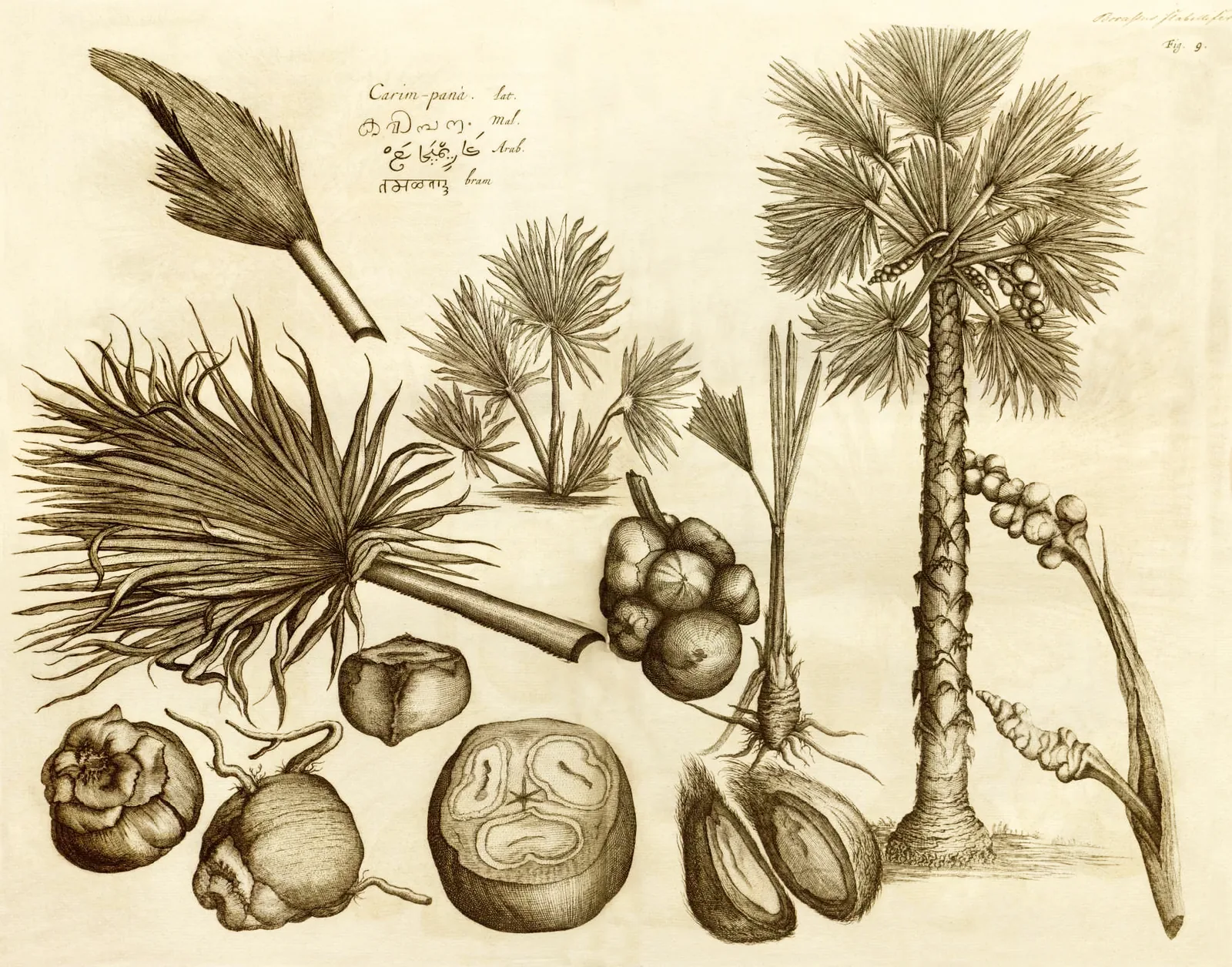
Van Rheede was genuinely here, and the Hortus Malabaricus is genuinely extraordinary — twelve volumes covering some 740 plants of this coast, compiled with around twenty-five collaborators and printed at Amsterdam between 1678 and 1693, with plant names recorded in several languages including Malayalam. Look at any plate and the Malayalam is right there beside the Latin.
That multilingual naming is the tell. This was not a European looking at Indian plants; it was a European project resting on Kerala botanical knowledge, and the book admits as much on its own pages. The scholarship is real. Only the address is doubtful.
Why the building says nothing about any of this
David Hall carries no interpretation of its own history. It was acquired and restored in 2003 by CGH Earth, the Kerala hotel group, and runs as a gallery and garden café — the gallery operated as a not-for-profit showing young and local artists who exhibit without paying for the space. That is a genuinely good use of a heritage building and it is not a museum, so nobody is employed to argue about a seventeenth-century date on the wall.
The result is that the corrected version exists mostly in genealogies and dates, while the tidy version is on the signage everywhere else in town. Go for the architecture — the thick walls, the deep verandah, the high ceilings, the monsoon roof — sit in the garden, and know that the two things you were told at the gate are the two things that do not check out.
Frequently asked questions
Did van Rheede live in David Hall?
Almost certainly not as the story is told. He died at sea on 15 December 1691 and the building is usually dated to about 1695, so the popular version is impossible. The building’s date is itself disputed — 1665 has also been proposed — so either the date or the residence is wrong. The connection is unproven either way.
Where is van Rheede buried?
At Surat, in the Dutch cemetery, under a large domed and columned mausoleum built to outdo the tombs of his English rivals the Oxendens next to it. A Dutch admiral who saw it in 1775 wrote that it exceeded every other monument there in size, elegance and richness of material.
Who is the David in David Hall?
Probably E. D. David, who died in 1958 — the father of Gladys Koder, the last Jewish owner of the house. The popular story credits a David Koder, but the Koder family record names Samuel Koder’s sons as Elias, Shabdai (S. S. Koder) and Cecil, with no David among them. We publish this as the better-supported reading rather than a closed case.
What is the Hortus Malabaricus?
A twelve-volume work on the plants of this coast, describing some 740 species, compiled with around twenty-five collaborators and printed at Amsterdam between 1678 and 1693. Plant names are given in several languages including Malayalam, which is visible on the plates — a record of the local botanical knowledge the project was built on.
How old is the building?
Not established. It is generally attributed to the Dutch East India Company and dated to about 1695, but 1665 is also proposed, and it is usually described as the survivor of a group of three houses the Company built in Fort Kochi in the later seventeenth century — reportedly raised partly from the stone of demolished Portuguese churches.
What is David Hall now?
A gallery and garden café. CGH Earth acquired and restored the building in 2003 and runs the gallery as a not-for-profit focused on young and local artists, who exhibit without paying for the space. There is no entry ticket and no historical interpretation on site — it is a working exhibition space in a private heritage building.